YouTube Shorts Monetization Requirements (2026): 500 vs 1,000 Subs

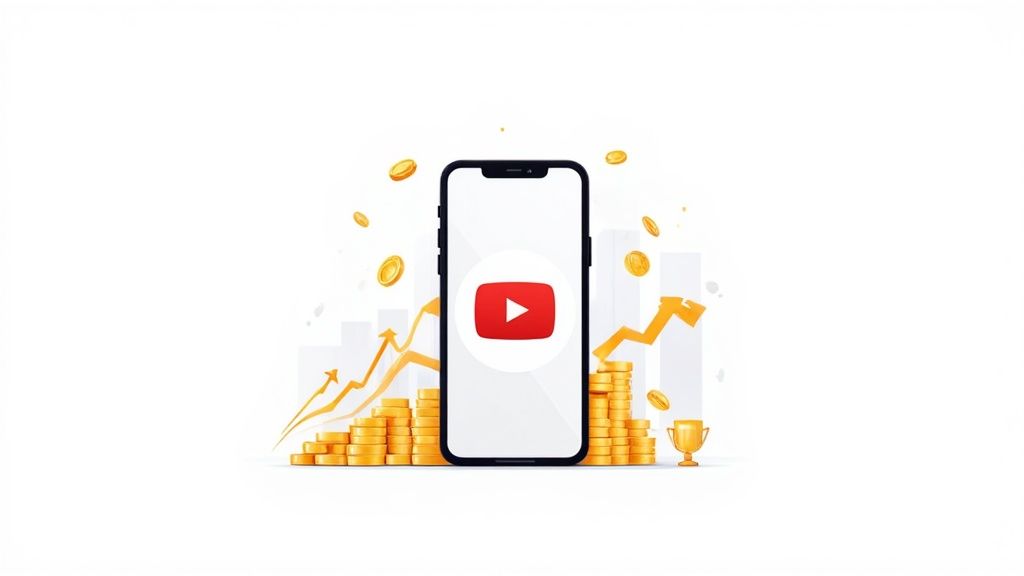
To start making money from your YouTube Shorts, you first need to get into the YouTube Partner Program (YPP). This used to be a really steep climb, but now YouTube has created two different ways to get in, which is great news for creators just starting out.
The first tier is designed to help you start earning sooner. You'll need 500 subscribers to qualify. Alongside that, you have to hit one of two performance goals: either get 3 million public Shorts views in the last 90 days or rack up 3,000 public watch hours on your long-form videos over the past year. Hitting this level unlocks fan funding features like Super Thanks, letting your audience support you directly.
YouTube Shorts monetization requirements
Two tiers — you only need one performance metric per tier.
Unlocks Super Thanks, memberships & fan funding.
Unlocks ad revenue sharing, Shorts feed ads & full YPP.
Understanding the YPP Entry Paths
YouTube has really changed the game with its monetization requirements, making the whole process much more friendly for Shorts creators. Not too long ago, the only way into the YPP was the traditional route: 1,000 subscribers and 4,000 watch hours. Now, there are separate paths, which finally gives creators who live and breathe short-form content a real shot.
As of 2026, the entry-level tier requires just 500 subscribers and at least three public posts in the last 90 days. From there, you need to hit either 3 million valid public Shorts views in that same 90-day window or 3,000 public watch hours on your regular videos in the last 12 months. This is a clear signal that YouTube is serious about supporting its growing community of Shorts creators.
Comparing the Two Monetization Tiers
Think of these two YPP tiers as different doors into the same club. The first door is easier to unlock and gets you inside, giving you access to the fan funding features. The second door requires a bit more work but opens up everything, including a cut of the ad revenue pie. To get the full picture, it's always a good idea to check the official YouTube Shorts monetization requirements directly.
Here’s a simple table to break down the requirements for each path.
YouTube Partner Program Eligibility Tiers
This table lays out exactly what you need for both the introductory fan-funding tier and the full program that includes ad revenue sharing.
| Requirement | YPP with Fan Funding | Full YPP (Ad Revenue) |
|---|---|---|
| Subscribers | 500 | 1,000 |
| Shorts Views | 3 Million (in 90 days) | 10 Million (in 90 days) |
| Watch Hours | 3,000 (in 12 months) | 4,000 (in 12 months) |
The key thing to remember is that you only need to meet one of the performance metrics—either the Shorts views or the long-form watch hours—not both. This gives you the flexibility to focus on the content style that works best for your channel.
Of course, getting those views is the hard part. If you want a leg up, check out our guide on YouTube SEO optimization tips to help get your videos in front of more people.
Choosing Your Monetization Path
Getting into the YouTube Partner Program (YPP) isn't a one-size-fits-all deal anymore. You've got a choice to make, and it’s a bit like deciding between running a sprint or a marathon.
The Shorts path is the sprint: fast, intense, and all about catching that viral wave. You need a massive number of views in a short time. The traditional long-form video path? That’s the marathon. It’s a game of endurance, built on holding your audience's attention over the long haul.
Neither is better—they just serve different kinds of creators. If your channel is all about quick hits and trending topics, the sprint is probably your lane. But if you're building an educational hub or a deep-dive commentary channel, the marathon route will feel much more natural. Your choice should come down to the content you actually enjoy making.
Sprint vs. Marathon: Which Is Right for You?
The "sprint" is your first entry point into making money on YouTube. To get there, you need to hit 500 subscribers and rack up 3 million public Shorts views in 90 days. Nail that, and you unlock the first tier of monetization.
This level is all about fan funding—think Super Thanks, Super Chats, and channel memberships. It’s a fantastic way for new creators to start earning directly from their most loyal fans without needing a massive channel first.
The classic "marathon" path requires 1,000 subscribers and 4,000 public watch hours over the last 12 months. This has been the standard for years and usually relies on a solid library of longer videos that keep people watching.
This decision tree gives you a clearer picture of how your content focus—Shorts or long-form—steers you toward different ways to earn.
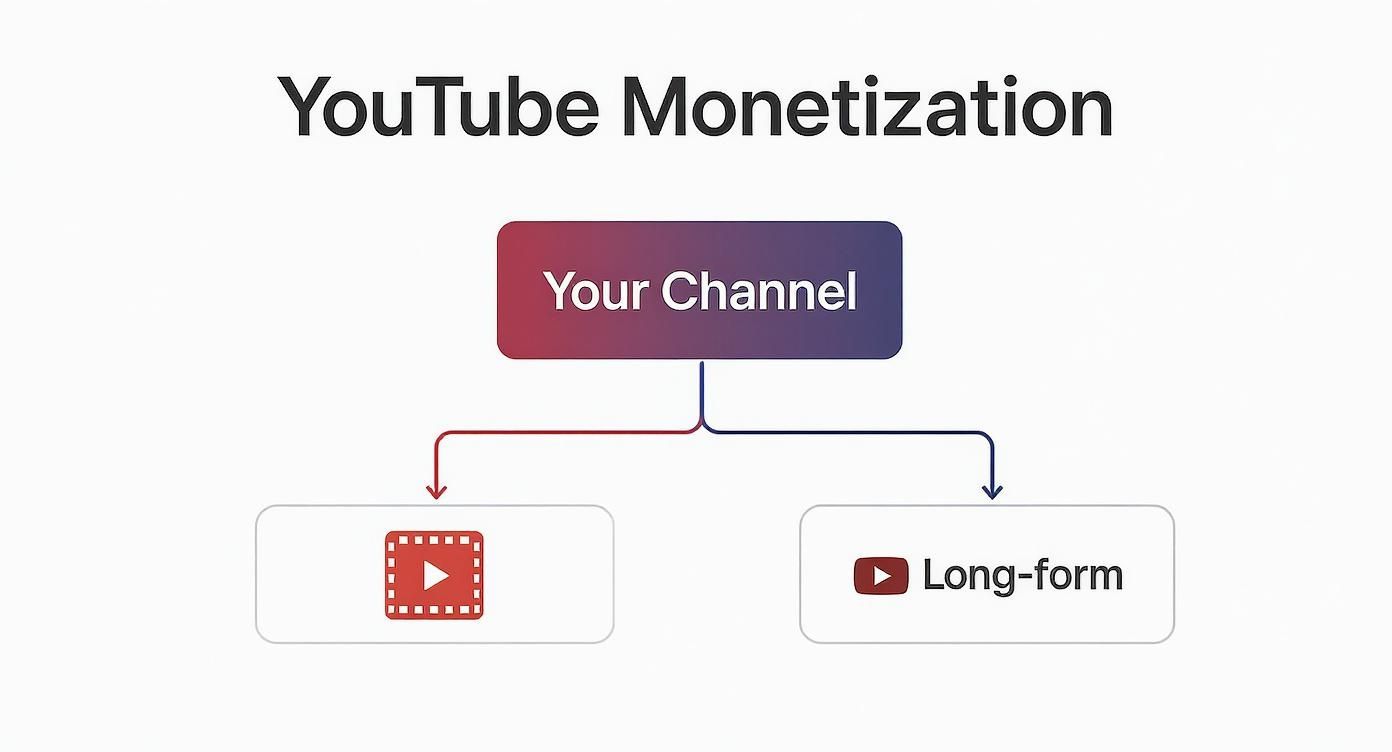
As you can see, both paths lead to monetization, but where you start and what you unlock first are totally different.
Comparing the Monetization Tiers
So, what's the real difference between these levels? It all comes down to the benefits you unlock.
The first, more accessible tier is built entirely around direct support from your audience. It’s an incredible milestone that proves your content is connecting and gives you that first taste of revenue. But—and this is a big but—it does not include a cut of the ad revenue from the Shorts feed.
To get that piece of the pie, you need to qualify for the full YPP. That means hitting 1,000 subscribers and either 10 million Shorts views in 90 days or the classic 4,000 watch hours. This is where you start earning a percentage of the ads shown between Shorts, turning raw views into a more predictable income stream.
Many of the smartest creators are using a hybrid strategy. They use Shorts to go viral and grow their subscriber base like crazy, all while building out a library of longer videos. This approach is especially powerful, and it's a key reason we're seeing the explosive growth of creators who know how to start a faceless YouTube channel and scale it fast.
Beyond YouTube's specific rules, it's always a good idea to understand general strategies for monetizing online content. The more you know about building a business online, the more resilient your creator career will be.
How to Check Your Eligibility and Apply to the YPP
So, you've picked your path to monetization. Now for the fun part: tracking your progress and officially applying to the YouTube Partner Program (YPP). YouTube has made this surprisingly simple by putting everything you need in one place—no more hunting around.
Everything happens inside the Earn tab, tucked away in the left-hand menu of your YouTube Studio dashboard. Think of this page as your command center for all things monetization. It’s where you’ll go from an aspiring creator to a paid partner.
Navigating the Earn Tab in YouTube Studio
Once you click into the Earn tab, you'll see a set of clean, visual trackers for each of the core requirements. These progress bars show you exactly where you stand on subscribers, public Shorts views, and long-form watch hours.
There’s no need to guess or keep a manual tally. YouTube updates these numbers for you in real time, giving you a live look at your performance. Honestly, seeing those bars inch closer to the goal is a huge motivator and helps you know if your content strategy is actually working.
Here’s a look at the monetization progress trackers in action. It's a clear, at-a-glance view of your subscriber count and public Shorts views.
This dashboard takes those big, abstract numbers and turns them into tangible milestones you can actually see yourself hitting.
The YPP Application Process Step-by-Step
The moment you hit those magic numbers, the grayed-out "Apply Now" button will light up. Clicking it kicks off a straightforward, multi-step application.
- Review Base Terms: First up, you'll need to read and accept the YouTube Partner Program’s base terms. This is the main agreement covering all the program's rules of the road.
- Sign Up for Google AdSense: Next, you have to connect a Google AdSense account. This is how Google pays you. You can either link an account you already have or create a new one right there. Double-check that all your info is accurate to avoid any payment headaches later.
- Get Reviewed: With the paperwork out of the way, your channel officially enters the review queue. A real person at YouTube will manually review your channel to make sure your content follows all their monetization policies, community guidelines, and AdSense rules. This review usually takes about a month, but sometimes it’s faster.
Key Takeaway: The review isn't just a numbers game. YouTube is looking for authentic channels that bring real value to viewers. They’re actively scanning for things like spam, reused content, and other policy no-nos before giving you the green light.
Before you smash that apply button, do a quick pre-flight check to make the review process as smooth as possible:
- Two-Step Verification: Is two-step verification turned on for your Google account? This is non-negotiable for security.
- Active Community Strikes: Do you have any active Community Guideline strikes? You have to wait for these to expire before you can apply.
- AdSense Account Status: Is your AdSense account active and in good standing? If you’re connecting an existing one, make sure it’s ready to go.
Taking a few minutes to run through this list can seriously boost your chances of getting a quick "yes" from YouTube.
The Rules You Can't Afford to Ignore
Hitting your subscriber and view count goals feels amazing, but it's really just getting you to the starting line. Before you can monetize your YouTube Shorts, your channel has to be in perfect alignment with YouTube's core policies. These aren't just friendly suggestions—they're the non-negotiable rules of the road for anyone in the YouTube Partner Program (YPP).
The two big ones you need to know inside and out are the YouTube Community Guidelines and the AdSense Program Policies. Think of the Community Guidelines as the laws for what’s allowed on the platform, period. The AdSense policies are all about what advertisers feel comfortable putting their brand next to. Breaking either can get you demonetized in a heartbeat, or worse, get your channel terminated.
What "Valid Public Shorts Views" Actually Means
A tiny but crucial phrase in the YouTube Shorts monetization requirements is "valid public Shorts views." This is YouTube's way of saying not all views are created equal, and they're very specific about which ones count toward your goal.
For a view to be "valid," it has to come from a Short that is set to public. Simple enough. But YouTube also filters out views from certain sources to stop people from gaming the system and to make sure your engagement is legit.
Here’s a quick rundown of what doesn’t count:
- Private Videos: Any views your Shorts get while they're set to private are completely ignored for monetization purposes.
- Ad Campaigns: Pumping up your views by running Google Ads campaigns on your Shorts? Nope, those don't count.
- The Shorts Shelf: Views from certain places outside the main feed, like when someone embeds your Short on their website, might not be included in the total.
The bottom line is that YouTube wants to see organic views happening right where the action is: the Shorts feed. This proves your content is actually connecting with people who are actively scrolling and looking for something to watch.
Key Insight: The whole system is built to reward authentic audience growth, not viewership you can buy or artificially inflate. Your energy should be focused on making stuff people genuinely want to watch and send to their friends.
The Content That Gets an Instant "No"
Even if you rack up millions of views, some types of content are immediate deal-breakers for monetization. YouTube has gotten incredibly strict about cracking down on low-effort or unoriginal content that adds zero new value.
Here are some of the most common offenders that get channels rejected:
- Unedited Clips: Just ripping clips from movies, TV shows, or someone else's stream and uploading them without adding your own significant edits or commentary is a fast track to rejection.
- Lazy Compilations: You can't just stitch together a bunch of other people’s TikToks or Shorts, slap some music on it, and call it a day. If you didn't add any real creative input, it's not monetizable.
- Robotic Content: Think of those videos with a text-to-speech voice reading a Reddit thread over generic gameplay footage. If it feels automated and lacks a human touch or original analysis, YouTube sees it as low-value.
Finally, there’s a simple logistical hurdle: you have to live in a country where the YouTube Partner Program is actually available. YouTube keeps an official list of eligible countries, so double-check that your location is on it before you even think about applying. If it's not, you won't be able to monetize, no matter how many views you have.
A Creator's Plan to Hit Monetization Targets
Knowing the YouTube Shorts monetization requirements is one thing. Actually hitting them? That takes a real plan. This isn't about crossing your fingers for a single viral hit; it's about building a consistent workflow that creates its own momentum. Think of it as a 30-day sprint designed to stack the odds in your favor.
The main goal here is to build a predictable content engine. That means carving out 30 to 60 minutes every single day for a focused set of tasks: creating, optimizing, and analyzing. When you're consistent, you're sending a strong signal to the YouTube algorithm that your channel is active and reliable, which can earn you better visibility.
This daily habit keeps you from burning out and ensures you’re always feeding the algorithm fresh content—a non-negotiable for growth in the dizzyingly fast Shorts feed.
Your 30-Day Quick-Start Schedule
To make this feel less like a mountain to climb, we're going to break it down. A structured daily schedule turns a huge goal like "get 3 million views" into a series of small, manageable actions you can actually complete.
Here’s a simple, repeatable daily workflow:
- Trend Spotting (10 mins): Before you do anything else, spend a few minutes scrolling the Shorts feed. What's popping off in your niche? Look for trending audio, popular formats, or recurring challenges. Jot down three to five quick ideas.
- Content Creation (30 mins): Now, batch-create two or three Shorts based on what you just found. Don't get hung up on perfection. Speed and authenticity are your friends here. If you have longer videos, a tool like Opus Clips can be a lifesaver, quickly chopping them up into multiple Shorts with viral potential.
- Optimization (10 mins): Write titles and descriptions that make people want to click. A tool like QuillBot can help you sharpen your wording. Always include
#shortsand two or three other tags specific to your niche. - Scheduling (5 mins): Upload your Shorts and schedule them to go live when your audience is most active. The key is posting at least once per day to keep the momentum going.
This simple routine turns the overwhelming task of "making content" into a daily habit, steadily building your channel’s authority one Short at a time.
Scrappy Tactics for Small Channels
When you're a smaller creator, every single view and subscriber feels like a massive win. Getting that initial traction requires a scrappy, hands-on approach. You have to fight for it.
Pro Tip: Those first 100 subscribers are the toughest grind. Your mission is to create content that’s so shareable people can’t help but send it to a friend. Solve a very specific problem or tap into a strong emotion. Organic sharing is infinitely more powerful than just waiting for the algorithm to find you.
Try these tactics to get the ball rolling faster:
- Create Content Loops: End your Shorts with a hook that makes people want to watch it again or click over to another video on your channel. A simple "Wait for it..." or a clever cliffhanger can do wonders for your watch time.
- Engage with Comments Immediately: Make it a rule to respond to every comment within the first hour of posting. This tells the algorithm your content is sparking conversation and helps you build a loyal community that feels seen.
- Cross-Promote Smartly: Share your Shorts on other platforms like TikTok or Instagram Reels, but always include a clear call-to-action that points people back to your YouTube channel.
Putting these strategies into play will help you build a solid foundation. If you're ready for the next level, our complete guide on how to grow YouTube subscribers lays out a detailed roadmap for expanding your audience.
Common Monetization Mistakes to Avoid
Hitting your subscriber and view count goals is a massive win, but getting rejected from the YouTube Partner Program (YPP) for a mistake you could have avoided is just brutal. I've seen it happen countless times: creators grind for months, hit the numbers, and then get hit with a rejection during the channel review because of a few common slip-ups.
Let's walk through these pitfalls so you can get approved on the first try. The single biggest reason channels get denied falls under the big, scary umbrella of "reused content." This policy is notoriously vague and trips up an incredible number of creators. It's basically YouTube's way of saying your content isn't original enough.
The Reused Content Trap
The reused content policy is there to stop people from monetizing videos they didn't really make. Think about it: if you're just clipping funny moments from a movie, grabbing highlights from a Twitch stream, or reposting someone else's video without adding your own spin, you're not really creating anything new.
To get past the review, you need to add something significant. This could be unique commentary, an in-depth review, or some seriously creative editing that completely transforms the original clips.
This is especially true for compilations. The old strategy of just stitching together a bunch of viral TikToks or other Shorts with a trending song in the background is dead. YouTube cracked down on that hard.
Crucial Insight: The review team is made up of real people, and they're looking for your creative fingerprint. If they can't immediately tell what you brought to the table—your voice, your ideas, your editing style—they're probably going to deny your application.
Copyright Strikes and Music Missteps
The other major hurdle is copyright, particularly with music. It’s so easy to get this wrong. While the audio library inside the Shorts editor is full of licensed, safe-to-use tracks, grabbing audio from anywhere else is a huge gamble.
Using a trending song you found on another platform without the proper license is a fast pass to a copyright claim or, even worse, a copyright strike. Either of those can bring your monetization application to a screeching halt.
Here’s a quick audit you should run on your channel before you even think about applying:
- Originality Check: Does every single Short feature your face, your voice, or your distinct creative editing?
- Music Source: Is the music in your Shorts from YouTube’s official audio library? If not, do you have explicit, written permission to use it?
- Value-Add Review: If you’re using clips from other sources, have you truly transformed them with significant commentary, educational insight, or a comedic twist?
- AdSense Status: Is your linked Google AdSense account active and in good standing? A duplicate or inactive account is a classic reason for delays and rejections.
Taking the time to fix these issues before you click "apply" is the best thing you can do for your channel. It saves you from the frustration of getting rejected and having to wait 30 days to re-apply, and it sets you up with a sustainable, policy-friendly channel for the long haul.
Even with a solid plan, the nitty-gritty of YouTube Shorts monetization can throw a few curveballs your way. Let's tackle some of the most common questions creators have.
How Much Do YouTube Shorts Pay Per 1,000 Views?
This is one of the most common questions creators have, and the honest answer is: not a lot compared to long-form videos. YouTube Shorts RPM (revenue per mille, or per 1,000 views) typically falls between $0.01 and $0.07, though some niches and geos can push that closer to $0.50.
To put that in perspective, 1 million Shorts views might earn you anywhere from $50 to $500. That's significantly less than long-form video RPMs, which often range from $2 to $12 per 1,000 views depending on your niche.
This is exactly why many successful creators treat Shorts as a growth engine rather than a primary income source. They use Shorts to go viral, build subscribers fast, and funnel that audience into longer videos where the real ad revenue lives. If you're relying purely on Shorts revenue, you'll need massive, consistent view counts to generate meaningful income.
How Is Shorts Ad Revenue Calculated?
This is where things get a little different from traditional YouTube videos. Shorts ad revenue isn't tied to your specific videos. Instead, YouTube pools all the ad money generated across the entire Shorts feed every single month.
From that big pot of money, the first cut goes to cover music licensing costs. What's left over is called the Creator Pool, and this is what gets distributed to monetized creators. Your slice of the pie is based on your channel's share of the total valid Shorts views for that month. Of that allocated share, you take home 45%.
Can I Monetize Shorts with Copyrighted Music?
Yes, you can—but you have to play by the rules. It's perfectly safe to use music from YouTube's own official audio library right inside the Shorts editor. When you do this, a portion of the revenue your Short earns is automatically paid out to the music rights holders before your share is calculated. It’s a seamless system.
The danger comes when you use copyrighted music from outside that library without a proper license. That's a fast track to copyright claims, strikes, and getting your video demonetized. It’s just not worth the risk. Stick to the library or find some great royalty-free tracks.
What Happens If My Views Drop After Monetization?
First, take a deep breath. Once you're in the YouTube Partner Program (YPP), you're in. A temporary dip in views won't get you kicked out, as long as you stay active on the platform and keep following all of YouTube's policies.
Key Takeaway: Don't freak out over short-term view fluctuations. Your YPP status is about your channel's overall health and your commitment to the rules, not just one slow month. The best thing you can do is focus on a sustainable, long-term strategy: consistently create good content, pay attention to what your audience responds to, and keep engaging with your community.