What Is Lead Scoring A Guide to B2B Sales Growth


Lead scoring is all about figuring out who’s actually ready to buy. It’s a system for giving each lead a score based on who they are and how they’ve interacted with you. Think of it as a priority filter for your sales pipeline, helping you separate the "hot" leads from the "cold" ones so your team knows exactly who to call first.
What Is Lead Scoring and Why Should You Care?
Imagine your sales team staring at a giant haystack of new leads. Somewhere in there are a few golden needles—the prospects who are a perfect fit and genuinely interested. Without a system to sort them, your team wastes precious time and energy chasing people who will never convert.
That's the exact problem lead scoring solves. It acts like a bouncer at an exclusive club, checking each lead's profile and behavior to decide if they get to talk to sales.
For a small B2B business, this isn't just a nice-to-have; it's a survival tactic. When your budget is tight and your team is small, every minute of sales effort has to pull its weight. Lead scoring creates a clear, data-driven definition of a "good lead," finally bridging that classic gap between marketing and sales.
By focusing on high-scoring leads, you ensure every sales call, email, and demo is aimed at someone who has already shown they’re a great fit and truly interested. This is how you maximize your odds of closing deals and build consistent revenue.
Here's a quick look at the core components of a lead scoring system.
Lead Scoring At a Glance
This table breaks down the essential pieces that work together to create an effective lead scoring model.
| Scoring Component | What It Is | Example Action | Example Score |
|---|---|---|---|
| Demographic Fit | Information about the person's company and role. | Lead is a "Director" at a company with 50-200 employees. | +15 |
| Behavioral Interest | Actions the lead takes on your website or with your content. | Lead downloads a case study. | +10 |
| Negative Signals | Actions or data indicating a poor fit or low interest. | Lead is a student or works at a competitor. | -20 |
| Scoring Threshold | The total score a lead must reach to be considered "sales-ready." | A lead reaches 75 points and is sent to sales. | MQL |
Ultimately, the goal is to combine these different signals into a single, actionable score that tells your team where to focus their energy.
The Core Components of Lead Scoring
At its heart, lead scoring works by blending two types of information:
- Explicit Data: This is stuff the lead gives you directly—their job title, company size, industry, or location. It tells you how well they fit your ideal customer profile.
- Implicit Data: This is all about behavior. Did they visit your pricing page? Open a specific email? Download a whitepaper? These actions signal their level of interest.
This practice really took off in the early 2000s when B2B teams started drowning in unqualified leads from the inbound marketing boom. Today, G2 data shows that scored leads can convert up to 3x better than their unscored counterparts. You can see exactly where this fits in the buyer's journey in our guide to the B2B sales funnel stages.
For a deeper dive into the fundamental mechanics, check out this excellent guide on What Is Lead Scoring and How Does It Work?.
Understanding the Core Lead Scoring Models
To build a lead scoring system that actually works, you need to understand its building blocks. It’s not about tracking one thing; it’s about piecing together different clues to get a complete picture of who’s likely to buy. Think of it like a detective investigating a case—some clues tell you about the suspect's identity, while others reveal what they've been doing recently.
The whole process boils down to three core models: firmographic, behavioral, and negative scoring. Each one has a specific job in filtering out the noise so your sales team can focus on prospects who are both a great fit and genuinely interested.
Firmographic Scoring: Who They Are
Firmographic scoring is all about identity. It answers one simple question: "Is this lead from the kind of company we actually want to sell to?" This model assigns points based on the hard facts—data about the company and the person's role there. You're basically checking if they match your ideal customer profile.
You can grab this info from your signup forms or let data enrichment tools like Apollo.io do the heavy lifting for you.
Key firmographic attributes to score include:
- Job Title: A "Founder" or "VP of Sales" is probably worth a lot more to you than an "Intern." Maybe the VP gets +25 points, while the intern gets +1.
- Company Size: If your sweet spot is businesses with 50-200 employees, leads from companies in that range should get a healthy score boost.
- Industry: If you only sell to SaaS companies, a lead from the "Software" industry is a much better signal than one from "Construction."
- Annual Revenue: If you're selling a high-ticket item, it makes sense to award more points to companies with the budget to afford it.
Behavioral Scoring: What They Do
Okay, so firmographics tell you if they're a good fit. But behavioral scoring tells you if they're interested. This model is all about tracking a lead’s digital body language—the actions they take on your site that signal they’re moving from just browsing to seriously considering a purchase.
Someone who lands on your pricing page is sending a much stronger signal than someone who just skimmed a single blog post two months ago.
Here are some common behaviors to track and score:
- High-Intent Page Visits: Points for anyone visiting your pricing, case study, or "contact us" pages. These are not casual stops.
- Content Downloads: Grabbing a whitepaper or an implementation guide shows they're doing their homework.
- Email Engagement: Are they just receiving your emails, or are they opening them and clicking the links inside? That's a sign of life.
- Demo Requests: This is one of the strongest buying signals you can get. Submitting that form should trigger a huge point increase.
Negative Scoring: Who They Are Not
Just as important as finding the good leads is filtering out the bad ones. That’s where negative scoring comes in. This model deducts points for attributes or actions that scream "bad fit." This is the crucial filter that keeps your sales team from chasing dead ends.
Without it, a competitor could spend all day on your website, rack up a massive behavioral score, and trigger a completely pointless sales call.
Common reasons for negative scores include:
- Student or Personal Email Addresses: A lead using a
.eduor@gmail.comaddress is rarely a serious B2B buyer. - Competitor Domains: Automatically flag and deduct points from anyone at a competing company.
- Out-of-Territory Locations: If you only sell in North America, a lead from Europe gets negative points.
- Unsubscribing from Emails: This is the digital equivalent of hanging up the phone. It's a clear signal they're not interested.
This visual shows how it all comes together—scoring acts as the critical filter between your broad marketing efforts and focused, effective sales engagement.
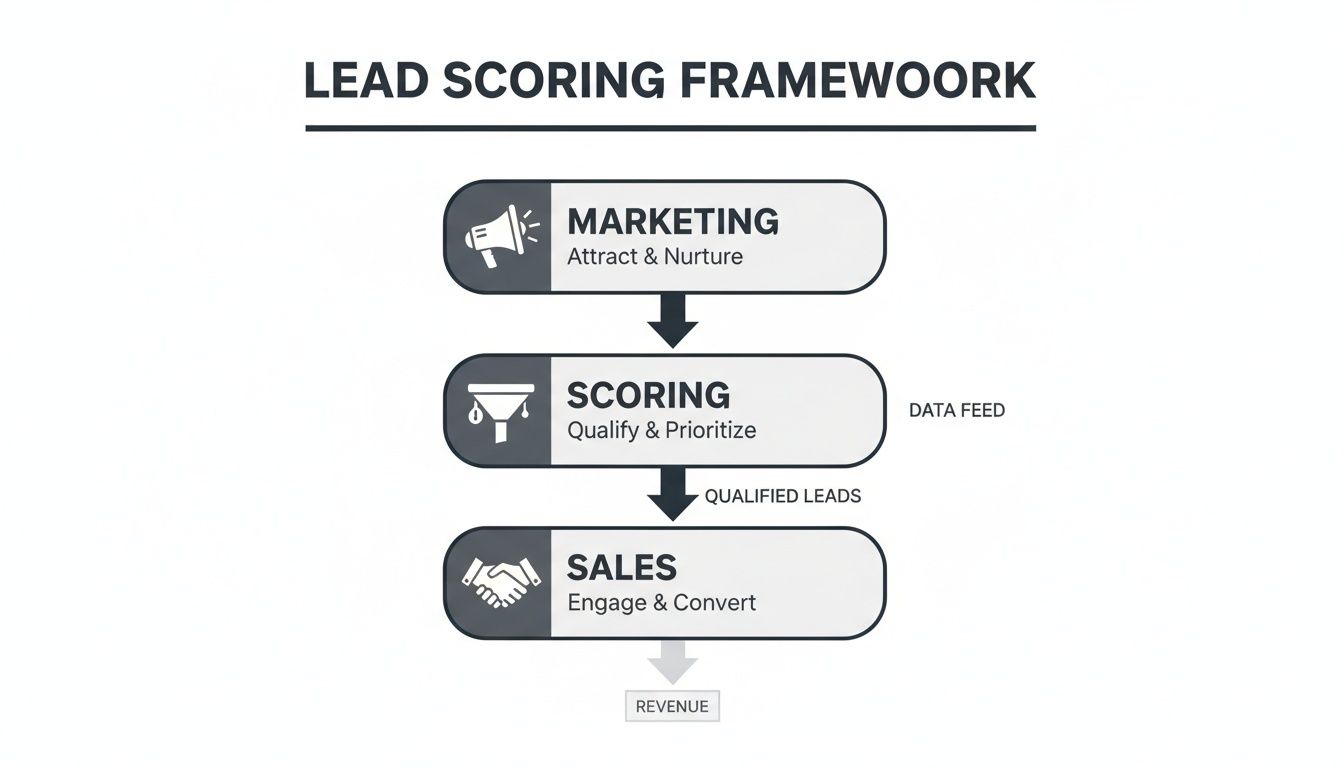
The real insight here is that scoring is the bridge. It translates all that messy marketing activity into a clean, prioritized list of opportunities your sales team can actually close.
How to Build Your First Lead Scoring Matrix
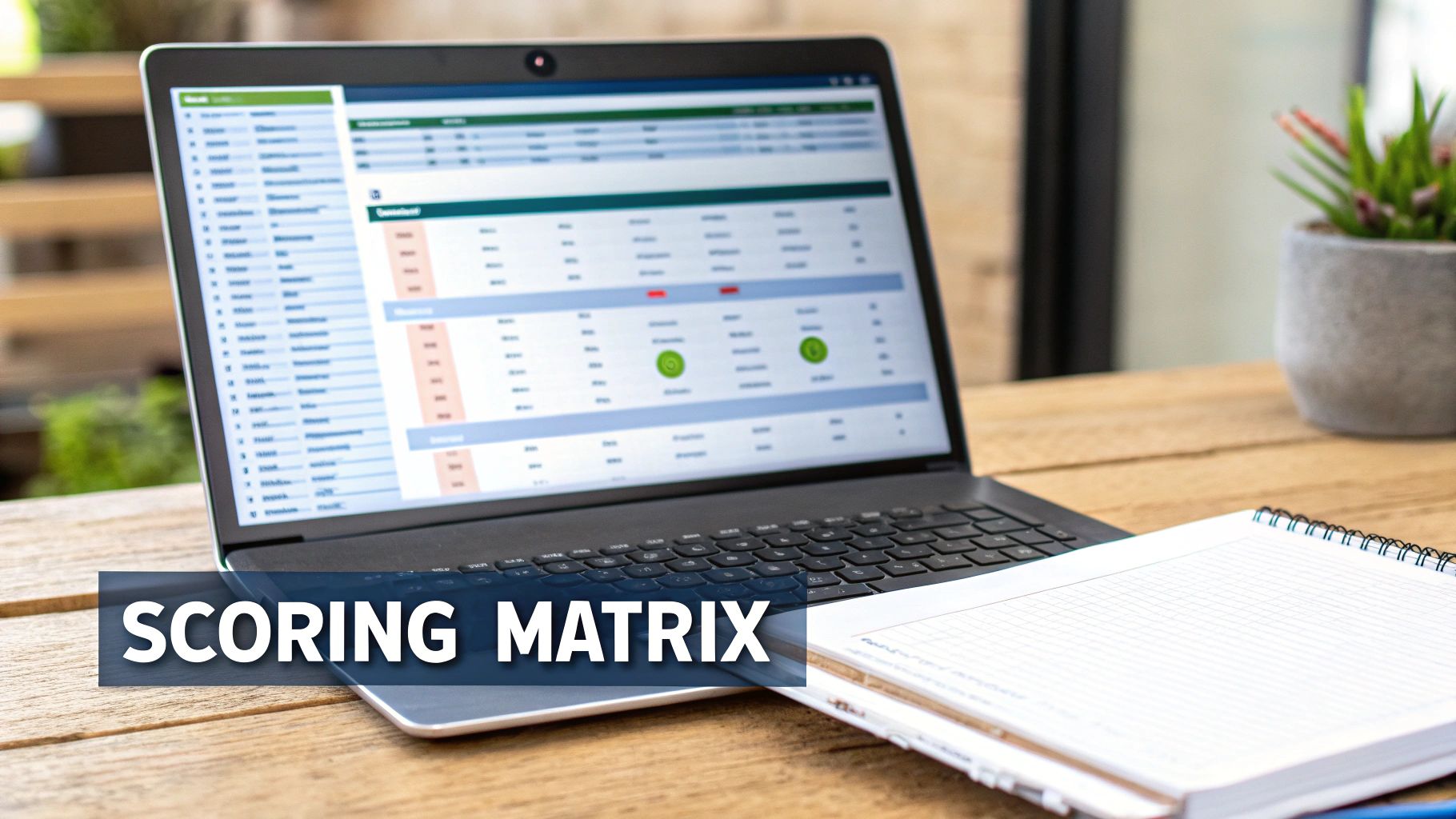
Building a lead scoring model sounds way more intimidating than it is. Forget expensive software for a minute. At its heart, lead scoring is just a simple set of rules you can track in a spreadsheet. This is your playbook for turning a jumble of lead data into a crystal-clear priority list for your sales team.
The whole point is to translate who a lead is and what they do into a number. That number tells you how ready they are to buy. You'll give points for good signals and, just as crucial, decide on the "magic number"—the score that tells your team it's go-time.
Assigning Point Values
First things first: decide what actions and attributes actually matter. A great place to start is by looking at your last 10-15 closed deals. What did those customers have in common? Were they all directors? Did they all download a specific case study? Use those patterns to build your rules.
For example, a form submission from a landing page you built with Leadpages is a solid start. But you can get way smarter. Use a tool like Apollo to enrich that lead with their real job title and company size, which lets you score their fit much more accurately.
Here’s a practical example of a scoring matrix for a small B2B agency. It's not meant to be a one-size-fits-all solution, but a solid template to get your gears turning.
Sample B2B Lead Scoring Matrix
| Category | Attribute/Action | Points Assigned |
|---|---|---|
| Firmographic (Fit) | Job Title: Founder or C-Level | +25 |
| Job Title: Director or VP | +15 | |
| Job Title: Manager | +10 | |
| Company Size: 50-200 Employees | +10 | |
| Behavioral (Interest) | Visited Pricing Page | +15 |
| Downloaded Case Study | +20 | |
| Attended a Webinar | +10 | |
| Opened 3+ Marketing Emails | +5 | |
| Negative Score | Email Address is Gmail/Yahoo | -10 |
The goal isn't perfection on day one. It's about building a logical system. Your point values should reflect real-world intent. A demo request will always be worth more than a single email open because it signals someone is actively looking for a solution.
Setting Your Scoring Thresholds
Once your points system is in place, the next move is setting thresholds. Think of a threshold as the score a lead needs to hit before they're officially "sales-ready" and get handed off. This one step stops your sales team from wasting cycles on leads who are just browsing.
A simple tiered approach works wonders here:
- Cold Lead (0-39 points): Either a poor fit or just not interested yet. Keep them on a nurturing email sequence, but don't bother sales.
- Warm Lead / MQL (40-74 points): They're showing promise. These are Marketing Qualified Leads that need a bit more engagement before they're ready for a call.
- Hot Lead / SQL (75+ points): This is it. A high-fit lead showing strong interest. A Sales Qualified Lead. Get them over to your sales team for immediate follow-up.
These thresholds are your action triggers. The moment a lead's score ticks over from 74 to 75, your process should automatically ping a sales rep. This system is how you turn your lead generation into a predictable pipeline. And if you need more ideas for filling that pipeline, check out our guide on how to generate B2B leads for your business.
Automating Your Lead Scoring and Outreach
A lead scoring model collecting dust in a spreadsheet is worthless. Its real power comes alive when it automatically triggers action, turning your strategic framework into an engine that drives sales without you having to lift a finger.
This is where you connect the dots between your scoring matrix and your outreach. You’re building a lean, automated system that saves hundreds of hours and ensures you’re always talking to the right people at the right time.
The workflow is beautifully simple: a lead hits your sales-ready threshold, an automation fires, and a personalized outreach sequence kicks off immediately.

This process closes the gap between a lead showing high intent and your team actually reaching out. That delay is often the difference between winning and losing a deal.
Building Your Low-Cost Automation Stack
You don't need a clunky, expensive, all-in-one platform to pull this off. A few smartly chosen tools can create a powerful, cost-effective workflow that puts your entire system on autopilot.
Here’s a practical tech stack that just works for small B2B businesses:
- Data Sourcing & Enrichment: A tool like Apollo.io is your starting point. You can find contacts and layer on the firmographic data you need to accurately score their fit.
- Automated Social Outreach: Once a lead hits your threshold, you need to engage them. A platform like PhantomBuster can automatically connect with high-scoring leads on LinkedIn and send a personalized message.
This combo turns your scoring model into an active sales machine. Imagine this: a lead from a target company visits your pricing page, their score jumps past 75, and within minutes, they receive a relevant connection request on LinkedIn. That's the power of automation.
The whole point is to build automated workflows—or "Phantoms"—that handle tedious tasks like profile scraping and sending connection requests, which is the key to this entire outreach strategy.
The Impact of Automated Scoring
Automating this process is what finally aligns your sales and marketing teams. When they’re in sync, the results speak for themselves. In fact, 77% of teams report revenue bumps of 10% or more after implementing these kinds of systems.
For small B2B businesses, the benefits compound. High-scoring leads are known to close up to 2.5x faster, freeing up your team's time for more strategic work instead of chasing dead ends. To get a broader perspective on this, explore our complete guide on marketing automation for small business.
The whole point of lead scoring is to create a system that doesn't just identify hot leads but also engages them instantly. Automation is what makes this possible, ensuring no high-intent lead ever slips through the cracks.
How to Test and Refine Your Scoring Model
Your lead scoring model isn’t a statue you build once and admire forever. It’s more like a garden. It needs regular tending. Markets change, your ideal customer evolves, and what worked last quarter might be completely wrong today.
The good news? This isn't some soul-crushing, complex process. A simple quarterly check-in is usually all it takes to keep your model sharp. This constant iteration is what turns a decent model into a machine that consistently surfaces real, revenue-generating opportunities.
Start with Sales Feedback
The single best source of truth for your model’s accuracy? Your sales team. They're the ones on the front lines, talking to the leads your system flags as "hot." If there's a gap between a high score and a terrible conversation, you need to find out why—fast.
Schedule a quick, recurring meeting with them. Your whole agenda can be boiled down to one critical question: "Are our closed-won deals consistently high-scorers?"
If they hesitate or just say "no," it's time to dig in. Get their honest, unfiltered feedback on recent leads. Their qualitative insights are pure gold for figuring out where the model is nailing it and where it's completely missing the mark.
The real goal here is to shrink the gap between what the data says is a good lead and what your sales team knows is a good lead. When those two things align, your efficiency goes through the roof.
Make Data-Driven Adjustments
Now, you translate that raw sales feedback into tangible tweaks to your scoring matrix. This is all about spotting patterns in the chaos and adjusting point values to better match reality.
Here's what that review process should look like:
- Analyze Your Wins: Pull up the last 20 deals you won. What were their final scores? If a surprising number of them didn't hit your "sales-ready" threshold, it means you're undervaluing something. Figure out which attributes or behaviors need a points boost.
- Investigate Your Losses: On the flip side, look at the high-scoring leads that went nowhere. Is there a common thread? Maybe you discovered that leads with a certain job title always take a demo but never, ever buy. That's a crystal-clear signal to slash the points for that attribute.
- Adjust the Point Values: Don't be timid. If you notice every single new customer downloaded a specific case study, jack up the points for that action. If an entire industry vertical consistently churns after six months, maybe it's time to add a negative score to filter them out earlier.
Common Pitfalls and the Inevitable Rise of Predictive Scoring
Even a perfectly designed lead scoring model will fall apart if you let it gather dust. In the real world, things break. But a few common mistakes are surprisingly easy to sidestep. The classic one? Over-engineering your first scoring matrix. Seriously, start simple. Focus on a handful of the most powerful buying signals and expand from there.
Another frequent own goal is building the model in a marketing silo without getting sales to sign off on it. This is a surefire recipe for disaster, creating a huge gap between the leads marketing thinks are hot and the ones sales knows will actually close. But the biggest trap of all is treating your model like a slow cooker—"set it and forget it." A scoring system has to evolve with your business, otherwise it's on a fast track to becoming useless.
The Rise of Predictive Scoring
Once your business starts to scale and you've got a decent amount of data, a much more powerful approach comes into view: predictive lead scoring. Unlike the traditional models that run on rules you create by hand, predictive scoring uses machine learning to dig through your historical data and find the hidden patterns.
It looks at every single one of your past wins and losses to figure out the subtle mix of attributes and behaviors that truly correlate with a closed deal. This lets it spot connections a human would never catch. For instance, it might discover that a prospect who downloads three ebooks but never visits the pricing page is actually less likely to buy than someone who skips the content and goes straight for a free trial.
Predictive scoring takes the guesswork out of the equation. Instead of you telling the system what a good lead looks like, the system analyzes your past successes and tells you what your next best customer will look like.
This approach has been gaining serious ground since around 2015. It turns out that predictive models, trained on actual conversion data, can forecast closes with 28% higher precision than manual scoring. It's no wonder that 55% of SMBs are now using some form of it, a huge jump from just 12% in 2018. The result? Sales cycles that are, on average, 15% faster.
You can read the full research on lead scoring effectiveness to see just how much these models are changing the game. Making the leap from a manual to a predictive system is the natural next step for any growing business with enough data to fuel it.
Your First Steps to Smarter Lead Scoring
Theory is great, but let's be honest—results come from doing. This is your immediate action plan. It's a quick sprint designed to get your first lead scoring system off the ground today.
No complex lead scoring software, no endless meetings. Just three clear steps to move from reading to doing.
Here’s your three-step launch plan:
Define Your Ideal Customer Profile (ICP)
Schedule a 30-minute workshop with your sales team. Your only goal is to define who your best customers are. Focus on firmographics like company size, industry, and the job titles of your decision-makers.Build Your V1 Scoring Matrix
Open a blank spreadsheet. Using the examples from this guide, build your first scoring matrix. Assign points for the key firmographic and behavioral signals you just identified with your team.Enrich Your Lead Data
Sign up for a free trial of a tool like Apollo. Use it to enrich a handful of your existing leads with accurate data and run them through your new matrix.
Quick Answers to Common Lead Scoring Questions
Getting started with lead scoring always brings up a few practical questions. Let's tackle the most common ones so you can move forward with confidence.
How Often Should I Update My Lead Scoring Model?
You should plan to review your model at least once a quarter. But the real trigger for an update is when you notice a significant dip in lead quality or a slump in sales performance.
Here's a simple gut check: pull up your last 20 closed-won deals. If those customers didn't have high scores right before they became clients, your model is broken. It's missing the real buying signals, and it's time to get back to the drawing board.
What Is a Good Score for a Sales-Ready Lead?
This definitely varies, but a solid starting point is 75-80 points on a 100-point scale.
Don't get married to that number, though. Think of it as a baseline. The most important step is to monitor the quality of the leads who cross that threshold and then get direct, honest feedback from your sales team. Their experience on the front lines is the only thing that really matters here.
Can I Do Lead Scoring Without Expensive Software?
Absolutely. When you're just starting out, a simple spreadsheet is more than enough. The logic behind your scoring—the why—is way more important than the tool you use.
You can easily pull demographic and company data from a tool like Apollo and mix it with behavioral data from your Leadpages forms. No fancy, expensive platform required.