What Is a Landing Page Explained for B2B Growth

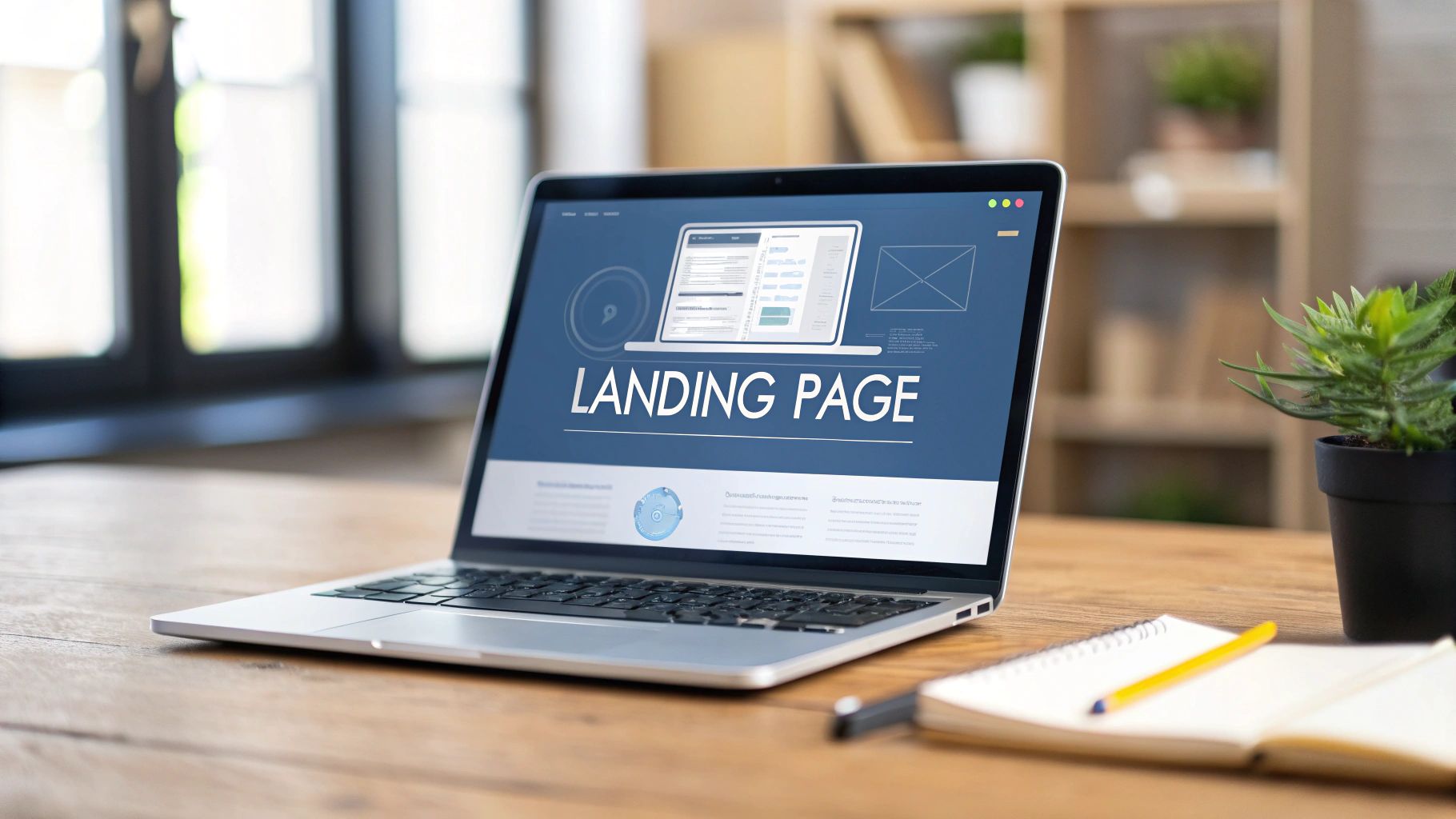
A landing page is a single, standalone web page built for a specific marketing campaign. It has one job and one job only: to convince a visitor to take a single, focused action. This is its call to action (CTA), making it a precision tool for turning visitors into leads.
Why Landing Pages Are a B2B Superpower
Think of your website as a big, bustling department store. It has tons of aisles, products, and signs pointing everywhere. It’s designed for browsing and exploration.
A landing page, on the other hand, is a focused pop-up shop. It has one product on display and a single, clear checkout counter. Its entire purpose is to guide a visitor toward one specific action by stripping away all other distractions—like your main navigation menu, links to other pages, or unrelated offers.
For B2B companies, this laser focus is a superpower. It takes targeted traffic from a specific campaign—like a Google ad or a marketing email—and efficiently converts passive browsers into active leads for your sales pipeline. This singular focus is what makes a landing page completely different from your homepage. For a deeper dive, check out this great explainer on what a landing page is.
Landing Page vs Homepage At a Glance
While they're both web pages, they serve entirely different masters. Your homepage is built for exploration; a landing page is built for conversion. Grasping this distinction is the first step to building a marketing funnel that actually works.
The table below breaks down the core differences.
| Attribute | Landing Page | Homepage |
|---|---|---|
| Primary Goal | Convert visitors for one specific offer (e.g., download an ebook, book a demo). | Encourage exploration of the entire brand, services, and content. |
| Navigation | Usually has no main navigation menu to minimize distractions. | Features a full navigation menu to guide visitors to different site sections. |
| Traffic Source | Receives targeted traffic from a specific campaign (e.g., ads, email). | Receives traffic from a wide variety of sources (e.g., direct, organic). |
| Call to Action (CTA) | Features a single, prominent CTA directly related to the campaign goal. | Has multiple CTAs for different goals (e.g., "Learn More," "Contact Us"). |
By isolating a single offer on a dedicated page, you take control of the prospect’s journey. This makes it far more likely they’ll take the action you want without getting distracted or lost along the way.
The Anatomy of a High-Converting B2B Landing Page
Great B2B landing pages don't happen by accident. They’re engineered, with every single element working toward one goal: getting a high-value visitor to take action. For consultants, agencies, and SaaS companies, understanding this anatomy is the difference between clicks and actual leads. Think of it as a blueprint for persuasion.
Every piece—from the headline to the button—has to pull its weight. It's this intentional structure that separates a page that just gets traffic from one that consistently brings in business.
The Core Building Blocks
The pages that really work all share a similar DNA, built for clarity and trust. It all starts with the hero section at the top. This is your headline, a supporting subheadline, and a powerful visual. You have about five seconds to grab their attention and prove you're worth their time.
Right after the hero, you need to deliver on that initial promise with:
- A Unique Selling Proposition (USP): A short, sharp statement explaining why you’re different and, more importantly, better. It has to immediately answer the visitor's unspoken question: "What's in it for me?"
- Benefit-Driven Copy: Don't just list features. Talk about outcomes. How does your solution make their job easier, their company more profitable, or their problem go away?
- Social Proof: This is your trust engine. We’re talking client logos, direct quotes from happy customers, snippets from case studies, or hard numbers that prove your value.
- A Single, Unmistakable Call-to-Action (CTA): This is the finish line. Your button or form needs to pop off the page. Use action-focused words like "Get My Free Demo" instead of a passive "Submit."
This focused approach is what makes a landing page so different from a homepage, which is designed for broad exploration. A landing page has one job and one path.
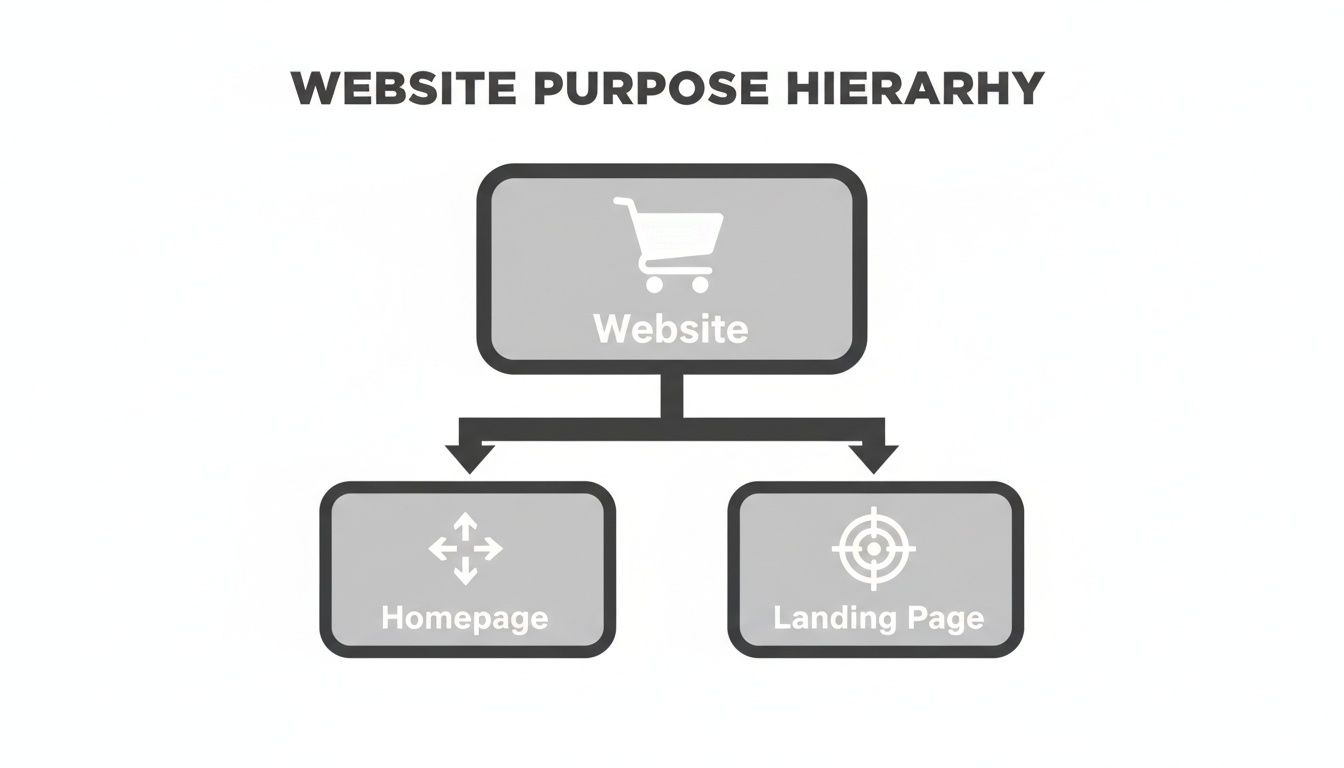
As the diagram shows, a landing page is a specialized tool. It's a direct route from an ad or email to a specific action, stripping away all the distractions of a typical website homepage.
Crafting Copy That Converts
Your words are doing the heavy lifting here. It’s no secret that landing page bounce rates are brutal, often between 60-90%. Clear, simple copy is your best defense. One study found that copy written at a 5th-7th grade level converts at 11.1%, trouncing college-level writing which only hits 5.3%. Simple is smart.
And don't forget the power of your customers' words. Testimonials show up on 37% of the best-performing pages for a reason—they build instant credibility.
A great landing page speaks directly to a visitor's problem and presents your offer as the clearest, most logical solution. Every word, image, and button should reinforce that single message.
Once you’ve got these fundamentals down, the next step is continuous improvement. Learning how to optimize landing pages that actually convert is where you start turning good results into great ones. For a deeper dive, our guide on landing page conversion rate optimization has more advanced strategies.
Key Types of Landing Pages and When to Use Them
Not all landing pages are created equal, and picking the right one is like choosing the right tool for a job. You wouldn't use a hammer to turn a screw. Each type is engineered to hit a specific B2B goal, moving a prospect through a very particular stage of their journey.
Getting this right from the start ensures your page's design, copy, and call to action all work together. This is what turns a simple click into a real business outcome, whether that's a new lead in your CRM or a sales call booked on your calendar.
Lead Generation Pages
This is the workhorse of B2B marketing. A lead generation landing page has one job and one job only: to capture a visitor's contact information. The entire design is built around a form, where you trade a valuable piece of content—often called a lead magnet—for their email and a few other details. For a deeper look, check out our guide on what is a lead magnet.
This is your go-to page for top-of-funnel campaigns where you're trying to build an audience and warm up new prospects.
- Primary Goal: Capture contact details (name, email, company).
- Core Components: A magnetic headline, copy that sells the benefit of the offer, a can't-miss form, and a clear call-to-action button.
- Best Use Case: Gating an ebook, a whitepaper, a webinar registration, or a checklist. This page is the perfect destination for cold traffic from an outreach campaign you're running with a tool like Apollo.
Sales Pages
A sales page does exactly what the name implies: it sells. Think of it as a long-form page designed to convince someone to make a direct purchase. It’s your best salesperson, working 24/7 to answer every possible objection, hammer home the benefits, and build an undeniable case for your product or service.
These pages are most effective when you're targeting warm traffic—people who already know who you are and are considering a purchase.
A great sales page doesn't just list features; it tells a story that moves the reader from problem-aware to solution-ready, culminating in a clear, confident purchase decision.
Click-Through Pages
Think of a click-through landing page as a bridge. Its main goal isn't to get a form fill but to get a visitor to click through to another page—usually a more complex checkout or registration page. Its job is to "warm up" the prospect with just enough information to build interest and trust before you ask for the bigger commitment.
This two-step process makes the user's decision feel much smaller and simpler. The first "click" is a low-stakes action compared to filling out a long form or pulling out a credit card. By focusing on that one small win, you reduce friction and can dramatically boost conversions for more complex offers.
A 5-Step Workflow for Building Your First Landing Page
Knowing the theory is one thing. Actually building a landing page that converts is another. It requires a repeatable playbook.
This is the exact process we follow to turn campaign traffic into measurable results. We’ll break it down into five clear steps, guiding you from a simple idea to a fully functioning, optimized page.
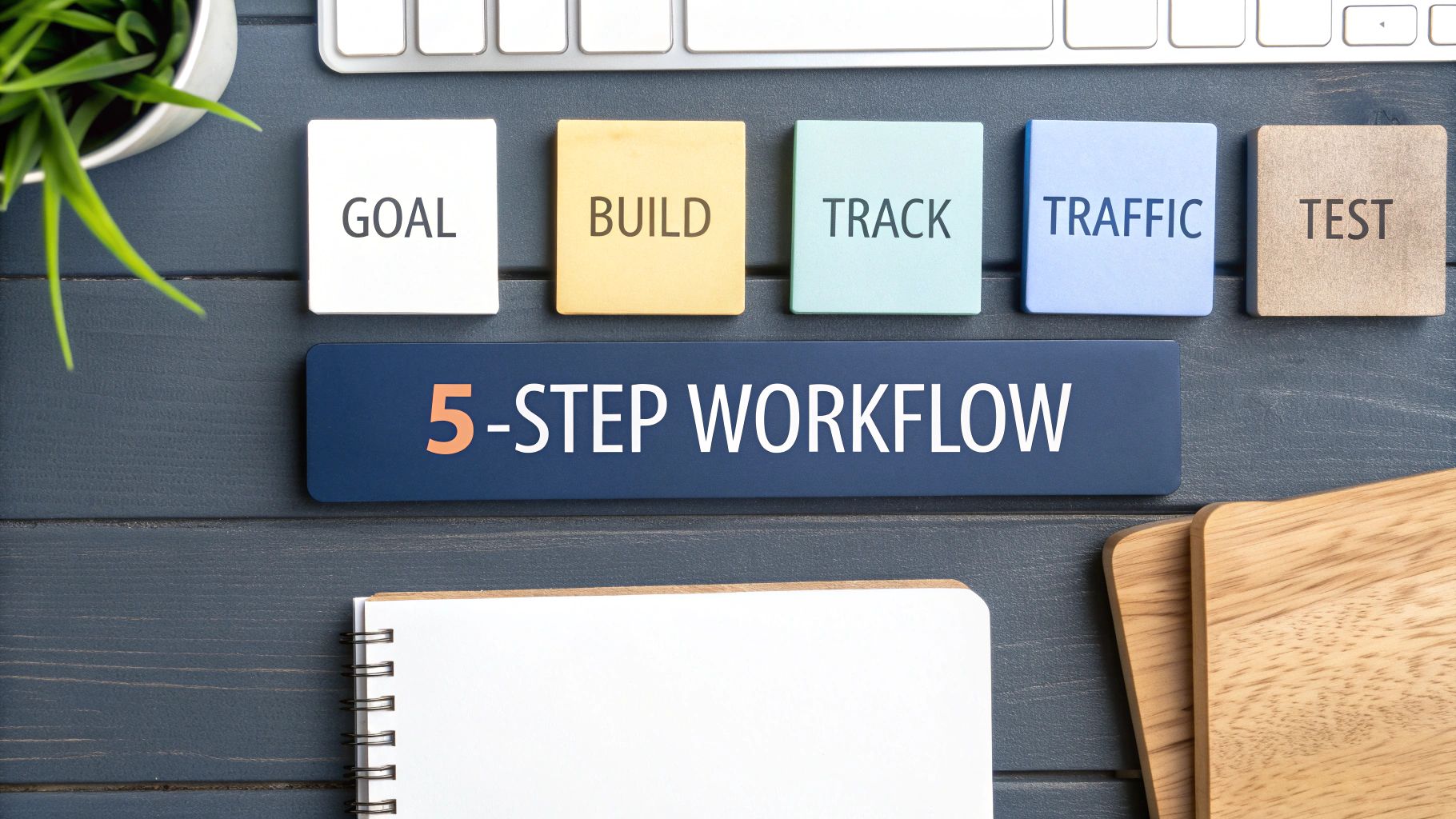
Step 1: Define Your Single Campaign Goal
Before you write a single word or even glance at a template, stop and define your objective. What is the one action you want a visitor to take? This singular focus is the entire foundation of a successful landing page.
Your goal could be anything from getting visitors to download a case study to booking a product demo. The key is to be specific and measurable. For example, "get more leads" is a weak, fuzzy goal. "Capture 50 qualified leads for our new webinar this month" is a strong goal you can actually build around.
Step 2: Build the Page and Match the Message
With a clear goal in mind, it's time to build.
Tools like Leadpages or Unbounce are fantastic for this because they offer templates designed for specific B2B goals, which dramatically speeds up the process. Pick a template that aligns with your objective and start customizing it with your copy, branding, and visuals.
The most critical part of this step? Message matching. The headline on your landing page must perfectly mirror the promise made in the ad, email, or social media post that brought the visitor there. If your ad promises a "Free SEO Audit," your landing page headline must say "Get Your Free SEO Audit," not something generic like "Digital Marketing Services." It's a simple rule, but breaking it kills conversions.
Step 3: Set Up Essential Tracking
A landing page without tracking is just a shot in the dark. You need data to understand what’s working and what isn’t. At a bare minimum, get Google Analytics set up to monitor key metrics.
Your primary focus should be tracking goal completions, which Google Analytics calls "conversions." You'll typically set this up to fire when a visitor successfully submits your form and lands on the "thank you" page. This simple setup allows you to measure your page’s conversion rate—the most important landing page KPI you have.
Step 4: Drive Targeted Traffic
Okay, your page is built and your tracking is live. Now you need to send the right people to it.
For B2B, this often means running highly targeted outreach campaigns. You can use a tool like PhantomBuster to automate outreach on platforms like LinkedIn, letting you connect with decision-makers in your target industry at scale.
Just like with your ads, your outreach message has to align perfectly with your landing page. If you're reaching out about solving a specific pain point, your landing page better greet them with a solution to that exact problem. This seamless transition from outreach to landing page builds trust and makes people far more likely to convert.
Step 5: Test and Improve Continuously
Your first version is never your last. The final—and ongoing—step is to start A/B testing. This just means creating a variation of your page to test against the original, changing one element at a time to see what improves performance.
Good starting points for your first tests include:
- Headline: Try a completely different angle or a more benefit-driven alternative.
- Call to Action (CTA): Test the button copy, color, or placement.
- Hero Image: See if a different visual resonates better with your audience.
This workflow is especially critical in B2B. Data shows that 48% of marketers build a brand new landing page for each and every campaign. Within those pages, personalized CTAs can boost conversions by a massive 202%.
But don’t get discouraged if you don’t see huge wins immediately. Only about 1 in 8 A/B tests produce significant results, which is why continuous, focused testing is the only way to win in the long run. To dig deeper, check out these and other landing page statistics and findings.
How to Measure Landing Page Success
Launching your landing page is just the starting line. The real work begins when you start figuring out what’s actually working—and what’s not. It’s easy to get lost in a sea of data, but for a B2B business, you have to cut through the noise. Focusing on a handful of key performance indicators (KPIs) is what separates smart decisions from analysis paralysis.
This is how you diagnose problems and find the levers that actually improve your ROI.
These core metrics tell the true story of your page's effectiveness. They give you a clear, data-driven picture of how well you’re turning clicks into customers.
The Most Important Landing Page KPIs
While dozens of numbers might seem important, only a few really matter for your business goals. For a B2B landing page, success boils down to these three. Everything else is secondary.
Conversion Rate: This is the undisputed champion. It’s the percentage of visitors who do the one thing you asked them to do, whether that's filling out a form or booking a demo. A high conversion rate means your page is persuasive. While the median rate across industries is 6.6%, a B2B SaaS company should see 3-5% as a solid benchmark to aim for.
Cost Per Lead (CPL): This metric ties your marketing spend directly to results. You calculate it by dividing the total cost of your campaign by the number of leads it generated. A low CPL means your landing page is an efficient machine, turning ad dollars into valuable prospects for your sales team.
Bounce Rate: This is the percentage of visitors who land on your page and leave without doing anything at all. A high bounce rate is a red flag. It often means there’s a mismatch between your ad and your landing page, your copy is confusing, or your value proposition just isn't landing.
To track these properly, you need a solid analytics setup. Our guide on Google Analytics for small business will get you started on the right foot.
Why Your Traffic Source Matters
Not all traffic is created equal. The channel that brings someone to your landing page has a massive impact on whether they’ll convert. By analyzing performance by source, you can double down on what’s working and cut spending on what isn’t.
Understanding where your best leads come from is the key to scalable growth. A landing page that performs poorly with one traffic source might be a superstar with another.
For instance, email traffic, on average, converts at an impressive 19.3%. That’s 77% higher than paid search at 10.9%. Paid social media isn't far behind at 12%, but display advertising lags at just 4.1%.
Knowing these differences is crucial. It helps you set realistic goals for each channel and allocate your budget where it will have the biggest impact. You can discover more insights about landing page performance to keep refining your strategy.
Your Pre-Flight Landing Page Checklist
Theory is great, but cash comes from action. This final checklist boils everything down into a scannable format you can actually use.
Run your existing pages through this audit. Use it as a blueprint for your next build. Think of it as your pre-flight check before launching any campaign—each item patches a common leak that kills conversions.
The Absolute Must-Haves
Before you spend a dime driving traffic, make sure these fundamentals are locked in. Getting them right is non-negotiable.
- Kill All Navigation: A landing page has one job. Remove every link to your homepage, blog, or services. The only path forward should be your CTA button. No exits.
- Match Your Headline to Your Ad: If your ad promises a "Free B2B Growth Plan," your landing page headline better say the exact same thing. Any disconnect creates instant distrust.
- Nail the Value Proposition: Right away, answer the visitor’s only real question: "What's in it for me?" This needs to be crystal clear, right at the top of the page.
- Show Proof You're Legit: You need at least one piece of powerful social proof. A client logo people recognize, a sharp testimonial with a real name and face, or a hard data point that builds instant credibility.
- Have One, Obvious Call-to-Action (CTA): Your CTA button needs to scream for attention. Use a color that clashes with everything else on the page. Use action words like "Get My Free Demo," not a weak, passive "Submit."
A landing page isn't just another page on your website; it's a purpose-built tool for a single campaign. Its power comes from eliminating choice and forcing the user's focus onto one single, desired outcome.
Put This to Work Today
Enough reading. It’s time to build.
Open up Leadpages, grab a B2B template, and build a quick page for your most valuable offer. Next, drive your first 50 clicks to it from an email campaign. Your goal for this week: hit a 3% conversion rate. Go.
Sticking Points: Your Landing Page Questions Answered
Even with a solid game plan, you're going to hit a few snags. It's totally normal. This last section is all about tackling those common questions that pop up for B2B founders and small marketing teams when they start building landing pages. Think of it as a quick way to get unstuck.
How Many Landing Pages Do I Actually Need?
There’s no magic number here, but a good rule of thumb is to create a unique landing page for every single offer or campaign. You wouldn't use the same sales script for two different products, right? Same idea.
The data backs this up. Businesses that go from fewer than 10 landing pages to 10-15 see their leads jump by 55%. For a small B2B shop, a great starting point is to build one dedicated page for each core service or lead magnet. If you're running ads on LinkedIn and Google, make a separate page for each. Matching the message from the ad to the page is a simple trick that works wonders for conversions.
Can't I Just Send People to My Homepage?
You can, but please don't. It's one of the most common—and costly—mistakes I see.
Your homepage is built for exploring. It has a navigation bar, links to your "About" page, your blog, your services... it's a hub. A landing page has one job and one link: the call-to-action button. Sending paid traffic to your homepage is like trying to have a serious conversation in the middle of a loud party. People get distracted and wander off. A dedicated page keeps them focused on the one thing you want them to do.
A homepage is a general store designed for browsing. A landing page is a specialist's office designed for a single, specific diagnosis and treatment. Confusing the two is one of the costliest marketing mistakes you can make.
What's a Good Conversion Rate for B2B Anyway?
This is the million-dollar question. While you'll see stats floating around that the average conversion rate is about 6.6%, that number is a mix of everything from e-commerce to B2C apps. B2B is a different beast; the sales cycle is longer, and the commitment is bigger.
For a B2B SaaS or service business, a solid benchmark to aim for is 3-5%. But that number can swing wildly depending on what you're offering. A free tool or a simple checklist? That might convert at 10-15%. A high-friction ask like a "Request a Demo" form for an expensive product? You might be looking at 2-3%.
The most important thing is to stop worrying about industry averages and start benchmarking against yourself. The only number that matters is your own, and the goal is to keep testing and nudging it upwards. If you need a flexible platform to build and test on, a tool like Webflow is a great place to start.