Small Business Marketing Automation for Consistent Growth

Small business marketing automation is the engine that finally gets you off the project-to-project treadmill and onto predictable, recurring revenue. It's not about enterprise-level complexity or expensive software. It’s about building lean, repeatable workflows that directly fatten your bottom line.
This is your unfair advantage.
Why Automation Is Your Unfair Advantage
Forget saving a few minutes on emails. We're talking about a fundamental shift in how you grow your business. For a small team trying to lock in that first $2k–$5k in MRR, automation is the only way to scale without cloning yourself. It turns messy growth problems into simple, actionable systems.

Let's be real: manual outreach, endless follow-ups, and lead management are massive time sinks that deliver sporadic results. Building an automated system means you have a machine that works for you 24/7, even when you're busy delivering for clients.
The New Standard for Growth
Small businesses are no longer just dabbling; they're going all-in on automation as a lifeline for real expansion. The data is clear: 94% of owners are projecting growth this year, an all-time high. And of the 56% already using AI, a staggering 63% are pointing it directly at their marketing.
This isn't just hype. It's delivering an 87% positive business impact across the board.
For B2B hustlers, this looks like using a tool like Apollo to source perfect-fit contacts, then hooking it up to PhantomBuster to run LinkedIn outreach on autopilot. The proof is in the numbers: companies embracing this model see 80% more leads, with conversions jumping by 77%. You can read the full report on how AI is fueling small business confidence here.
From Unpredictable to Repeatable
The real magic of marketing automation is building a predictable client acquisition machine. Instead of waking up and wondering where the next project will come from, you have a system that consistently finds leads, nurtures them, and tees them up for a sales call.
This isn't just theory. It's about building a workflow that turns your ideal client profile into a steady stream of qualified appointments. It's the bridge from feast-or-famine cycles to sustainable MRR.
That’s exactly what this playbook is designed to do. We're going to get practical and focus on:
- Building a lean tech stack that doesn't burn cash.
- Creating automated lead capture and enrichment flows.
- Launching repeatable outreach campaigns that actually convert.
The goal is to hand you the exact steps to build an engine that fuels your growth. That way, you can get back to what you do best—delivering incredible value to your clients.
Building Your Lead Capture And Enrichment Machine
A solid marketing automation setup isn't about casting a wide net and hoping for the best. It's about building a well-oiled machine that reliably grabs high-quality leads and tees them up for your sales team. Think of it as creating a self-sustaining top-of-funnel that just works without you having to mess with it every day.
The first piece of this machine is a place for potential leads to land. This is where a simple, high-converting landing page is non-negotiable. I'm a big fan of tools like Leadpages for this. You can spin up a page optimized for one single action—like booking a demo or grabbing a case study—in minutes. Forget about getting bogged down in a complex website build; speed and clarity are what matter here.
On that page, you need a form. And that form needs to be as frictionless as possible. Just ask for the absolute essentials: a name and a work email. That's it. Every extra field you add is another reason for someone to bounce.
Turning Raw Leads Into Qualified Prospects
Okay, so someone filled out your form. A raw email address lands in your system. This is where the real magic of automation kicks in. An email alone isn't enough to start a meaningful conversation. You need context. This is where data enrichment changes the game.
By connecting your lead capture form directly to a B2B data platform like Apollo, you can instantly turn that basic email submission into a rich, detailed prospect profile. This all happens in the background, without you lifting a finger.
This one integration automatically pulls in the data points that actually matter, saving you hours of manual research:
- Accurate Job Titles: You'll know immediately if you're talking to a decision-maker or an intern.
- Company Details: Get the firmographics you need, like company size, industry, and where they're located.
- Contact Information: It verifies their info and often finds extra contact details, setting you up for multi-channel outreach.
The goal here is simple: every single lead that enters your system should be immediately armed with the data you need for smart, personalized outreach. It completely eliminates the guesswork and kills the tedious hours spent stalking profiles on LinkedIn.
With this setup, your system isn't just a bucket for collecting leads—it actively qualifies and prepares them for the next step in your outreach sequence. This seamless flow from capture to enrichment keeps your pipeline consistently full of prospects who are a genuine fit for what you sell.
What you've built is a powerful engine that turns anonymous website visitors into real, actionable sales opportunities. And the best part? It all runs on autopilot.
Automating Your Outreach Cadence On LinkedIn And Email
So, you've got your lead capture and enrichment machine humming along. A steady stream of qualified prospects is flowing in. What's next? You need to actually talk to them, but without spending your entire day sending one-off messages.
This is where you build an automated outreach cadence, a smart sequence that blends LinkedIn and email to kickstart real conversations, consistently.
The idea isn't to spam people with generic pitches. It’s about scaling personalized touchpoints. For most B2B plays, LinkedIn is the natural starting point. A tool like PhantomBuster is your best friend here. It lets you automate connection requests and follow-ups, targeting the exact list of prospects you pulled from Apollo.
You can set up a "Phantom" that works like a virtual assistant. It'll visit the profiles of your target leads, send a connection request with a short, personalized note, and then ping them again a few days after they accept. It mimics exactly what you'd do manually, but it runs quietly in the background, freeing you up to handle replies from people who are actually interested.
Here's how that whole flow connects, from the initial lead capture to the final outreach.
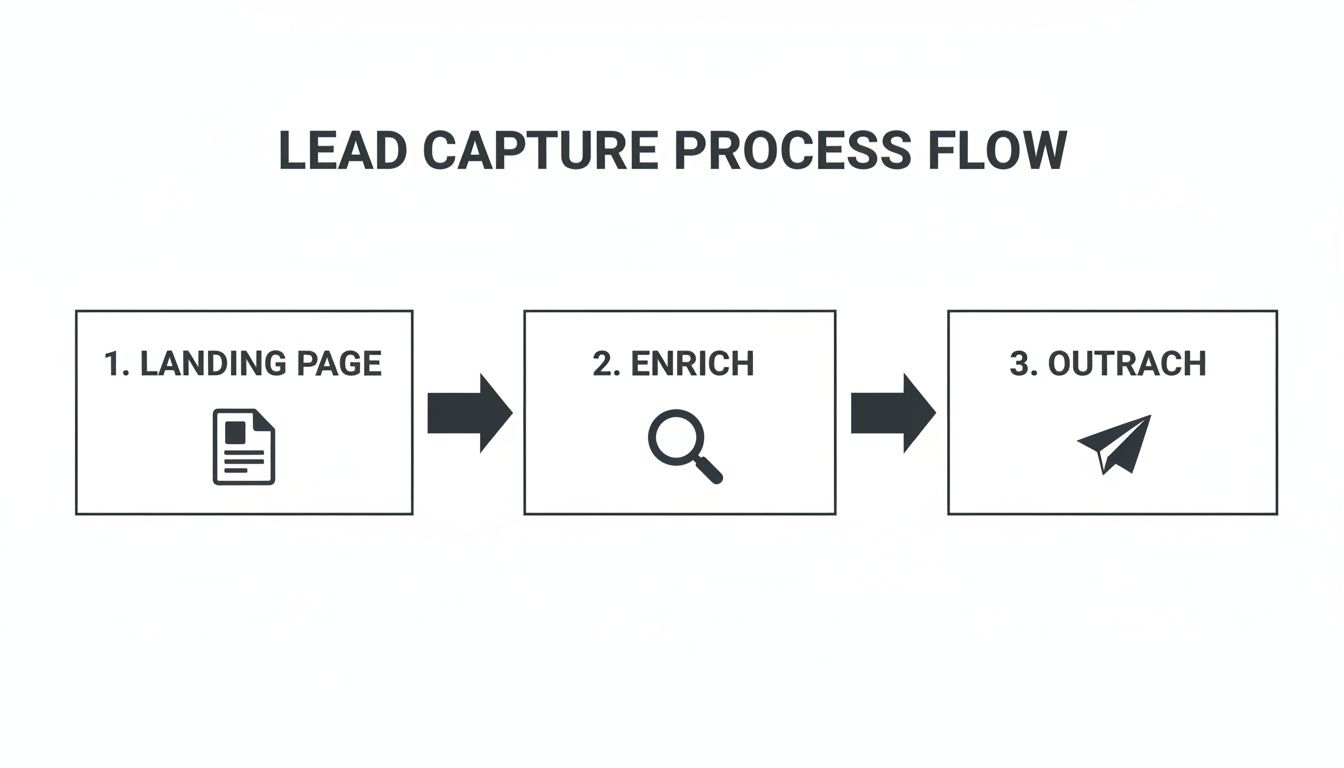
This simple, three-stage process is the absolute backbone of any effective small business marketing automation engine.
Crafting The Email Sequence
While LinkedIn is fantastic for breaking the ice, email is where you build the relationship and lay out your value proposition in more detail. For this, an email marketing platform like Brevo is perfect for setting up automated sequences (often called drips).
Your email cadence shouldn't be a relentless sales pitch. Think of it as a carefully timed series of nudges, mixing value with a direct ask.
Here's a simple framework to start with:
- Email 1 (Day 3): Follow up on the LinkedIn connection. Keep it short and about them. Maybe reference a post they shared or a common interest.
- Email 2 (Day 6): Give them something useful. This could be a case study, a quick guide, or a link to an article you know their industry is talking about. No selling.
- Email 3 (Day 10): Time for a soft ask. Suggest a quick chat to dig into a specific pain point your service is built to solve.
- Email 4 (Day 14): The final, gentle check-in. This is often called a "breakup" email, designed to get a "no" if it's not a fit, so you can move them to a long-term nurture list and clean up your pipeline.
Timing and relevance are everything. Hitting a new contact with four emails in four days is the fastest way to get marked as spam. If you want to go deeper on the copy itself, check out our guide on how to write cold emails.
This multi-channel approach isn't just a nice-to-have anymore; it's becoming the standard. By 2026, a third of small businesses will be using AI-powered marketing automation, with another 27% planning to get on board. They're mainly using it for data analysis (45%) and campaign management (44%)—which is precisely what this playbook is all about.
Sample 14-Day Outreach Cadence
To make this concrete, here is a multi-channel outreach sequence combining LinkedIn and email. The goal is to maximize your chances of getting a response without annoying your prospects.
| Day | Channel | Action |
|---|---|---|
| 1 | Visit profile & send a connection request with a personalized note. | |
| 3 | If accepted, send a brief follow-up message thanking them for connecting. | |
| 5 | Send Email #1: A warm, introductory email referencing the LinkedIn connection. | |
| 8 | Like or comment on one of their recent posts to stay on their radar. | |
| 10 | Send Email #2: Offer a valuable resource like a case study or guide. | |
| 14 | Send Email #3: The "soft ask" for a brief call to discuss a pain point. |
This cadence provides multiple touchpoints across different platforms, which feels more natural than a string of six emails. It respects their inbox while still keeping the conversation moving forward.
The trade-off is simple but powerful: you exchange a few hours of strategic setup for a system that generates a consistent flow of conversations with potential clients, day in and day out. It’s the ultimate leverage for a small team aiming for growth.
Designing Landing Pages That Convert Visitors Into Leads
Your automated outreach is only half the battle. Seriously. If the landing pages you're driving all that hard-won traffic to don't actually convert, the entire system just falls apart. This is where a click becomes a real conversation, and it demands a lean, laser-focused approach.
Forget about building a custom-coded masterpiece. A simple, conversion-first page built with a tool like Leadpages is more than enough to get the job done. The goal here is speed and results—getting a page launched and tested this week, not next month.
The Non-Negotiable Elements of Conversion
Every landing page I've seen that actually performs shares a few core components. These aren't just suggestions; they're the absolute must-haves for turning a visitor into a genuine lead for your B2B service.
- A Compelling Headline: This needs to speak directly to your ideal client’s biggest headache or their most desired outcome. Keep it clear, concise, and make sure it promises a specific benefit.
- A Clear Value Proposition: In one or two sentences, explain what you do, who it's for, and what makes you the obvious choice. Ditch the jargon. Just give them a straightforward statement of value.
- Frictionless Call-to-Action (CTA): Your CTA button should be impossible to miss. Use action-oriented text like "Book Your Demo" or "Download the Case Study"—anything but a passive "Submit."
- Social Proof: You need testimonials, client logos, or snippets from case studies. In the B2B world, social proof is a powerful signal that you can actually deliver on your promises.
The single biggest mistake I see small businesses make is treating their landing page like a brochure. A landing page should have one job and one job only—book a consultation, capture an email, whatever. Cut out everything that doesn't support that one goal.
From Good to Great Through A/B Testing
Getting your page live is just the starting line. The real gains come from relentless improvement, and that means A/B testing. The process is simple: create two versions of your page with one key difference—maybe the headline, maybe the CTA text—and send traffic to both to see which one performs better.
This data-driven approach takes the guesswork out of your marketing. To make sure your tests are grounded in solid strategy, dive into proven landing page optimization best practices. They provide a great framework for what to test first.
I always recommend starting with the headline, as it usually has the biggest impact on conversion rates. For instance, you could test "Streamline Your Agency's Workflow" against something more tangible like "The Project Management System That Saves Agencies 10 Hours a Week." Even tiny shifts in messaging can lead to huge lifts in performance. If you want to go deeper, we've put together a full breakdown of landing page conversion rate optimization in our detailed guide.
This iterative process is at the heart of effective small business marketing automation. It ensures your system doesn't just run on autopilot but actually gets smarter and more efficient over time, squeezing maximum value out of every single click your campaigns generate.
Measuring Your Automation ROI To Drive Growth
Flipping the switch on your automation engine feels good, but that’s just the starting line. To actually grow, you need to know what’s working and what’s not—down to the dollar. This is where you stop caring about vanity metrics like social media likes and get obsessed with the numbers that hit your bank account.
For a small B2B shop, that means qualified leads, conversion rates, and that beautiful acronym: MRR.
Your new system is going to spit out a ton of data. The real skill is learning to ignore most of it. By focusing on the right key performance indicators (KPIs) at each step, you can see exactly where the leaks are, double down on what’s working, and start making decisions with real confidence.
Core KPIs for Your Automated Funnel
Don't drown yourself in spreadsheets. Just a handful of metrics will tell you almost everything you need to know about the health of your funnel.
Think of it as your command dashboard. Here’s what needs to be on it:
- Landing Page Conversion Rate: This is ground zero. What percentage of people hitting your landing page actually fill out the form? If this number is low, nothing else matters because the whole system starves.
- Cost Per Lead (CPL): Simple but critical. How much money are you burning to get one person into your funnel? This tells you if your ad spend is efficient or just a bonfire of cash.
- Email Reply Rate: Forget open rates—they're unreliable and mostly a vanity metric now. A reply, even a "no thanks," means your message was sharp enough to cut through the noise and get a human response. This is gold for cold outreach.
- Demo Booking Rate: Of the leads who actually engage, how many book a call? This is the ultimate test. It measures how well your automation is teeing up actual sales conversations for you to close.
Watching these numbers like a hawk lets you diagnose problems instantly. High landing page conversion but a terrible demo booking rate? The problem isn't your ad, it's your follow-up sequence. Simple.
Tracking ROI isn't about justifying your software bill. It’s about building a predictable growth machine. When you know that every $100 in ads reliably generates 3 qualified demos, you've cracked the code. You've built a repeatable formula to scale.
The Staggering Return on Investment
When you understand your ROI, you can reinvest with confidence and let the results compound. And the financial upside here is massive. Studies show that marketing automation isn't just a small win; it delivers a jaw-dropping 544% ROI on average. That’s $5.44 back for every dollar you put in, with most businesses getting their initial investment back in under six months.
For a small B2B company chasing that first $2k-$5k in MRR, this is the machine you need to build.
On average, businesses see a 34% jump in revenue, and it’s common to see a 10% lift in just six to nine months. In the B2B world specifically, where 71% of companies are already automating their email, the payoff is an 80% surge in leads and a 77% increase in conversions.
These aren't just fancy numbers. They prove that smart small business marketing automation isn't an expense. It's a high-yield investment that directly feeds your sales pipeline and builds a foundation for real, sustainable growth. You can discover more about these powerful marketing automation statistics and see how the pros are using them.
Alright, theory is great, but execution is what gets you paid. Let's turn all this talk into a practical to-do list you can knock out this week.
This is your launch plan. The goal here isn't to build some flawless, enterprise-level machine. It's about getting your first automated workflow live, seeing what happens, and getting some real data to work with.
Momentum is everything.
Your Three-Step Launch Plan
Progress beats perfection, every single time. Here’s how to get your first campaign up and running.
- Find Your Best Lead Source: Seriously, where do your best clients actually come from? Is it LinkedIn? A specific referral partner? Pinpoint that one channel and build your entire test around it. Don't overcomplicate it.
- Spin Up a Single Landing Page: Grab a tool like Leadpages and create one, hyper-focused landing page. It needs a dead-simple offer and a form that’s easy to fill out. That's it.
- Launch a Small Test Campaign: Use Apollo to pull a list of 50 contacts who look exactly like your ideal customer. Then, use PhantomBuster to run a simple LinkedIn outreach sequence that pushes them toward your new landing page.
Think of this first workflow as your minimum viable machine. It’s designed to prove the concept works and give you a baseline to improve upon.
Once you've got this running and want to explore more powerful options, we've broken down our favorites in this guide on the 12 best small business automation tools.
Still Have Questions?
Yeah, I get it. Setting up a whole new system can feel like a lot. Here are a few common questions that pop up when founders are just getting started.
How Much Is This Really Going to Cost Me?
Less than you probably think. You can get the ball rolling with a tool like Brevo on a free plan for your email automation. For outreach, platforms like Apollo and PhantomBuster have affordable tiers that are perfect for getting started without a huge commitment.
Realistically, you can build a solid B2B stack—covering lead sourcing, outreach, and landing pages—for around $150-$300 a month. The goal isn't to spend money; it's to get a return. As we've seen, this investment can pay for itself within just a few months.
Okay, But How Long Until I’m Actually Up and Running?
If you follow this playbook, you can have your first end-to-end workflow live in a single weekend. Seriously. That means building a landing page on Leadpages, pulling a targeted list from Apollo, and kicking off a simple outreach sequence.
Don't aim for perfection right out of the gate. The whole point is to launch fast, get real-world data, and then tweak your small business marketing automation from there. Get it 80% right and hit go.
Won't This Make My Outreach Sound Like a Robot?
It absolutely will... if you do it wrong. The secret is using automation to scale the human parts of your outreach, not to replace them.
Use the data you get from Apollo to drop highly specific details into your templates—things like a prospect's exact job title or a recent company milestone. Let the robots handle the boring, repetitive stuff. That frees you up to jump in and have real, meaningful conversations the second someone replies.
You're automating the process, not the relationship. That’s how you make sure your messages land as relevant and valuable, not just another piece of spam.