OpusClip Review 2026: Is It Actually Worth It?

Real pricing breakdown, credit system explained, and an honest look at what the AI actually delivers in 2026.

OpusClip review 2026 — AI video repurposing tool
Quick verdict

★★★★☆4.2 / 5

OpusClip is the fastest way to turn a one-hour podcast or YouTube video into a month of short-form social content. The AI handles clipping, captions, reframing, and scheduling — all in under five minutes. The Pro plan at ~$14.50/month (billed annually) is genuinely good value for anyone publishing regularly. Just know it is a first-draft machine: plan to review every clip and expect to discard or tweak 20–40% of what the AI picks.

✓ Best for podcasters & YouTubers ✓ Strong caption accuracy ⚠ Scheduler can be unreliable Free trial available
Try OpusClip free. 90-minute Pro trial — no credit card required.
Start free trial →

What is OpusClip?

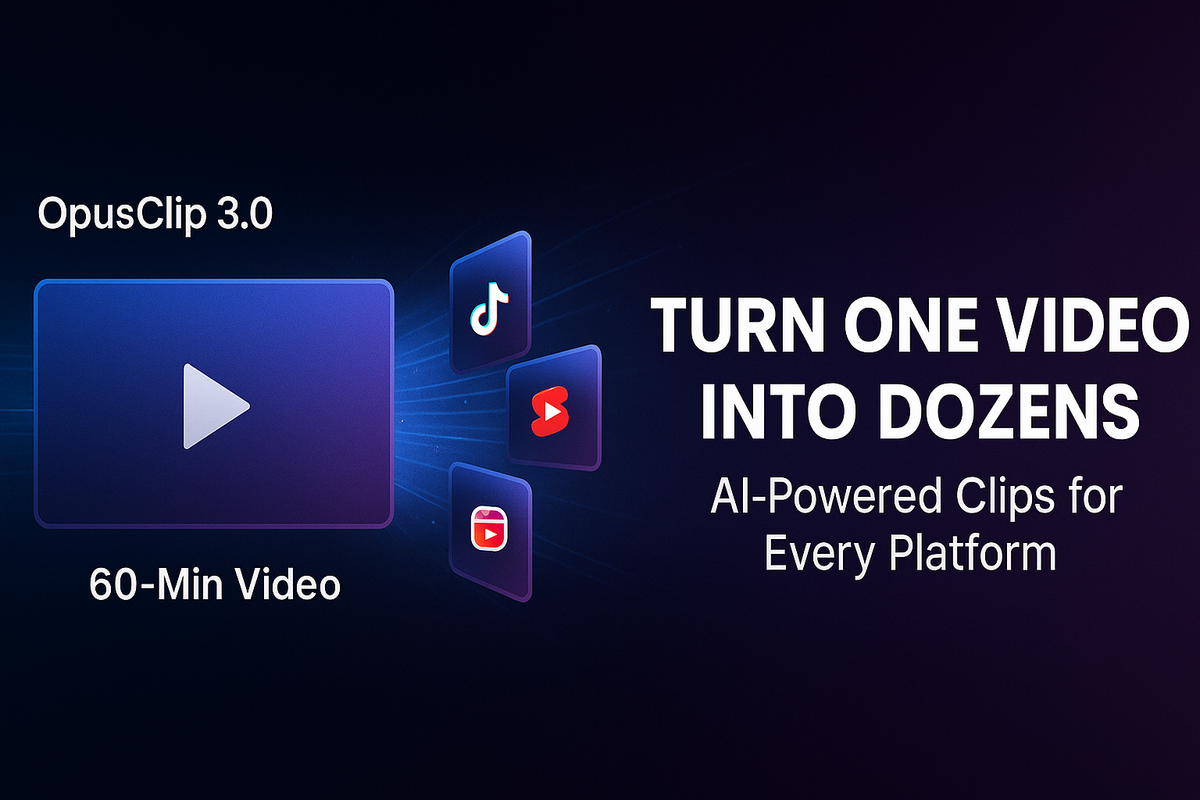
OpusClip is an AI-powered video repurposing tool that automatically clips long-form video into short, social-ready vertical clips. Paste in a YouTube URL, upload an MP4, or connect a Zoom recording — and within a few minutes the AI delivers 10–25 clips, each pre-loaded with animated captions, auto-reframed for vertical viewing, and tagged with a Virality Score.

Founded in 2022, OpusClip now serves over 10 million users who have collectively generated more than 172 million clips. The company has raised ~$50 million — including a 2025 SoftBank Vision Fund 2 investment — at a reported $215 million valuation. It is the current market leader in AI video repurposing, though competition is growing fast.


OpusClip pricing 2026: what you actually get

OpusClip uses a credit-based system — 1 credit = 1 minute of source video processed, regardless of how many clips come out. Here is how the four plans compare:

PlanPriceCredits/monthKey inclusionsBest for
Free $0/mo 60 min Watermarked exports, 9:16 only, 3-day clip storage Testing the tool only
Starter $15/mo 150 min No watermark, Virality Score, auto-captions, basic auto-posting Casual creators (1–2×/week)
Pro
Best value
$29/mo
~$14.50/mo annual
300/mo
3,600/yr annual
AI B-Roll, social scheduler, XML export, team workspace, multi-aspect ratio, 100GB storage Most creators & marketers
Business Custom Custom API, SSO, dedicated support, unlimited seats Agencies & enterprise

How OpusClip credits actually work

Credits confuse a lot of new users. Here is the plain-English version:

  • 1 credit = 1 minute of source video. A 30-min podcast costs 30 credits.
  • The number of clips generated does not affect credit use — 5 clips or 25 from the same video, same cost.
  • Free plan (60 credits) = roughly two one-hour episodes per month.
  • Pro annual (3,600 credits/yr) = about two 45-min episodes per week.
  • Monthly credits expire after 60 days. Annual credits valid for 13 months.
  • A 7-day free trial with 90 credits is available on Pro — no card required.

90 free credits, no credit card. Test with a real video before committing.

Claim your free Pro trial at opus.pro →

Key features: what actually works (and what does not)

ClipAnything — the AI clipping engine

Most AI clippers only work with talking-head content because they rely entirely on transcripts. OpusClip's ClipAnything model goes further: it analyses visual cues, audio sentiment, facial expressions, and emotional peaks simultaneously. This means it can handle vlogs, sports highlights, gaming footage, and content with minimal dialogue — something competitors like Vizard.ai still struggle with.

In practice, expect 10–25 clips from a one-hour video. Of those, 60–80% will be usable with minor edits. The remaining 20–40% will miss the punchline, cut mid-sentence, or start mid-thought — the AI still lacks comedic timing and nuance.

Virality Score

Each clip scores 0–99 based on four factors: hook strength, emotional flow, perceived value, and trend alignment. Higher-scored clips do tend to perform better — but treat it as a sorting heuristic, not a guarantee. Clips rated 40 sometimes beat clips rated 85.

Auto-captions

One of OpusClip's strongest features. Caption accuracy sits around 95% on clean audio in independent testing (OpusClip claims 97–99%), across 25+ languages. You get 10+ animated caption templates, keyword highlighting, auto emoji insertion, speaker colour coding, and custom font upload on Pro. This alone saves several hours per week compared to manual captioning.

AI B-Roll (Pro only)

OpusClip automatically inserts relevant stock footage or AI-generated visuals into clips. It works best for generic topics — for niche subjects the AI sometimes inserts off-topic images, and AI-generated visuals can have the usual glitches (extra fingers, misaligned faces). You can manually adjust or disable B-Roll per clip.

Social media scheduler (Pro only)

Bulk scheduling and direct auto-posting to YouTube Shorts, TikTok, Instagram Reels, LinkedIn, X, and Facebook. Also generates platform-specific captions, hashtags, and titles via AI.

⚠ Honest caveat on the scheduler Many experienced OpusClip users bypass the scheduler entirely. TikTok connections drop frequently and require re-authentication. Posts occasionally fail silently — they simply never publish. If consistent posting is critical, download clips and post manually or use a dedicated tool like Buffer alongside OpusClip.

XML export to Premiere Pro / DaVinci Resolve (Pro only)

Export an XML timeline and open it directly in Premiere Pro or DaVinci Resolve — clip structure, captions, reframing data, and B-Roll all intact. One of the most underrated Pro features. It bridges AI-generated rough cuts with professional post-production without starting from scratch.

Agent Opus — text-to-video (August 2025)

Launched August 2025, Agent Opus creates original videos from text prompts, articles, URLs, or audio. It is a separate product that handles scripting, narration, voiceover, and motion graphics — think of it as a bonus tool bundled into the ecosystem rather than a core repurposing feature.


Who should use OpusClip — and who should not

✓ Podcasters & interviewers Spoken dialogue with clean audio regularly produces 80%+ usable clip rates. This is the core use case.
✓ Talking-head YouTubers Single-speaker educational or commentary content converts cleanly into Shorts and Reels.
✓ B2B marketers Webinar repurposing, case study clips, conference recordings. G2 reviewers report 70%+ time savings here.
✓ High-volume creators & agencies Anyone producing multiple long-form videos per week will see the biggest ROI from Pro or Business.
✕ Gaming & streaming content Visual-heavy content without clear dialogue still underperforms. Dedicated gaming clip tools work better.
✕ Comedy relying on timing The AI lacks comedic timing and misses physical humour or sarcasm. Expect a higher discard rate.
✕ Budget creators who post infrequently The free plan's watermark and 3-day storage make it impractical. Vizard.ai has a more generous free tier.
✕ Anyone needing reliable auto-posting Scheduler reliability issues make it a risky single point of failure if posting consistency matters.

OpusClip pros and cons

Pros
  • Fastest time-to-clips on the market (2–5 min)
  • ~95% caption accuracy in 25+ languages
  • ClipAnything handles non-podcast content
  • Pro plan excellent value at ~$14.50/mo annually
  • XML export bridges AI output and pro editing
  • 10M+ users — battle-tested at scale
  • No credit card for Pro free trial
Cons
  • AI clip selection inconsistent — discard 20–40%
  • Social scheduler unreliable (especially TikTok)
  • Billing complaints documented on Trustpilot
  • Free plan: watermark + 3-day storage = unusable
  • AI B-Roll glitches on niche content
  • Basic built-in editor — not a full production tool
📋 Billing note Multiple Trustpilot reviewers report being charged after cancellation or experiencing unexpected auto-renewals. Always confirm cancellation via your payment processor directly. The company does respond to complaints, but exercise caution when managing your subscription.
Ready to test it yourself? Start with 90 free credits.
Try OpusClip free →

OpusClip vs alternatives: quick comparison

ToolPrice fromFree planBest forvs OpusClip
OpusClip Leader $15/mo 60 min/mo High-volume repurposing, all content types Fastest; most clips; ClipAnything
Vizard.ai ~$10/mo Yes (more generous) Budget-conscious creators 50% cheaper; fewer clips per video
Descript $16/mo Limited Deep editing, text-based cut Better editor; only 3–5 clips vs 20+
Quso.ai ~$15/mo Yes All-in-one: clip + schedule + analytics More features; less powerful AI clipping
CapCut Free / $10 Yes (generous) Manual editing, TikTok-native templates No auto-clipping — 100% manual

Final verdict: which plan should you get?

OpusClip earns its position as the market leader. Nothing else currently matches the combination of processing speed, ClipAnything's multimodal AI, caption quality, and the depth of the Pro feature set at this price point.

The headline recommendation is simple: if you produce long-form video regularly and publish short-form content, the Pro annual plan at ~$14.50/month is the sweet spot. You get 300 credits/month, AI B-Roll, the social scheduler, XML export, and team workspace — everything you need to go from raw recording to published clips with minimal manual work.

If you are just starting out or posting once a week, begin with the free Pro trial (90 credits, no card required) and decide from there. The Starter plan at $15/month removes the watermark and unlocks Virality Scores, but the lack of a scheduler and multi-aspect ratio export makes it feel limited for anyone serious about the workflow.

Set realistic expectations: OpusClip is a first-draft machine. The AI does the heavy lifting — but you still need to review, cull, and occasionally edit the output. The creators who get the most out of it treat it as a power tool, not a fully automatic publishing pipeline.

Best pick: Pro annual at ~$14.50/month.
Or start free — 90 credits, no credit card required.
Start at opus.pro →

Frequently asked questions

Yes — 60 credits per month, but exports carry a watermark and are only accessible for 3 days. It is useful for testing but not practical for regular use. New users also get a 7-day Pro trial with 90 credits and no credit card required — that is the better way to evaluate it. Start your free trial here.
One credit = one minute of source video processed. A 45-minute podcast costs 45 credits. The number of clips generated does not affect consumption — whether the AI produces 5 or 25 clips, you still spend 45 credits. Credits on monthly plans expire after 60 days; annual plan credits are valid for 13 months.
For anyone producing long-form video regularly, yes. The Pro plan at ~$14.50/month annually offers strong ROI versus hiring a video editor at $25–75/hour. For occasional creators posting once a week or less, the value proposition is weaker and Vizard.ai's more generous free tier may serve you better.
Three most commonly cited: (1) AI clip selection is inconsistent — roughly 20–40% need editing or discarding; (2) the social scheduler is unreliable, especially for TikTok, with dropped connections and silent failures; (3) multiple users report billing issues after cancellation. Always confirm cancellation through your payment provider directly.
Podcasts, interviews, talking-head YouTube videos, webinars, and educational content — formats where clear speech drives the narrative. It underperforms on gaming, music videos, comedy relying on timing, and content where important moments are primarily visual rather than verbal.
Yes, on Starter and above. However, TikTok auto-posting is known for reliability issues — dropped connections and posts that fail silently. Many power users prefer to download clips and post manually or via a dedicated scheduler like Buffer or Later.
Cancel from your account settings at opus.pro. Given documented reports of unexpected post-cancellation charges, also confirm cancellation via your payment provider (PayPal, bank, or card issuer) as a secondary check.
The fastest way to turn long videos into short clips.
Try the Pro plan free for 7 days — 90 credits, no card needed.
Get started free →

Last updated: February 2026  ·  Affiliate disclosure: links on this page use an affiliate referral code. We earn a small commission if you sign up — at no extra cost to you. This does not influence our review. Ratings are based on independent testing and aggregated user feedback from G2, Trustpilot, and Product Hunt.