How to Introduce Yourself in an Email and Actually Get a Reply

To get someone to actually read your introduction, the email has to feel personal, relevant, and valuable from the first sentence. Your only goal is to signal that this isn't another generic email blast clogging up their inbox, but a thoughtful message genuinely worth their time. That means you have to ditch the tired templates and focus on making a real connection.
Why Most Introduction Emails Get Deleted on Sight
Let's be real—the average B2B inbox is a warzone. Decision-makers are buried under an avalanche of outreach, and they’ve gotten ruthless with the delete key. If your email even smells generic, automated, or self-serving, it’s gone. It's a harsh truth, but most attempts to introduce yourself in an email fail before they're even fully read.
This happens for a few key reasons. Too many emails have zero real personalization, leaning on lazy openers like "Hope you're having a great week." Others just miss the mark completely. Their value proposition is either confusing or totally irrelevant to the person they're contacting. They drone on about what they do, not what problems they can solve for the reader.
The Psychology Behind the Delete Button
The decision to trash an email is a split-second, almost subconscious one. It's usually triggered by a few things:
- Cognitive Overload: A packed inbox is mentally draining. Anything that looks like it'll require a lot of effort to understand gets tossed immediately.
- Pattern Recognition: Your prospect has seen thousands of bad sales emails. The moment your message fits a familiar, spammy pattern, their brain flags it as junk.
- Irrelevance: If the first line doesn't connect to a problem, goal, or interest they actually have, it’s just noise.
"Your introduction email isn't just competing with other salespeople. It's competing with internal memos, project updates, and messages from the CEO. If it doesn't scream 'relevant and valuable' in the first five seconds, it's already lost."
Breaking Through the Noise
If you want to succeed, you have to reverse-engineer this entire process. Instead of blasting out a generic message, the real work starts with highly targeted research. This is where a tool like Apollo becomes invaluable for identifying the right contacts from the get-go. With that foundation, you can craft an introduction that feels personal because it actually is.
The numbers tell the story. While cold email open rates can hit a respectable 40% to 60%, the response rates often crater to a dismal 1% to 5%. But here's the kicker: just personalizing the subject line can boost opens by 26%. It shows that even small, genuine efforts pay off big.
Of course, none of this matters if your email lands in the spam folder. A critical first step is mastering email deliverability strategies to make sure you actually reach the inbox in the first place.
Cold Email vs General Marketing Email Benchmarks
It's helpful to see just how different cold outreach is from the marketing emails people opt-in to receive. The metrics, and the mindset required, are worlds apart. This table gives you a quick snapshot.
| Metric | Cold Email (B2B Outreach) | General Marketing Email | Key Takeaway |
|---|---|---|---|
| Open Rate | 40% - 60% (with good targeting) | 20% - 30% | Cold emails can get high opens if the subject line is compelling and relevant to a specific pain point. |
| Click-Through Rate (CTR) | 2% - 7% | 2% - 5% | CTR isn't the primary goal; the focus is on starting a conversation, not just driving traffic. |
| Response Rate | 1% - 5% | N/A (not the main goal) | This is the most important metric for cold outreach. A 1% rate is standard; 5% is exceptional. |
| Unsubscribe Rate | < 1% (ideally) | 0.1% - 0.5% | A high unsubscribe or spam complaint rate is a major red flag that your targeting or messaging is off. |
The takeaway here is clear: while getting an open is achievable, converting that open into a real conversation is the real challenge in cold email. Every element of your message has to be dialed in perfectly to earn that 1-5% response rate.
Writing Subject Lines and Openers That Earn a Click
Your email's fate is decided in about five seconds. If you want to introduce yourself and actually get a response, you have to win the battle of the inbox immediately. Nailing the subject line and the first sentence is non-negotiable—they're the gatekeepers to your entire message.

Forget generic advice. The data is clear: personalized subject lines get 50% higher open rates. That's a massive advantage in a crowded inbox. Even the length matters more than you'd think. Subject lines between 61-70 characters hit a sweet spot, with open rates peaking around 43.38%. It’s proof that being brief and relevant is a killer combination.
What this really means is your subject line needs to be short, intriguing, and feel like it was written just for them—without being creepy.
Crafting Magnetic Subject Lines
The goal of a subject line isn't to summarize your email. It's to spark just enough curiosity to get that click. So, instead of boring, predictable titles like "Introduction from [Your Name]," try something that hints at a real connection or specific value.
Here are a few formulas I've seen work time and again:
- Reference a recent action: "Loved your recent post on [Topic]"
- Mention a mutual connection: "Intro via [Mutual Connection's Name]"
- Pose a relevant question: "Question about [Their Company's recent project]"
- State a clear benefit: "Idea for scaling [Their Company's] outreach"
These approaches instantly signal that you've done your homework and aren't just blasting out another generic email. If you want a longer list for inspiration, this post has some great ideas: 70 sales email subject lines that get opened, read, and responded to.
Nailing the Opening Sentence
Once your subject line gets the click, that first sentence has to deliver on its promise. This is your chance to solidify the connection you hinted at. A strong opener bypasses the standard "Hello, my name is..." and dives straight into what matters to them.
"The best opening lines are about the recipient, not the sender. They instantly answer the subconscious question, 'Why should I care about this email?' by making it about their world."
Instead of leading with yourself, start with a "hook" that shows you're paying attention. Maybe you reference a recent company announcement, a podcast they were on, or a project they shared on LinkedIn. This creates an immediate, personal link that makes them far more receptive to whatever you have to say next.
And if you’re still struggling to even get those initial clicks, you should also check out our guide on how to improve email open rates.
Let's look at a quick before-and-after.
Weak Opener:
"Hi Sarah, My name is John and I'm the founder of a marketing agency."
Strong Opener:
"Hi Sarah, I just finished reading your team's latest case study on the Acme Corp project—really impressive work on driving lead acquisition."
The second one just hits different, right? It kicks off with genuine, specific praise. It shows you've invested time and effort, which instantly sets you apart from the ninety-nine other cold emails clogging up their inbox that day.
Structuring Your Email for a Quick and Easy Yes
You got the open. Your subject line did its job. Now what?
The body of your email is where the real work begins. One wrong move here—a dense paragraph, a vague offer, a big ask—and you’re sent straight to the trash folder. The goal is to make your email lean, scannable, and incredibly easy for them to understand and act on.
A high-converting intro email really only needs three things: a quick line to set the context, a crystal-clear value proposition, and a call to action that’s dead simple to say yes to. Anything else is just noise. Cut it.
Nail Your Value Proposition in One Sentence
This is the most critical part of the entire email. Your value prop isn't a long, meandering paragraph about your company’s history or your full suite of services. Nobody cares.
It needs to be a single, sharp sentence that hits on a pain point you know your prospect is dealing with. This is the "aha" moment where they stop skimming and realize your email might actually be for them.
For example, don't say this: "We are a full-service marketing agency that helps B2B companies." It’s generic and lazy.
Instead, get specific: "We help B2B consulting firms like yours build a predictable client pipeline without relying on paid ads." See the difference? It immediately calls out a specific audience and promises a desirable outcome.
Key Takeaway: A strong value proposition isn't about what you do. It's about the specific, valuable result you deliver for someone just like your recipient.
This one sentence should do all the heavy lifting, making it obvious why they should keep reading. If you really want to go deep on this, our guide on how to write cold emails breaks this down even further.
Craft a Low-Friction Call to Action
The final piece of the puzzle is your call to action (CTA), and this is where most people completely blow it.
Asking for a “15-minute call” right away is a huge ask. You're a total stranger asking for their most valuable asset—their time—before you've earned an ounce of trust. It’s too much, too soon.
Instead, aim for a low-friction CTA. Your only goal right now is to start a conversation, not book a demo.
Let’s look at the difference:
| CTA Type | Example | Friction Level | Why It Works (or Doesn't) |
|---|---|---|---|
| High-Friction | "Are you free for a 15-minute call next Tuesday?" | High | This is a big ask for a first touch. It requires scheduling, commitment, and feels like a sales pitch. |
| Low-Friction | "Is scaling your client acquisition a priority for you right now?" | Low | This is a simple, open-ended question. It's easy to answer with a "yes" or "no" and opens the door for a natural dialogue. |
By asking a simple question, you shift the entire dynamic. It’s no longer a sales pitch; it’s a conversation between two peers. This tiny change can have a massive impact on your reply rates simply by making it incredibly easy for them to engage.
Building Your B2B Outreach Machine
Theory is great, but let's be honest—it doesn't pay the bills. The real win comes from turning ideas into a repeatable, scalable workflow that actually lands clients. This is where we build your outreach engine. It's a lean but powerful system designed to find the right people, get on their radar, and land your intro email in their inbox at just the right moment.
This isn't about blasting out thousands of emails and praying for a response. It’s a strategic, multi-step process that makes sure every message you send is relevant and has the highest possible chance of getting a reply.
Sourcing Hyper-Targeted Contact Lists
Your outreach is only as good as your list. A perfectly written email sent to the wrong person is just digital noise. This is why a powerful data tool isn't a nice-to-have; it's non-negotiable.
For this, we’ll use Apollo, a platform that lets you build incredibly specific lists of contacts. Forget just filtering by job title. Here, you can layer on multiple signals to pinpoint your absolute ideal client.
I've seen these filter combinations work exceptionally well for B2B agencies and consultants:
- To find early-stage startups:
- Industry: Software, FinTech, HealthTech
- Employee Count: 1-50
- Funding: Seed or Series A
- Keywords in Profile: "Founder," "CEO," "Head of Growth"
- To target established companies ready to scale:
- Job Postings: Actively hiring for "Sales Development Representative" or "Marketing Manager"
- Technologies Used: HubSpot, Salesforce (this signals they're serious about growth)
- Headquarters Location: Your target region
This approach ensures you're not just finding people with the right title, but companies with the right intent. They're already spending money in the exact areas where you can step in and help.
Automating the Warm-Up Touchpoint
Before you even think about hitting "send," you can dramatically increase your odds of a good response by making a subtle, digital first impression. An automated LinkedIn profile view is perfect for this. It puts your name on their radar without being pushy.
This is where PhantomBuster comes into play. The tool automates actions on platforms like LinkedIn, letting you warm up prospects at scale without lifting a finger.
Pro Tip: Set up a PhantomBuster flow to automatically view the LinkedIn profiles of the contacts you just sourced from Apollo. I recommend scheduling this to run 24-48 hours before your first email goes out. This simple "warm-up" makes your name familiar when your email lands, turning a stone-cold outreach into a slightly warmer one.
Structuring a Simple and Effective Sequence
With a dialed-in list and a warmed-up prospect, you're ready to launch your sequence. This isn't some complex, ten-email monster campaign. In my experience, a simple, value-first sequence is what gets replies.
This flowchart breaks down the essential structure for every email you send.
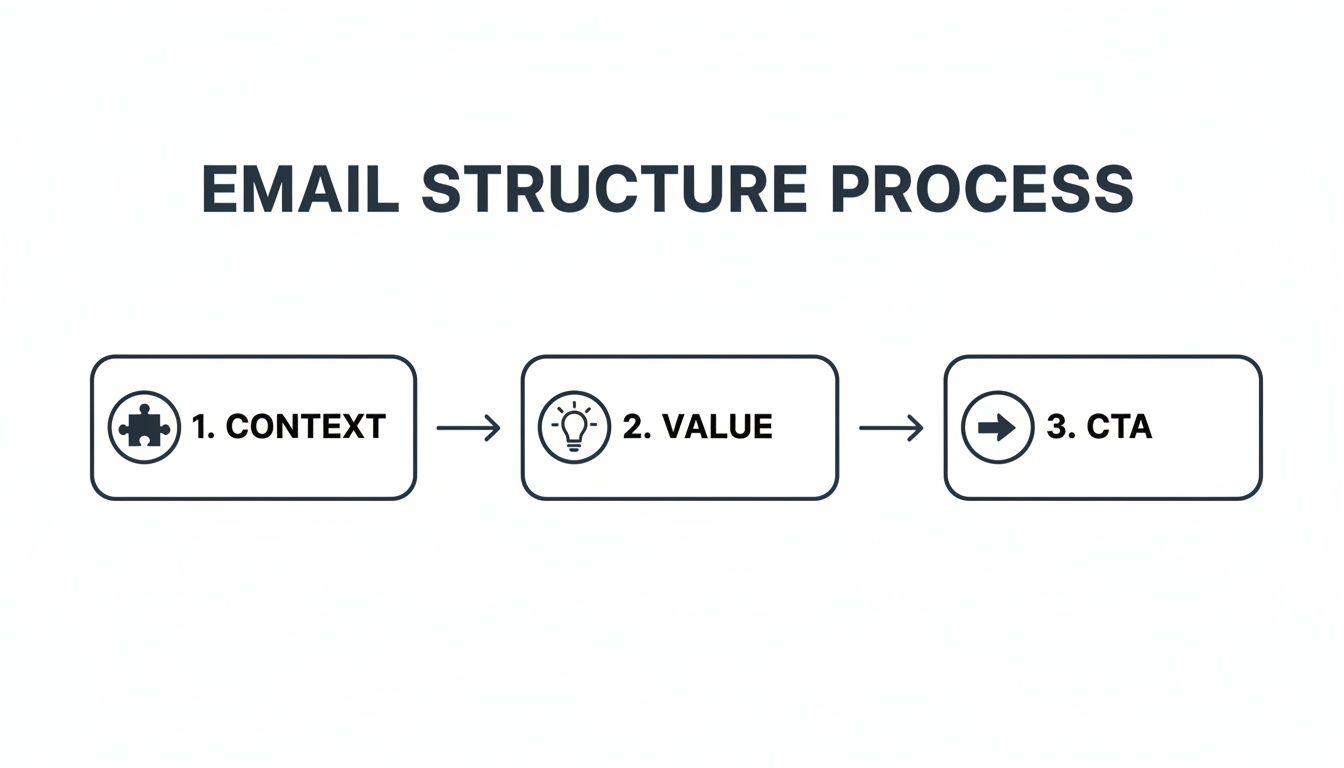
The flow is simple: establish context, deliver value, and then make a clear, easy ask. That's the core of a successful introduction.
Here’s a practical sequence you can steal and implement today:
- Day 1 (Profile View): Your PhantomBuster automation views their LinkedIn profile. You make zero direct contact.
- Day 2 (Personalized Intro): You send the first email. This needs the strong subject line, personalized opener, one-sentence value prop, and low-friction CTA we covered earlier.
- Day 4 (Value-Add Follow-Up): If you hear crickets, send a follow-up. Don't just say "bumping this up." That's lazy. Instead, offer another piece of value—a link to a relevant case study, a helpful article, or a quick insight about their industry.
This simple three-touch sequence respects their time, provides genuine value, and positions you as a helpful expert, not just another salesperson. It’s the foundation of a B2B outreach machine that builds relationships and, most importantly, drives replies.
Double Your Reply Rate With a Smarter Follow-Up
Sending that first email is just firing the starting pistol. The real race is won in the follow-up, but that's exactly where most people drop the ball. If you're not planning your follow-up sequence before you even hit send on that first message, you’re leaving most of your potential replies on the table.
Done right, persistence isn’t about being a pest—it’s about providing consistent, lightweight value. A smart follow-up shows you’re serious and keeps your name top-of-mind. The key is to make every single message a new, low-friction opportunity for them to engage.
The Value-First Follow-Up Framework
Ditch the dreaded "just bumping this up" email for good. Instead, use a simple framework that actually adds value with each touchpoint. This approach respects your prospect's time while quietly building your credibility.
Here’s a simple 2-step sequence to roll out after your initial intro:
- Email 2 (2-3 days later): The Relevant Resource. Your only goal here is to be helpful. Briefly reference your first email, then share something genuinely useful. This could be a link to a recent case study, a high-value blog post you wrote, or a short video explaining a concept that’s perfect for their industry.
- Email 3 (4-5 days later): The Quick Insight. This is your final, no-pressure nudge. Share a single, concise observation or a surprising statistic about their market. The aim is to spark a little curiosity and prove you understand their world.
Key Takeaway: A great follow-up never just asks for something. It always gives something first. Shifting your mindset this way changes the entire dynamic from an annoying poke to a welcome piece of insight.
Know Your Numbers: Tracking Key Outreach Metrics
You can't improve what you don't measure. Tracking a few key metrics is the only way to figure out if your outreach is actually working. While welcome emails can see an astonishing 83.63% average open rate, cold outreach is a totally different game. That’s why 47% of marketers automate their follow-up sequences—it keeps them consistent and makes performance easier to track. You can learn more about these email marketing statistics and see how they can sharpen your strategy.
For your introductory campaigns, you really only need to focus on a few core metrics.
Here’s a quick rundown of the most important numbers to watch, what they mean, and what a "good" benchmark looks like in the wild.
Key Outreach Metrics to Track
| Metric | What It Measures | Good Benchmark | How to Improve It |
|---|---|---|---|
| Open Rate | The percentage of people who opened your email. | 40% - 60% | Test different subject lines; warm up your domain to improve sender reputation. |
| Click Rate | The percentage who clicked a link in your email. | 2% - 7% | Make your links more relevant and your call to action impossible to misunderstand. |
| Reply Rate | The percentage who replied to your email. | 1% - 5% | Simplify your CTA; crank up the personalization in the email body. |
These benchmarks give you a clear target to aim for. If your numbers are falling short, you now have a specific area to focus on. For instance, a low open rate almost always points to a weak subject line. A low reply rate? That usually means your core message or CTA isn't resonating.
This data-driven approach is how you stop guessing and start systematically getting better results over time.
Your First Outreach Campaign Action Plan
Alright, we've covered a lot of ground. But information without action is just noise.
Instead of letting this guide become just another bookmarked tab, let's turn these ideas into a concrete plan you can execute today. This isn't about theory anymore—it’s about building real momentum with a small, measurable first step.
Here’s a simple, three-step action plan to launch your first micro-campaign and start getting replies.
Launch Your Campaign in Three Steps
Build a Hyper-Targeted List
First, open up Apollo. Your mission is to build a list of just 25 ideal prospects. Don't go for volume. Use the advanced filters we talked about—focus on sharp signals like recent funding, specific technologies they use, or active job postings. This ensures your list is primed for your offer from the get-go.Draft Your Core Email
Using the frameworks from this guide, write two distinct subject lines. You're going to A/B test them. Then, draft the body of your email. Focus on a razor-sharp one-sentence value proposition and a low-friction CTA. If you're stuck for ideas, these B2B cold email templates are a great starting point.Launch and Monitor
Now, select your first 10 prospects from the list. Send them personalized versions of your email—five with the first subject line, five with the second. All you have to do now is watch. Track your open and reply rates over the next 48 hours. This will tell you which subject line is pulling its weight and give you your first batch of real-world data.
Common Questions, Answered
When you're fine-tuning your outreach, a few common questions always pop up. Here are some quick, no-nonsense answers to the ones I hear most often.
How Long Should an Introduction Email Be?
Keep it short. Seriously. Your target is between 75 and 150 words.
Think about it—your prospect is probably reading this on their phone while juggling ten other things. You have seconds, not minutes. Your goal isn't to close a deal in the first email; it's just to get a response. A short, sharp message forces you to be clear and respects their time, making a reply far more likely. Anything longer is just asking to be deleted.
Is It Okay to Follow Up More Than Once?
Not just okay—it's essential. Most replies don't happen on the first send. A smart follow-up sequence is where the real magic happens.
That said, don't just "bump" the old message. That's lazy and annoying. A good follow-up strategy usually involves 2-3 emails, each spaced a few days apart. Every single one needs to add new value. Share a relevant article, a quick insight you had about their company, or a short case study. You want to be seen as a helpful expert, not a persistent pest.
The key is to be persistent without being a pest. Your follow-up should always give more than it asks, offering value that keeps the door open for a future conversation.
What Are the Biggest Mistakes to Avoid?
It's just as important to know what not to do. A few rookie mistakes can kill your chances before you even get started.
Here are the three deadliest sins of cold outreach:
- Making It All About You: This is the big one. Nobody cares about your company's founding story or your long list of features. The email has to be about them—their challenges, their goals, their industry.
- Having a Vague or High-Friction CTA: Asking for a 30-minute demo right away is like asking someone to marry you on a first date. It's too much, too soon. Your call to action should be a simple, low-effort question that’s easy to answer.
- Using a Generic Template: People can smell a copy-pasted email a mile away. If you haven't taken 60 seconds to find a single unique detail about the person you're emailing, you're signaling that you don't really care. That email is going straight to the trash.