How to write consulting proposal that wins clients


Let's get one thing straight about writing a consulting proposal: it’s not a sales pitch. It's a confirmation.
This document is the final handshake before the work begins. It should clearly mirror the client's problem, outline the solution you've already discussed, and detail the investment. Your goal is to make their "yes" feel like a simple, logical conclusion to your conversations.
The Blueprint for a High-Converting Consulting Proposal
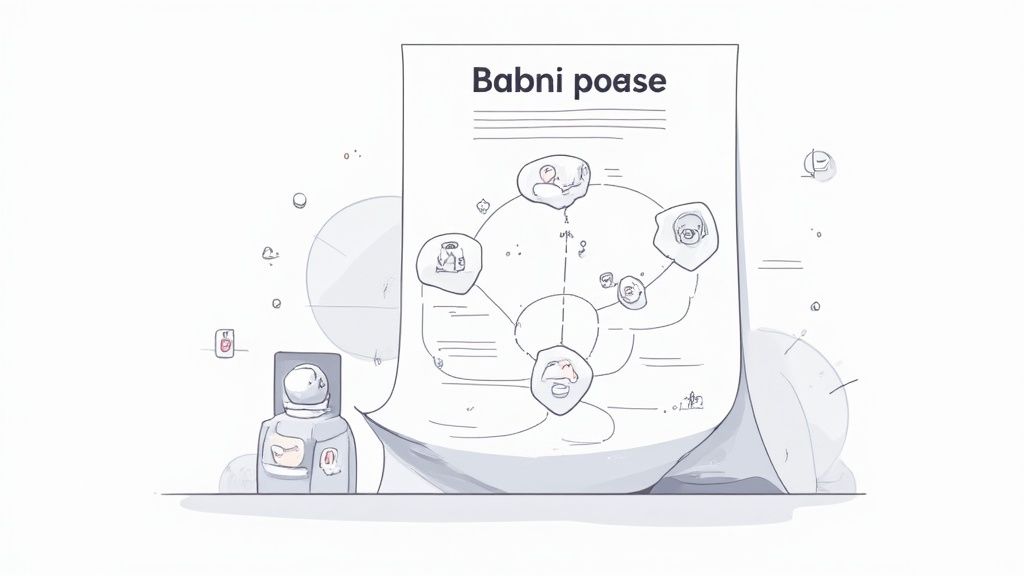
Stop thinking of your proposal as just a price quote. It's the final, critical conversation in your sales process. Too many consultants make the classic mistake of using the proposal to sell their services. By that point, the selling should already be done. If you're sending a proposal hoping it will convince a hesitant client, you've probably already lost.
A truly effective proposal acts like a mirror. It reflects the client's challenges back to them so clearly that they feel deeply understood. From there, it positions your solution as the only sensible path forward. This completely changes the dynamic—you're not just "selling services," you're cementing a partnership built on the trust you established in your discovery calls.
What Every Great Proposal Needs
To build a document that actually closes deals, you need a structure that walks the client from their current pain to their desired future. Every high-impact proposal I've ever written or seen is built around a few core components that, together, tell a compelling story.
Here's a quick look at the essential sections every effective proposal should have. Think of these as the building blocks for creating clarity and confidence.
Core Components of a High-Impact Consulting Proposal
| Component | Purpose |
|---|---|
| Compelling Problem Statement | Shows you listened by articulating their challenge in their own words. |
| Clear Objectives & Outcomes | Defines what success looks like in measurable business terms, not just activities. |
| Defined Scope & Deliverables | Sets firm boundaries on what is included (and what isn't) to prevent scope creep. |
| Transparent Investment Breakdown | Frames your fee as an investment with a clear return, justifying the value you bring. |
| Simple Next Steps | Makes it incredibly easy for them to say "yes" and kick off the project. |
This structure creates a logical flow that builds trust and removes any friction from the decision-making process.
This entire framework is designed to make your proposal a formality—the logical conclusion to a series of value-packed conversations. To speed things up, I highly recommend creating reusable templates. I build mine out in a tool like Notion, which lets me quickly customize a battle-tested structure for each new client without starting from scratch.
The Pre-Proposal Work That Actually Matters
Here’s a hard truth: a winning consulting proposal is almost never won by the document itself. The real victory happens long before you type a single word. It’s won in the discovery call.
That conversation is your chance to shift from just another service provider to a genuine strategic partner. If you treat that call like a simple Q&A session, you’re basically rolling the dice on the whole deal.
The magic happens when you peel back the layers and get past the surface-level problem. Your proposal should feel like a confirmation of everything you’ve already discussed and agreed upon—a perfect reflection of their world, their language, and their frustrations. When done right, your solution feels like the only logical next step.
Digging Deeper Than the Obvious Problem
So many consultants fall into the trap of asking basic questions like, "What problem are you trying to solve?" It's a necessary starting point, but it barely scratches the surface. To really get what’s going on, you need to understand the consequences of that problem.
Insightful discovery questions are your best tool here. They help you uncover what truly matters to the client and arm you with the exact language and pain points to frame your entire proposal around.
Here are a few questions I always try to work into my discovery calls:
- To See Their Vision: "Let's fast forward six months. This project has been a massive success. What does that actually look like for you and the business?"
- To Uncover Past Failures: "What internal hurdles or previous attempts to fix this have kept the problem from being solved already?"
- To Quantify the Impact: "What’s the real cost of not solving this over the next year? Think in terms of lost revenue, wasted time, or even team morale."
- To Map the Stakeholders: "Besides yourself, who else on the team will be involved in the final decision-making process for this project?"
Pro tip: Record and transcribe these conversations. It’s a total game-changer. I use a tool called Fathom so I can stay fully present in the conversation instead of frantically scribbling notes. Later, I can pull the client's exact phrases from the transcript to make sure my proposal hits home.
Identifying the True Decision-Makers
Often, the person championing your project isn't the only one signing off on it. I’ve seen perfectly good proposals fail simply because they didn't speak to an unseen stakeholder, like the CFO who only cares about ROI or a department head worried about implementation.
Your proposal needs to speak to everyone in the decision-making chain. The contact who is championing your project internally needs a document that helps them sell your solution to their boss. Make it easy for them.
During your call, you need to gently probe to understand the full approval process. A simple question like, "What does the approval process look like for a project of this nature?" can reveal everything. It helps you identify who holds the budget and what they truly care about.
For example, a marketing manager might be obsessed with lead quality, but the CFO is looking exclusively at cost-per-acquisition. Knowing this lets you tailor specific sections of your proposal to address each person's priorities directly.
Ultimately, this pre-proposal work boils down to deep listening and smart questions. It all starts with getting the right people on a call. For a deeper dive into the strategies that lead to these crucial conversations, check out our complete guide on how to get consulting clients.
Structuring Your Proposal for Maximum Impact
Once you’ve wrapped up the discovery phase and really listened to your client, you have all the raw material you need. Now, the goal isn't just to list out services; it’s to craft a story that walks the client from their current headache to your clear, compelling solution. The right structure is what makes that story stick.
Think of it like building a logical argument. Each section needs to flow naturally into the next, guiding the client to the only conclusion that makes sense: hiring you. If the proposal feels disjointed or confusing, you create doubt, and doubt kills deals.
It all boils down to a simple, powerful process.
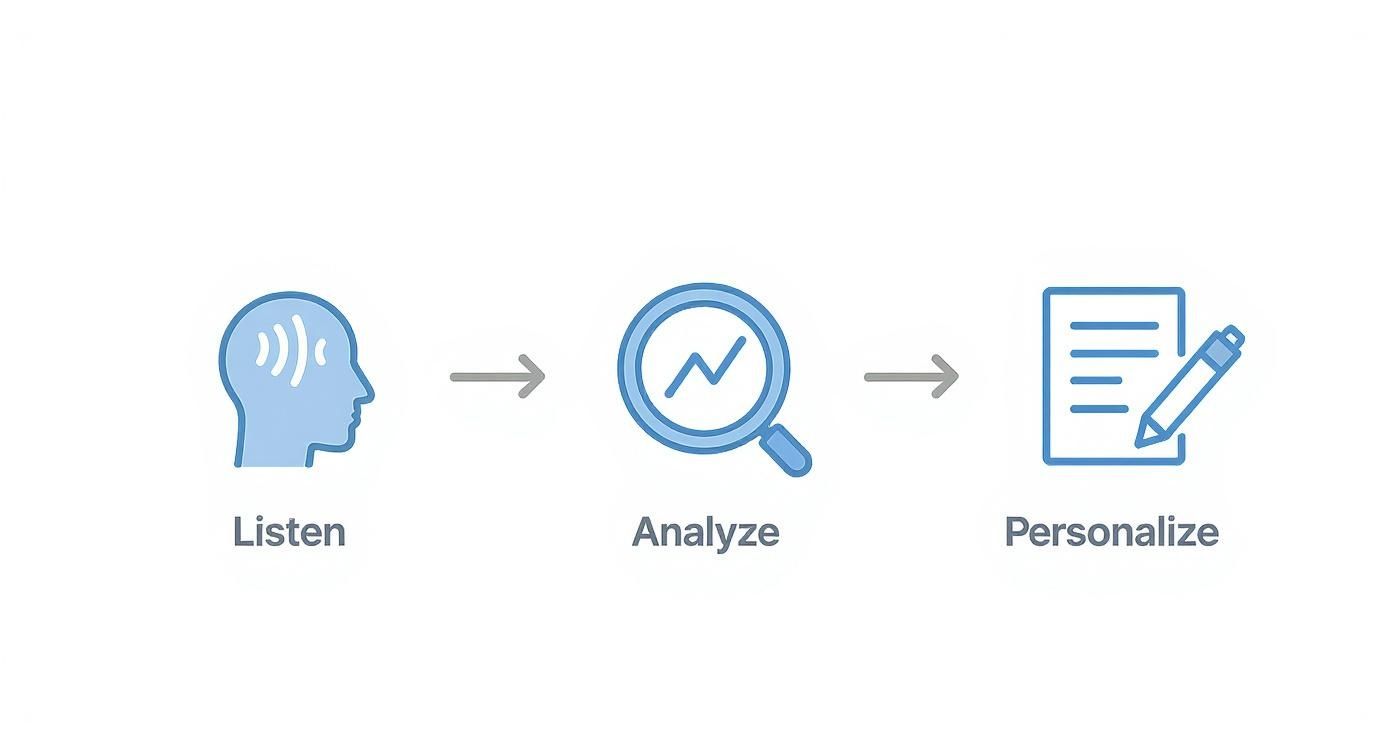
This really just reinforces a fundamental truth: you can't create a truly personalized proposal without first digging deep into the client’s world and figuring out what’s really going on.
The Executive Summary: Your Hook
Let's be blunt: this is the most critical part of your entire proposal. Most executives and key decision-makers will scan this section first to decide if the rest of your document is even worth their time. It has to grab them immediately and prove you get it.
Keep your executive summary tight—just a few powerful paragraphs. It needs to do three things, fast:
- Acknowledge Their Problem: State their core challenge back to them, using the exact language they used on your discovery call. This instantly shows you were listening.
- Present Your Solution: Briefly outline your proposed approach and—crucially—why it’s the perfect fit for their specific situation.
- Highlight the Outcome: Paint a vivid picture of success. Focus on the business value and the return on their investment.
A great executive summary makes the client feel completely seen and understood. It’s not about your company’s long history; it’s a mirror reflecting their problem and the clear path you’ve mapped out to solve it.
Defining Scope and Deliverables
Ambiguity is the absolute enemy of a successful consulting project. This is the section where you draw firm lines in the sand to eliminate any confusion down the road. The scope of work clarifies what you will do, while the deliverables are the tangible things the client will physically receive.
Vague language here is a direct path to scope creep and frustrating disputes. Don't just write "social media management." Get specific: "Management of company LinkedIn and Twitter profiles, including three scheduled posts per week on each platform, community engagement, and one monthly performance report."
To keep myself honest, I map out every milestone and deliverable in a tool like Todoist before I even start writing the proposal. This forces me to think through the project logically, ensures the timeline is realistic, and makes sure nothing gets forgotten.
Building a Clear Timeline and Milestones
A timeline isn’t just a list of dates; it’s a project roadmap. It manages expectations and shows the client you have an organized, professional approach from day one. More importantly, it shows them when they can expect to see progress and results.
For anything more than a short project, break the timeline into distinct phases with clear milestones. This makes a large undertaking feel much more manageable and creates natural checkpoints for feedback and course correction.
Here’s a simple structure you can adapt:
- Phase 1: Discovery & Strategy (Weeks 1-2): Kick-off meeting, stakeholder interviews, delivery of the strategic plan.
- Phase 2: Implementation (Weeks 3-8): Execution of core activities, with bi-weekly progress check-ins.
- Phase 3: Optimization & Hand-off (Weeks 9-12): Performance review, team training workshops, and delivery of final reports.
Framing Your Pricing as an Investment
How you present your fees can make or break the deal. Never just drop a single number on the page without context. You need to frame your pricing as an investment that will generate a meaningful return. If your discovery phase was thorough, you should be able to connect your fee directly to the value you’re creating—whether that’s increased revenue, saved time, or reduced risk.
The industry gets this. The global proposal management software market was valued at USD 3.2 billion in 2025 and is expected to hit USD 9.0 billion by 2035, growing at 11.1% annually. That boom shows just how seriously businesses are taking the process of communicating value clearly. You can see more on trends like this in our deep dive into key consulting statistics.
Essential Terms and The Final Step
Finally, every proposal needs to include the boring-but-critical terms of engagement. This section protects both you and your client by setting clear ground rules. Make sure it covers payment terms (e.g., 50% upfront), confidentiality, and the process for handling any changes to the scope.
Once all these pieces are in place, you’re ready to send it off. I highly recommend building your templates in a flexible tool like Notion, which can save you countless hours on future proposals. Then, for that last, crucial step, use a service like Sign now or Airslate. They make the signing process seamless and let clients approve your proposal with a single click.
How to Price Your Consulting Services Confidently
Let's be honest: pricing is the part of the proposal where your palms get sweaty. It’s the moment of truth, and far too many consultants fumble it by defaulting to hourly rates. This is a huge mistake. When you charge by the hour, you’re basically telling the client, "Hey, rent my time." You immediately turn your expertise into a commodity.
To get this right, you have to completely reframe the conversation. Stop thinking about what your service costs. Start focusing on what it’s worth to the client's business. Your proposal shouldn't present your fee as just another expense; it’s a strategic investment with a clear, measurable return. You already laid the groundwork in your discovery call. Now it’s time to prove it with your pricing.
Moving Beyond Hourly Billing
Hourly rates might seem safe, but they punish you for being efficient and put a hard cap on how much you can earn. They have their place for tiny, undefined tasks, but for real projects, you need a model that reflects the value you’re creating.
- Project-Based Fees: This is the go-to for most consultants. You quote one flat fee for the whole project. The client gets cost certainty, and you get to price based on the outcome, not how many hours you clock in. Simple and effective.
- Value-Based Pricing: This is the holy grail. Your fee is tied directly to the value you generate—think a percentage of new revenue or cost savings. It requires a much deeper dive into the client's business metrics, but it perfectly aligns your success with theirs. You’re not a vendor; you’re a partner.
The global market for proposal writing services hit about USD 1.89 billion in 2024. That tells you something important: businesses are more than willing to pay for expertise that delivers results. They aren't just buying your time.
Using Tiered Packages to Anchor Value
One of the best psychological tools you have is tiered pricing. Instead of giving a single, "take-it-or-leave-it" price, you offer two or three options. This simple shift gives the client a sense of control and helps you anchor the value of your work.
Here’s a classic three-tier structure that just works:
| Package Tier | Description | Best For |
|---|---|---|
| Core | Solves the client's most immediate, painful problem. Just the essentials. | Clients on a tight budget who need a foundational fix. |
| Growth | Your recommended option. It includes the core solution plus extras that speed up results. | Most clients. This is the sweet spot that balances investment and impact. |
| Strategic | The "all-in" premium package. Think long-term support, training, and a true partnership. | Clients who are ready for a complete transformation and want a deep, ongoing relationship. |
This little trick changes the client's internal question from, "Should I hire this person?" to "Which way should I hire them?" Most people naturally gravitate to that middle "Growth" option. It feels like the safest and smartest choice.
Structuring Payment Terms for Healthy Cash Flow
Your pricing strategy isn't finished until you’ve nailed down the payment terms. Cash flow is the lifeblood of a consulting business, and you can’t afford to wait until a project is over to get paid. That's just asking for trouble.
Always, always require a deposit to get started. The standard is 50% upfront and 50% upon completion. For longer projects, break it down into milestones: maybe 33% upfront, 33% at the midpoint, and 34% at the end.
This structure gets you client commitment from day one and keeps your business financially healthy.
To make this seamless, use professional invoicing software like Xero to automate everything. If you're working with international clients, a platform like Deel is a lifesaver for managing global payments and contracts. For a deeper look at different compensation models, check out our guide comparing pay-per-lead vs. retainer agreements.
Designing a Proposal That Looks Professional
Long before a client reads a single word, the visual design of your proposal is already talking. A sloppy, dense, or poorly formatted document screams "I don't care about the details." On the flip side, a clean, polished, and easy-to-read proposal instantly builds trust. It signals that you're an organized professional who respects their time.
Good design isn't about being flashy; it's about making your value effortless to understand. It guides the reader’s eye, breaks down complex ideas, and makes the entire document feel approachable. This first impression can be the difference between a client eagerly reading your solution and one who just skips to the price tag and moves on.
Branding and First Impressions
Your proposal should feel like an extension of your brand. Using your company’s logo, colors, and fonts consistently is table stakes—it reinforces your professional identity. But here's an advanced move: subtly incorporate the client’s branding, too.
Try adding their logo next to yours on the cover page. Or use their primary brand color for the headings. This small gesture has a huge impact. It shows this isn't some generic template you blasted out to ten other prospects, but a custom document built specifically for them. You’re signaling that you see this as a partnership from the very beginning.
Readability and Visual Hierarchy
A wall of text is a proposal killer. It's intimidating, and it’s the fastest way to get your hard work ignored. The real key to a great proposal is using formatting to create a clear visual hierarchy. You have to guide the reader to the most important points.
- Generous White Space: Let your content breathe. Ample margins and spacing between paragraphs make the whole thing feel less dense and more inviting.
- Clear Headings and Subheadings: Use bold, easy-to-read headings (H2s and H3s) to break the document into scannable chunks. This is critical for busy executives who need to find the section that matters most to them—fast.
- Simple Graphics: A well-placed chart or graph can communicate complex information far better than a block of text. This works especially well for laying out timelines and project phases.
Your goal is to make it easier for the client to say "yes." Every single design choice should focus on removing friction and making your core message as clear and compelling as possible.
Static PDF vs. Live, Interactive Proposals
For years, the standard has been to send proposals as static PDF documents. They’re reliable, but they have their limits. A much more modern approach is to use a live, trackable link.
Tools like Webflow let you build stunning, web-based proposals that can include embedded videos, dynamic pricing tables, and other interactive elements that just aren't possible with a PDF.
But the biggest advantage? Analytics. You can see precisely when a client opens your proposal, how much time they spend on each section, and if they've shared it with others on their team. That kind of insight is gold for timing your follow-up and figuring out which parts of your pitch are really hitting home.
The Follow-Up Strategy That Closes Deals
Hitting 'send' on your proposal isn't the finish line—it's just the starting gun. Seriously. What you do next is often what separates a signed contract from getting ghosted. A smart, non-aggressive follow-up strategy keeps the conversation moving and shows you’re a helpful partner, not just another pushy vendor.
The first thing you should do is send an immediate confirmation email. A simple, "Just wanted to make sure this landed in your inbox safely" is all it takes. This tiny step prevents your hard work from getting lost in the digital void and confirms your point of contact has what they need to get started.
The Value-Add Follow-Up
If you haven't heard back in three or four business days, it's time for your next move. But this isn't the dreaded "just checking in" email. That’s a waste of everyone’s time. Instead, your goal is to add more value and keep yourself top-of-mind.
Find a relevant article, a compelling case study, or even a new industry report that speaks directly to the challenges you talked about. For example, shoot them a link and say, "Came across this piece on [Client's Problem] and thought of our conversation. The findings on page 5 might be particularly useful for your team." This approach is helpful, not demanding.
The goal of your follow-up is to be persistently helpful. Each touchpoint should offer a piece of value, reminding the client that you're already thinking about their success.
This method keeps the dialogue warm and positions you as a proactive resource. For more ideas on how to frame these messages, you can adapt some of the concepts from our B2B cold email templates.
The Polite Check-In and Automation
Okay, so a week has passed with nothing but silence. Now it’s time for a final, polite check-in. Ask if they have any questions and gently inquire about their decision-making timeline. This shows you're organized and respectful of their internal process.
Let's be real, the odds are competitive. The average RFP win rate is just 45% across industries, so a polished follow-up process is a massive differentiator. In a management consulting market valued at over USD 357.85 billion, these small, professional touches are exactly what help you stand out from the crowd. You can dig into more of these industry win rate statistics if you're curious.
To make this whole sequence foolproof, think about using automation. You can set up a simple follow-up cadence in a CRM like Brevo or with a dedicated tool like Lemlist. This ensures no lead ever falls through the cracks and you stay top-of-mind without becoming a nuisance.
A Few Lingering Questions on Consulting Proposals
Even with the best templates in hand, a few questions always seem to trip people up when they're putting together a proposal. Let's tackle the most common ones I hear from other consultants so you can get yours out the door with confidence.
How Long Should My Proposal Be?
There’s no magic number here. A straightforward project might only need 4-5 pages, while a complex, multi-phase engagement could easily hit 15 or more.
Stop worrying about the page count. Instead, obsess over clarity. Does the proposal answer every single question the client might have? Is the value so obvious they can't ignore it? As a rule of thumb, 5-10 pages is a solid target, but never add fluff just to hit a number. Impactful brevity is always the goal.
Your proposal needs to be long enough to cover everything important, but short enough to actually get read. If a section doesn't help the client make a decision, cut it.
Should I Actually Put Case Studies in the Proposal?
Absolutely. Don't just tell them you can solve their problem—show them you've done it before. Relevant social proof is your single most powerful tool for building trust. A short, sharp case study or a couple of powerful testimonials can completely change the game.
But don't just paste in generic praise. Find a success story that mirrors the exact problem this new client is facing. When you do that, you're not just showing off; you're proving you're a safe bet and have a repeatable process for delivering the results they're after. It makes saying "yes" feel a whole lot less risky for them.
What are the Biggest Mistakes to Avoid?
I see even seasoned pros make simple mistakes that end up costing them the project. The good news is that the top three are incredibly easy to sidestep once you know what they are.
- Making it all about you. This is the big one. Your proposal needs to be a mirror, reflecting their problems, their goals, and your solution designed specifically for them. Nobody cares about your company's long history unless it directly proves you can solve their immediate problem.
- Using fuzzy language. Vague promises about scope, deliverables, or timelines are a huge red flag for clients. Ambiguity creates mistrust and is a recipe for scope creep down the road. Be brutally specific. Tools like QuillBot can even help you tighten up your writing and sound more professional.
- Sending a generic, copy-paste document. Clients can smell a template from a mile away. If your proposal doesn't reference specific details from your conversations, it signals you weren't really listening. Personalization isn't optional; it's the bare minimum.