How to Start Consulting Business: A Practical Path to Thriving

Ready to turn what you know into a real business? It all boils down to three big moves: pinpointing a profitable niche, packaging your services into irresistible offers, and pricing yourself based on the value you create. Get these right, and you’ll have a clear path from day one.
Your Blueprint for a Profitable Consulting Launch

Shifting from being an expert to an expert-for-hire requires a plan. Forget the dusty, 50-page business plans nobody reads. What you need is a simple, actionable blueprint that gets you from idea to your first paying client—fast. This is all about building a solid foundation, not getting bogged down in administrative quicksand.
The entire point is to make three critical decisions that will define your business. These choices are the foundation of a sustainable and profitable solo practice.
Get These Four Pillars Right
Your launch plan doesn't have to be complicated. It just needs to be clear. Before you even think about a website or business cards, you need to nail down exactly what you sell, who you sell it to, and why they should care.
This table breaks down the four most important things to get right before you launch.
| Pillar | Key Action | Why It Matters |
|---|---|---|
| Niche | Get hyper-specific. "Marketing consultant" is too broad. "SEO for B2B SaaS" is a niche. | Specificity makes you the obvious choice for a defined audience. It's the difference between being a generalist and a go-to expert. |
| Offer | Productize your service. Instead of selling hours, package your work into clear offerings with defined outcomes. | Clients buy solutions, not your time. A packaged offer is easier to understand, sell, and deliver. |
| Pricing | Price on value, not time. If you can help a client make $100,000, your fee should reflect a piece of that outcome. | This decouples your income from the clock, allowing you to earn based on the results you deliver. |
| Launch | Start outreach immediately. Don't wait for everything to be perfect. Get your offer in front of people on day one. | Momentum is everything. The faster you start conversations, the faster you'll land your first client and learn what the market truly wants. |
Getting these pillars in place forces you to think like a business owner from the start, focusing on creating repeatable systems instead of just bouncing from one-off project to the next.
And the timing couldn't be better. The global consulting industry is on track to hit revenues of around US$1.06 trillion in 2025, with projections showing it could reach US$1.32 trillion by 2029. This growth is being driven by high-demand areas like strategy and sustainability consulting, creating a massive opportunity for new specialists to jump in.
As you build out your own plan, checking out an essential guide to marketing for small businesses can give you a solid framework for the outreach you'll be doing soon.
Finding Your Niche and Crafting Irresistible Offers
The biggest mistake new consultants make is trying to help everyone. It’s a fast track to becoming invisible. The ones who succeed don't just solve problems; they solve specific, painful problems for a very defined group of people.
Your goal is to build a practice on a sharp niche and offers so compelling that your ideal clients feel like you’re reading their minds before you even hop on a call.
This focus isn't just a "nice to have" anymore. The global market is a mess of geopolitical tension and dizzying tech shifts. That chaos creates demand for specialized advice. Just look at the ESG (Environmental, Social, and Governance) consulting market—it's set to balloon from US$12.26 billion in 2023 to US$43.32 billion by 2029. That's how fast a hyper-specific niche can turn into a goldmine.
Zeroing In On Your Profitable Niche
A niche isn’t just an industry. It’s the tight intersection of a specific audience, a burning problem, and your unique expertise.
It's the difference between "I'm a marketing consultant" and "I help B2B SaaS companies under 50 employees double their inbound demo requests with content marketing systems." The second one instantly attracts—and repels—the right people.
To find your sweet spot, ask yourself three simple questions:
- What have people paid me to solve before? Dig into your work history. Where did you deliver results that made or saved someone money?
- What industry do I actually understand? If you spent a decade in logistics, you have an unfair advantage. You know the jargon, the politics, and the real-world headaches a generalist can't even imagine.
- Where is the expensive pain? The best niches are built around problems that are costing businesses a ton of money or stopping them from making it.
Once you have a few ideas, you need to validate them. A great, low-risk way to test the waters is to create a simple, one-off service on a platform like Fiverr. This lets you see if real people will actually open their wallets for your solution, giving you market feedback without needing to build a whole business first.
From Selling Hours to Selling Outcomes
Got your niche? Good. Now, stop selling your time.
Your clients don’t care about your hours; they care about the outcome. Your job is to package your expertise into clear, tangible offers with a defined scope and a predictable result. This is the single most important mental shift you can make.
When you craft a real offer, the conversation shifts from "What's your hourly rate?" to "What will this do for my business?" That's how you gain pricing power and become a strategic partner instead of just another contractor.
A killer strategy here is to structure your services into tiered packages. It lets you meet clients where they are, catering to different budgets while creating an obvious path for them to spend more with you later. Presenting these options clearly is a huge part of closing deals. Our guide on how to write a compelling consulting proposal gets into the nitty-gritty of how to structure these offers to win.
Real-World Example: SEO for B2B SaaS
Let’s make this real. Imagine an SEO expert who decides to focus exclusively on early-stage B2B SaaS companies. Instead of a generic "SEO services" page, they could create three distinct packages:
- The "Momentum" Audit ($2,500 One-Time Fee): A deep-dive audit of their current site, content, and backlinks, delivered with a prioritized action plan of quick wins. It’s a perfect low-risk entry point for a skeptical client.
- The "Growth Engine" Project ($7,500/month for 3 Months): This is where the work gets done. It includes implementing the audit's findings, building a foundational content strategy, and getting the first high-authority backlinks. The outcome is clear: a measurable jump in keyword rankings and qualified organic leads.
- The "Market Leader" Retainer ($12,000/month): An ongoing advisory and implementation service for SaaS companies ready to dominate their niche. This is about advanced content strategy, digital PR, and working directly with their marketing team to turn SEO into their primary growth channel.
This structure doesn't just list services—it sells a journey. It shows potential clients you have a plan not just for their immediate pain, but for their long-term success.
You’ve built an incredible offer, but an offer nobody sees is just a well-written document. The next step—and this is critical—is building a repeatable system that brings a steady stream of potential clients into your world.
This isn’t about random acts of marketing. It’s about creating a predictable, reliable engine for lead generation so your pipeline never runs dry.
We're going to focus on three high-impact channels: LinkedIn outreach, targeted cold email, and leveraging your professional network. Think of these not as one-off tactics, but as the foundational systems for your business. Success here is about consistency, not complexity.
Before you send a single message, everything hinges on getting your niche and offer right. Master this flow first, and your outreach will be ten times more effective because your message will actually mean something to the person reading it.
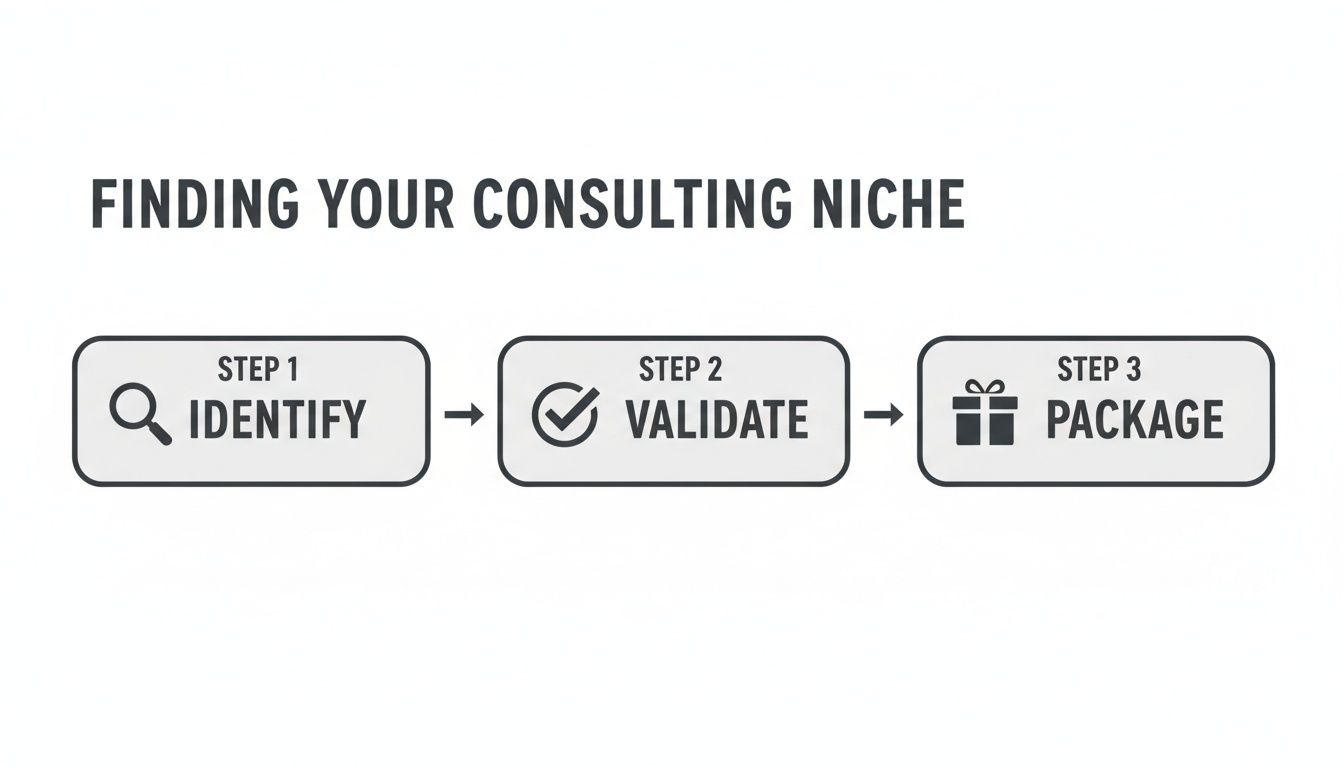
This simple loop—identifying a real pain point, validating that people will pay to solve it, and packaging a clear solution—makes client acquisition almost easy.
Strategic LinkedIn Outreach
Forget what you know about LinkedIn being an online resume. It’s a client acquisition machine if you use it correctly. The key is to stop broadcasting and start connecting.
First things first: optimize your profile. It needs to speak directly to your ideal client. Your headline and "About" section should act like a landing page, instantly telling a visitor who you help and what problem you solve for them.
Once your profile is dialed in, the real work begins. Don't just send generic connection requests. Use LinkedIn Sales Navigator to build hyper-targeted lists of decision-makers in your niche. You can filter by industry, company size, specific job titles, and even recent company activity.
To execute, a tool like PhantomBuster can handle the tedious parts, like sending personalized connection requests at a controlled pace. This frees you up to focus on the conversations that matter—turning new connections into qualified leads. For a deeper playbook on these exact methods, check out our full guide on how to get consulting clients.
Targeted Cold Email Campaigns
While LinkedIn is fantastic for building relationships, cold email is built for direct action. When done right, it's one of the fastest ways to get your offer in front of the exact people who can buy it.
The success of any cold email campaign comes down to three things: a high-quality list, a compelling message, and relentless follow-up.
First, you need accurate contact info. This is where a B2B database like Apollo is indispensable. It lets you find verified email addresses and direct dials for your target prospects, ensuring your message actually lands in the right inbox.
Next, your message has to be short, personalized, and focused entirely on the client's problem—not your life story. A great cold email feels like the start of a helpful conversation, not a sales pitch.
Finally, you need to manage your campaigns with a dedicated tool. A platform like Lemlist automates the follow-up sequences, which is where most of your replies will come from. It also lets you test different subject lines and copy to see what actually resonates with your audience.
The Role of Automation and AI
As you start to scale your outreach, doing everything by hand becomes a massive bottleneck. This is where modern tools give you an almost unfair advantage. AI-powered platforms are changing the game by automating personalization at a scale that was impossible just a few years ago.
For instance, an AI Sales Development Representative (SDR) tool like AiSDR can analyze a prospect's LinkedIn profile and company website to generate a hyper-personalized opening line for your cold email. This saves you hours of manual research and can dramatically increase your reply rates.
The goal of automation isn't to remove the human element; it's to focus it. By automating the repetitive tasks, you free up your time for the high-value work: strategy calls, building relationships, and closing deals.
The consulting game in 2025 is all about agility. Specialized niches that use technology and data are growing at double-digit rates, far outpacing the market's steady single-digit growth. This trend heavily favors nimble solo consultants who can integrate smart tools into their client acquisition and delivery workflows.
Lead Generation Channel Comparison
Choosing the right channel depends on your niche, your offer, and your personal style. Here's a quick breakdown to help you decide where to focus your energy first.
| Channel | Pros | Cons | Best For |
|---|---|---|---|
| LinkedIn Outreach | Highly targeted; builds social proof; great for relationship-building. | Slower sales cycle; requires consistent profile activity; connection limits. | Consultants selling high-trust, complex services to specific job titles. |
| Cold Email | Scalable; direct and fast; easy to track and optimize. | Low reply rates if done poorly; can be perceived as spam; requires a clean list. | Reaching a large, well-defined audience with a clear, high-value offer. |
| Referrals/Network | Highest trust and close rates; shortest sales cycle. | Not scalable or predictable; relies on others to act. | New consultants needing initial traction and "warm" introductions. |
Ultimately, a healthy consulting business uses a mix of all three. But when you're just starting, pick one, master it, and then add the next.
Leveraging Your Professional Network
Don't ever overlook the power of your existing network. This is your warmest source of leads, period. The people you've worked with in the past already know you, like you, and trust your work, making them your most powerful advocates.
Reach out to former colleagues, managers, and clients. Tell them what you're doing now and exactly who you're looking to help.
Being specific is key. Instead of a generic, "send anyone my way," try this: "I'm now helping B2B SaaS companies cut their customer churn. Do you know any VPs of Customer Success who might be struggling with this?" This makes it incredibly easy for them to connect you with the right person.
A simple, well-timed email or LinkedIn message can reactivate these relationships and put your new consulting business on the radar of dozens of potential clients. This channel almost always has the shortest sales cycle and the highest close rate. Start here.
Assembling Your Consulting Tech Stack and Operations
As a solo consultant, your time is everything. A smart tech stack isn't just a list of software; it's a system built to automate the grunt work, make you look like a pro, and give you back hours every week. Get this right from the start, and you’ll spend your days on high-value client work, not buried in admin.
The goal isn't to collect a dozen subscriptions. It's to pick a few powerful tools that play well together and cover the basics: your website, project management, money, and client communication.
Building Your Digital Storefront
Your website is your digital handshake. It’s where potential clients go to see if you're legit. You don't need a massive, custom-coded site to get started. You just need something professional, fast, and easy to update.
Two of the best options for this are Webflow and Leadpages.
- Webflow gives you incredible design freedom without forcing you to write code. It’s perfect if you want a polished, custom-branded site that can grow with your business.
- Leadpages is all about speed and getting leads. If your main goal is to launch landing pages that convert visitors for a specific service or lead magnet, it’s a killer choice.
In the early days, your site only needs to do three things: explain who you help, what problem you solve, and how someone can hire you. Anything else is just noise.
Creating a Central Hub for Client Projects
Once you land a client, the experience you deliver is what turns a one-off project into a long-term partnership that sends you referrals. This is where a dedicated client portal changes the game. It’s a single place to manage all communication, share files, and track progress.
Notion is ridiculously powerful for this. You can spin up a simple, customized portal for each client, keeping everything from the proposal to the final reports in one spot.
A shared space like this cuts down on endless email chains and makes sure you and your client are always looking at the same information.
For your own internal to-do list, a separate app like Todoist is a lifesaver. It lets you manage your personal workload across multiple clients without letting anything slip through the cracks, keeping the client-facing portal clean and focused.
Managing Your Finances and Operations
Getting your money and legal stuff sorted out from day one will save you from massive headaches down the road. You need simple, bulletproof systems for your accounting, invoicing, payments, and contracts.
Here are the essentials for a solid operational foundation:
- Accounting: A tool like Xero makes bookkeeping, expense tracking, and invoicing dead simple. It hooks up to your business bank account and gives you a clear view of your financial health at all times.
- International Payments: If you work with clients around the world, something like Deel is a must. It lets you get paid in different currencies without getting hammered by the fees traditional banks charge.
- Contracts: Never, ever start work without a signed agreement. A service like SignNow lets you send, sign, and store legally binding contracts online, making your onboarding process smooth and professional.
- Email Marketing: To keep your leads warm and stay in touch with your network, a basic email marketing tool is non-negotiable. Brevo has a great free plan that’s perfect for sending out a newsletter or occasional updates.
Your tech stack should be a force multiplier, not a source of complexity. Start with the essentials, master them, and only add new tools when you identify a clear, unavoidable gap in your workflow.
While these tools handle the back-office work, you still need a system for your sales pipeline. For a deep dive, our guide on the best CRM for solopreneurs will help you pick the right tool to manage leads from first contact to a closed deal. This combination of operational and sales tools creates a seamless workflow that will save you countless hours.
Onboarding Clients and Delivering World-Class Results

You did it. After all the outreach, the follow-ups, and the sales calls, you finally heard the magic word: "yes." It's a huge win, but now the real work starts. Your reputation isn’t built on your sales pitch; it's forged in the results you deliver and the experience you provide.
A slick, professional onboarding process is your first chance to prove they made the right call. It immediately replaces any lingering buyer's remorse with confidence, showing them exactly what kind of organized, high-value partner they just hired. This is where you set the tone for the entire engagement.
The Post-Sale Checklist
The moment you get a verbal agreement, the clock starts ticking. The gap between "yes" and the official project kickoff is a dead zone where momentum can die. You need to move with purpose.
Here's the simple, repeatable checklist I run the second a client commits:
- Send the Agreement: First things first, get it in writing. I send the consulting agreement over for an e-signature immediately. A tool like SignNow gets this done in minutes, not days. It's clean, professional, and legally sound.
- Issue the First Invoice: Right after the contract is signed, the invoice for the first payment goes out. This keeps the money side of things tidy from day one.
- Set Up the Shared Workspace: This is non-negotiable. I create a dedicated client portal in Notion to act as the central hub for our entire project—all files, updates, and communication live here. It keeps everything organized and transparent.
- Schedule the Kickoff Call: As soon as that first invoice is paid, I send a calendar invite for our official kickoff meeting. The invite always includes a clear agenda, so they know exactly what we’ll cover.
Running this sequence every single time ensures all the admin is handled cleanly before we ever talk strategy.
Mastering the Kickoff Call
The kickoff call is more than just a formality; it's the strategic launch of the project. This is your chance to align on expectations, lock in the definition of success, and establish the communication rhythm we'll follow.
My kickoff call agenda always hits these key points:
- Reconfirm the Goal: Start by restating the primary business objective they hired you to achieve. "Just to confirm, our main goal here is to..." This gets everyone laser-focused from the jump.
- Define Success: I ask this question every time: "What does a home run look like for this project?" Get specific about the KPIs. Is it leads? Revenue? A specific efficiency metric? Nail it down.
- Map Out the First 30 Days: Walk them through the immediate next steps and deliverables. This shows you have a concrete plan and aren't just winging it.
- Set the Rules of Engagement: How will we communicate? I usually direct clients to use our shared Notion portal for updates and asynchronous questions. Agree on this upfront.
A well-run kickoff call eliminates future headaches and scope creep. It instantly repositions you from a vendor to a strategic partner who is confidently leading the charge.
The Art of the Deliverable
How you present your work is just as important as the work itself. A brilliant strategy is completely useless if it’s buried in a dense, 50-page PDF that no one will read. Your deliverables have to be designed for impact.
Package your findings to be clear, scannable, and actionable. Use sharp headings, visuals, and always include an executive summary that highlights the most critical insights and recommended next steps. Think of every deliverable as another opportunity to prove your value.
To keep the momentum going, get into a rhythm of regular updates. A simple weekly progress report can be a game-changer. It doesn't have to be long; a short email or a quick update in your shared portal is perfect.
Just cover these three things:
- What we got done last week.
- What we're focused on this week.
- Any roadblocks or questions I have for you.
This simple habit builds incredible trust, prevents nasty surprises, and constantly reinforces the value you're providing. It’s how you turn happy clients into your most powerful referral engine.
Finalizing Your Legal and Financial Foundation
Alright, you've nailed down your offer and have a plan to get clients. Now for the part that isn't nearly as exciting but is absolutely critical: building the legal and financial scaffolding for your business.
Getting this right from day one saves you from massive headaches down the road. It’s what lets you operate with confidence, knowing you're protected and professional. Think of it as pouring the concrete foundation before you build the house.
Choosing Your Business Structure
First up, you need to decide how your business will exist in the eyes of the law. For most solo consultants, it boils down to two main options: Sole Proprietorship or a Limited Liability Company (LLC).
A Sole Proprietorship is the simplest path. You and your business are legally the same entity, which means less paperwork. The major downside? If something goes wrong—say, a client sues you—your personal assets are on the line. Your car, your house, your savings... it's all fair game.
An LLC, on the other hand, creates a separate legal entity. This builds a firewall between your business and personal life. If the business gets into trouble, your personal assets are shielded. It takes a bit more paperwork and a small filing fee, but the peace of mind is worth its weight in gold. For a solid overview of what this process involves, check out this guide on how to incorporate a business in Canada.
Creating a separate business entity is a critical step in risk management. It draws a clear line between your personal finances and your business operations, which is essential for long-term security.
Setting Up Your Financial Systems
Once your legal structure is set, it's time to get your money organized. Mixing business and personal funds in the same account is a classic rookie mistake and an absolute nightmare come tax season. Don't do it.
Here’s a dead-simple financial stack to get you up and running:
- Open a Business Bank Account: This is non-negotiable. All client payments go in, all business expenses come out. Clean and simple.
- Get Accounting Software: A tool like Xero is a lifesaver. Hook it up to your business bank account, and it automates most of your bookkeeping. It makes invoicing, tracking expenses, and tax prep almost painless.
- Establish a Standard Contract: Never, ever start work without a signed contract. A service like SignNow lets you create a reusable consulting agreement template. You can customize it for each new client and get it signed electronically. Your contract should clearly state the scope of work, payment terms, and timelines.
This straightforward setup makes you look professional, keeps you organized, and ensures you're ready for tax time from your very first client. With these legal and financial pillars in place, you’re officially open for business.
Common Questions About Starting a Consulting Business
Let's tackle some of the most common questions that come up when you're first thinking about going solo. These are the practical, real-world concerns that every new consultant faces.
How Much Money Do I Actually Need to Start a Consulting Business?
You can get a consulting business off the ground for surprisingly little, often under $1,000. The beauty of this model is that you're selling your brain, not a physical product, so the initial overhead is tiny.
Your main costs will be setting up the basics: business registration, a professional-looking website, and a few key pieces of software. You don't need a fancy office. You can get a slick, credible site with a platform like Webflow, manage your first outreach campaigns with a tool like Lemlist, and keep your books clean with affordable software like Xero.
How Should I Price My Consulting Services?
Stop thinking about hourly billing right now. The single most important shift you can make is to adopt value-based pricing. Figure out the tangible, dollars-and-cents outcome your service creates for a business, and then price your work as a fraction of that value.
A few common ways to structure this are project-based fees for a specific scope of work, monthly retainers for ongoing access and support, or even performance-based fees tied to hitting certain metrics. This approach immediately frames your fee around the results you deliver, not the hours you clock.
When you price on value, the conversation completely changes. It’s no longer "What's your hourly rate?" but "What business result can you help me achieve?" This instantly positions you as a strategic partner, not just a pair of hired hands.
Do I Need a Formal Business Plan to Start Consulting?
No, you do not need a 50-page, MBA-style business plan that will gather dust on a shelf. What you do need is a clear, simple strategy.
At a bare minimum, you need to write down your target client profile, exactly what service you're offering, your pricing model, and how you plan to find your first few clients.
A simple one-page strategy doc in a tool like Notion is a hundred times more effective than a rigid, formal plan because you'll actually use it and adapt it. The goal here is clarity and action, not a perfect document.