How to Price Consulting Services to Maximize Profit


Figuring out what to charge as a consultant isn’t about pulling a number out of thin air. There's a simple way to get started: add up all your annual business and personal costs, tack on a profit margin (I usually recommend 20-30%), and divide that by how many hours you can actually bill in a year.
This gives you a baseline hourly rate—the absolute minimum you need to make to stay profitable. But remember, this is your financial floor, not your value ceiling.
Laying the Groundwork for Your Pricing Strategy
Before you can throw a number at a client with any real confidence, you need a solid foundation. This isn't just about what you need to survive; it's about understanding your real worth.
Too many consultants, especially when they're new to the game, just guess a number that "feels right" or, even worse, copy what a competitor is charging. This is a fast track to underpricing your services, burning out, and building a business that can't sustain itself.
The goal here is to shift your mindset. You're not just trading your time for money. You're pricing your services based on the tangible, valuable outcomes you create for your clients. This initial work is what anchors your entire pricing strategy and stops you from taking on projects that actually end up costing you money.
Calculate Your Minimum Viable Rate
First things first, you need to know your "break-even" number. This is your minimum viable rate—the absolute lowest you can charge to cover all your expenses and pay yourself a decent salary. Think of it as your financial safety net.
Here’s a no-fluff way to calculate it:
- Tally Up Your Annual Business Costs: Add up everything you spend to keep the lights on for a year. This means software subscriptions (like Todoist for project management), marketing expenses, insurance, professional development—all of it.
- Decide on Your Desired Annual Salary: What do you realistically need to earn, pre-tax, for the year? Be honest with yourself.
- Don't Forget Taxes: A good rule of thumb is to set aside 25-30% of your total business costs and salary for taxes. Don't let this sneak up on you.
- Add a Profit Margin: A healthy business needs profit to grow and reinvest. Aim for at least 20% to start.
- Estimate Your Billable Hours: Be realistic about how many hours you can actually bill to clients. A solid starting point is assuming 25 billable hours a week for 48 weeks a year, which comes out to 1,200 billable hours.
The math is straightforward from there: (Business Costs + Salary + Taxes + Profit) / Annual Billable Hours = Your Minimum Hourly Rate.
Before you set any rates, it's smart to map out the core components of your strategy. This table breaks down the essentials.
Core Pricing Strategy Components
| Component | Key Question to Answer | Why It Matters |
|---|---|---|
| Minimum Rate | What is the absolute lowest I can charge to be profitable? | This is your financial safety net. Without it, you risk losing money on projects. |
| Value Proposition | What tangible outcome do I deliver for my clients? | This shifts the conversation from your time to their results, justifying premium pricing. |
| Market Positioning | Where do I fit in the market compared to my competitors? | Understanding the landscape helps you position yourself as a specialist, not a commodity. |
With these three pillars in place, you're not just guessing anymore. You're building a pricing model that's sustainable, defensible, and rooted in the real value you provide.
Define Your Unique Value Proposition
Okay, you've got your financial baseline. Now it's time to stop thinking about your costs and start focusing on your client's results. Your value proposition is the promise you make—the tangible outcome you deliver. It’s the clear, compelling answer to their question: "Why should I hire you?"
Your price is a reflection of the problem you solve, not the time it takes you to solve it. A client with a $1 million problem will gladly pay $100,000 for a solution, regardless of whether it takes you 10 hours or 100 hours to implement.
To really nail this down, ask yourself what you actually do for your clients:
- Do I help them increase revenue? (e.g., by optimizing their sales funnel)
- Do I help them save money? (e.g., by streamlining clunky operational workflows)
- Do I help them save time? (e.g., by automating repetitive marketing tasks)
The more you can articulate and quantify this value with hard data, case studies, and testimonials, the easier it is to justify a premium price. This is a non-negotiable step before you even think about trying to figure out how to get consulting clients who will happily pay for your expertise.
Research Your Market and Position
Finally, you need to understand the world you're operating in. The global consulting services market is booming and projected to hit $469.28 billion by 2030. That tells you there’s strong, sustained demand for expert advice. You can find more market insights here.
This isn't about being a jack-of-all-trades. Use this market context to position yourself as a specialist who can command a higher fee. Check out what other consultants in your specific niche with a similar background are charging. You're not doing this to copy them, but to understand the expected price range.
From there, you can confidently position your rates at the higher end of that spectrum, backed by a powerful value proposition and a crystal-clear understanding of the financial results you drive for your clients.
Choosing the Right Consulting Pricing Model
Alright, you’ve nailed down your minimum rate and you know the value you bring to the table. Now comes the fun part: picking a pricing model that actually sells that value. How you frame your fees is just as critical as the number itself. It sets the tone for the entire client relationship, manages expectations, and ultimately dictates how profitable—and scalable—your business can be.
Think of your pricing model as a strategic choice. It has to match the kind of work you do, your experience level, and the clients you're trying to land. Let's walk through the most common models, digging into where they really work and where they tend to fall flat.
This decision tree gives you a bird's-eye view of the process, from calculating your bare-minimum costs to defining the tangible value you deliver.
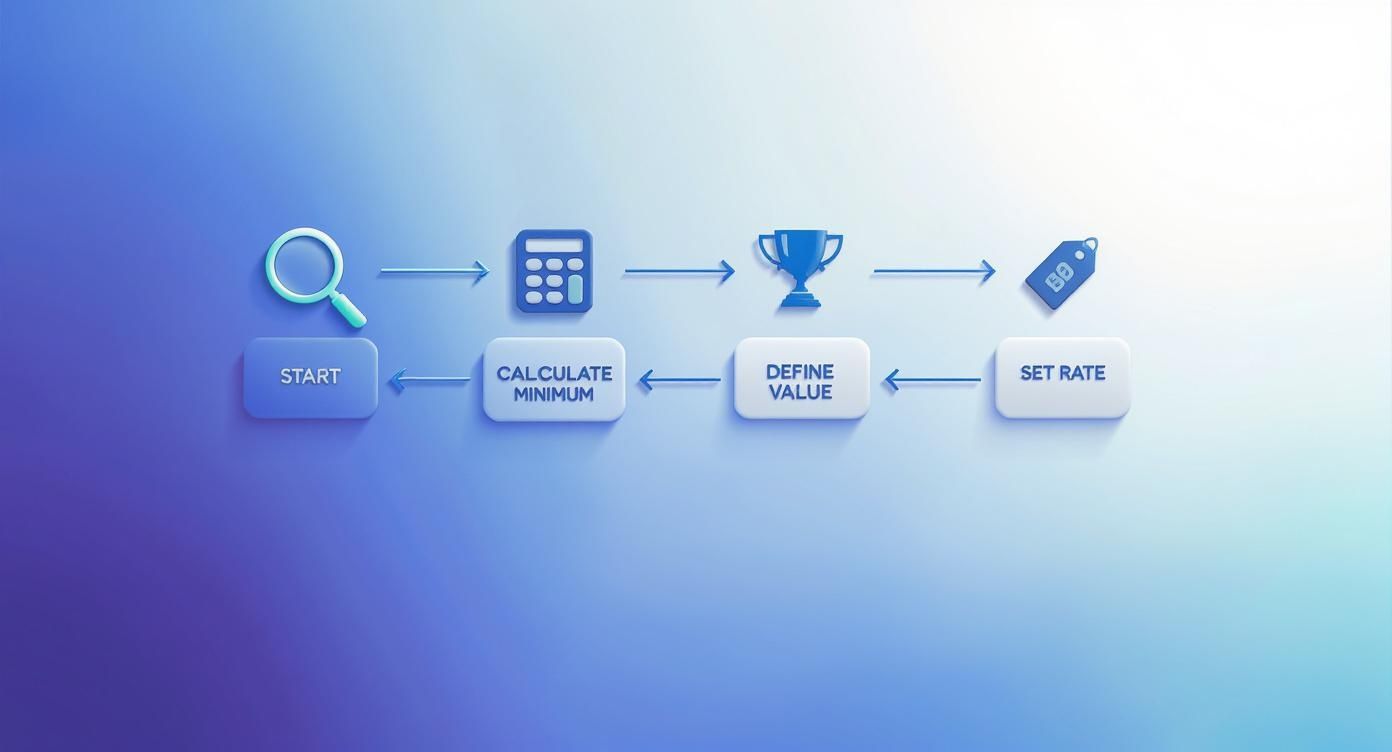
The key takeaway here? A solid, defensible rate is built on two things: knowing your numbers and proving your results.
To help you decide, here’s a quick side-by-side look at the most common models.
Consulting Pricing Model Comparison
| Pricing Model | Best For | Pros | Cons |
|---|---|---|---|
| Hourly Rate | New consultants, projects with unclear scope, short-term tasks. | Simple to calculate and explain. Feels low-risk for clients. | Caps your income. Punishes efficiency. Focuses on time, not results. |
| Project-Based | Clearly defined projects with specific deliverables (e.g., website builds). | Predictable costs for clients. Rewards efficiency. Focuses on the outcome. | High risk of scope creep. Requires accurate time/effort estimation. |
| Retainer | Ongoing, long-term work like SEO, content management, or advisory roles. | Predictable, recurring revenue. Fosters long-term client relationships. | Can still feel like trading time for money if not structured properly. |
| Value-Based | High-impact projects where you can directly influence a client's revenue or savings. | Highest earning potential. Completely decouples your income from your time. | Requires a strong sales process to prove ROI. Can be harder for some clients to grasp. |
Each model serves a purpose, but as you gain experience, you'll naturally want to move away from trading time for money. Let's break down each one in more detail.
The Classic Hourly Rate Model
Charging by the hour is where most of us start. It feels safe, it’s simple, and clients get it immediately. You work, you track time, you send a bill. Easy.
But there's a big catch. This model puts a hard ceiling on your income because there are only so many hours in a day. Even worse, it actually penalizes you for getting better at your job. The faster you solve a problem, the less you get paid. It's a completely backward incentive.
Hourly rates really only make sense for:
- Projects where the scope is a total mystery and likely to change.
- Quick, one-off advisory tasks where a client just needs "a couple hours" of your brain.
- When you're brand new and just need a simple way to start charging.
My Advice: If you have to bill hourly, always sell your time in pre-paid blocks or set a minimum engagement. This keeps you from getting pulled into tiny, disruptive tasks that aren't worth the invoice.
The Project-Based Fee Model
With project-based pricing, you charge a single flat fee for a project with a crystal-clear scope and deliverables. This is a huge step up because it shifts the conversation from your time to the outcome. Clients love the cost certainty, and you get rewarded for working efficiently.
The monster hiding in the closet here is scope creep. If you aren't ruthlessly precise about the project's boundaries, you'll end up doing weeks of extra work for free. Your proposal needs to spell out exactly what's included and—just as crucial—what is not included.
To make project fees work, you have to get really good at estimating the time and effort involved. It takes practice, but after a few projects, you'll develop a gut feeling for pricing them profitably.
The Retainer Model for Predictable Income
A retainer is a fee a client pays you upfront to secure your services for a specific period, usually monthly. For consultants craving stable, predictable revenue, this is the holy grail. Retainers are a perfect fit for ongoing work like SEO, content strategy, or any advisory service where the client needs continuous access to your expertise.
Retainers generally come in two flavors:
- Pay for Access: The client pays to have you "on call" for a certain number of hours or for general guidance each month. This provides that steady income but can still feel like you're just selling hours if you're not careful.
- Pay for Work: This is a fixed fee for a pre-defined set of deliverables every month—say, four blog posts and a newsletter. It’s often much more profitable because it’s tied directly to results.
If you want to dig deeper, check out our guide on pay-per-lead vs. retainer models for lead generation agencies to see how you can lock in more stable MRR.
The Value-Based Pricing Gold Standard
Value-based pricing is the most advanced—and by far the most profitable—model out there. Your fee is tied directly to the economic value your work generates for the client. The conversation isn't about your hours or deliverables; it's about their return on investment (ROI).
For example, if you can confidently show that your strategy will generate an extra $500,000 in revenue for a client, a $50,000 fee suddenly looks like an absolute bargain. This model totally separates your income from your time, letting you charge based purely on the results you can deliver.
The entire consulting industry is heading this way. A 2023 study found that while 30% of consultants now use project-based pricing, that number jumps for higher-value work. For projects between $20,000 and $50,000, a massive 55% of consultants use value-based pricing. What’s more, 79% of all consultants surveyed are actively trying to raise their fees, which tells you everything you need to know about the shift away from commoditized hourly work.
How to Price Yourself with Real-World Data
Figuring out your minimum rate is a great starting point, but it's an internal number. To price your services in a way that actually lands clients, you have to look outward. Grounding your rates in real-world data isn't about copying what everyone else is doing; it's about understanding the market so you can confidently position yourself as a premium choice.
When you see what the market is already paying for different levels of expertise, you get the confidence to charge what you're worth. It gives you a reference point—a sanity check—that helps you anchor your prices in a context clients already get. Think of it less as a rigid rulebook and more as a map of the landscape.
What’s the Going Rate for Your Experience Level?
Let's be real: your experience is the biggest lever you can pull on your pricing. A consultant just stepping out of a corporate job simply can't command the same fees as a 20-year veteran who has a track record of delivering multi-million dollar results. The market just has different expectations for different tiers of expertise.
Consulting rates can swing wildly depending on your skills and history. For instance, a solid mid-level expert might bill anywhere from $100–$300 per hour. A senior specialist with deep, niche knowledge? They're often in the $300–$500 per hour range. And those seasoned, C-level advisors are comfortably charging $500–$1,000 per hour (or more) for high-level strategy. I break down more of this in my guide to consulting rate statistics.
Knowing these tiers helps you find your place. If you've got five years of specialized experience and a portfolio of wins, planting your flag in that mid-level range is a perfectly reasonable place to start.
Don't Forget to Factor in Geography
Where you and your clients live plays a surprisingly big role in what you can charge. Consultants in major hubs like North America and Western Europe tend to command the highest fees, partly because of the higher cost of living and doing business, but also because that's where clients with bigger budgets are concentrated.
A marketing consultant in New York or London, for example, could easily charge 30-50% more than someone with the exact same skill set based in a lower-cost area. The boom in remote work has blurred these lines a bit, but regional pricing expectations are still very much a thing.
Pro Tip: If you're living in a lower-cost area but serving clients in expensive cities, you've hit a sweet spot. Price your services based on the market you serve, not the one you live in. It’s a simple way to seriously boost your profitability.
Take a Look at How Different Firms Price Their Services
It’s also smart to see what different types of consulting firms are charging. This isn't about trying to be McKinsey; it's about understanding what clients are willing to pay for expertise when it's packaged in different ways. Their pricing models are a masterclass in perceived value.
- Global Strategy Firms: These are the big names—McKinsey, Bain, BCG. They're working with massive enterprise clients on huge, complex problems. Their project fees are astronomical, often in the high six or seven figures. They're the absolute top of the market.
- Big Four Advisory Firms: Think Deloitte, PwC, and the like. They offer a huge menu of services and their rates are definitely premium, but usually a notch below the top-tier strategy firms.
- Boutique Agencies: These are the small, specialized shops that are masters of one specific thing, like e-commerce CRO or B2B SaaS marketing. Because they are the go-to experts in their niche, their rates are often right up there with the Big Four firms.
- Independent Consultants: This is most likely you. As a solo consultant, you can compete directly with boutique agencies by offering deep, personalized expertise without all the overhead.
When you see how much clients are willing to pay for specialization from a boutique firm, it should give you the confidence to position your own niche services at a premium. The goal isn't to be a generalist who can do a bit of everything. It's to be the boutique expert who is the best at one specific thing. That's how you justify a higher price tag.
Packaging Services and Crafting Winning Proposals
Having a solid rate is only half the battle. How you present that rate can make all the difference between landing a dream client and getting ghosted. This is where you shift from just calculating a number to packaging your value into an offer they can’t refuse.
Great packaging turns your pricing into a sales tool. It helps clients see exactly what they're getting, why it’s worth the investment, and which option is the best fit for them. It’s all about making it incredibly easy for them to say "yes."
Use Tiered Packaging to Guide Client Decisions
One of the most effective ways to present your services is through tiered packaging, often called a "Good, Better, Best" model. This approach is powerful because it frames your preferred option (usually the middle one) as the most logical choice.
Instead of hitting them with a single take-it-or-leave-it price, you give the client a sense of control. This simple psychological shift can seriously increase your average deal size.
Here’s a simple way to structure it:
- Tier 1 (The Starter): This is your entry-level package. It should solve a core piece of the client's problem but leave obvious room for an upgrade. Think of it as the perfect fit for clients with smaller budgets or simpler needs.
- Tier 2 (The Standard): This is your sweet spot—the ideal engagement you want most clients to pick. It should offer the most value and tackle their problem comprehensively. Price it attractively to make it the no-brainer choice.
- Tier 3 (The Premium): This is your all-inclusive, high-touch option. It includes everything from the other tiers plus extras like more one-on-one time, faster turnarounds, or additional strategic support. While fewer clients will choose it, its high price tag makes the middle tier look like an even better deal.
For each package, be ruthlessly clear about the deliverables, outcomes, and price. Ambiguity is a deal-killer. A client should be able to look at your options and know exactly what they get at each level.
Building a Proposal That Sells Your Solution
Your proposal is so much more than a price quote; it's your final sales pitch. A weak proposal can undo all the great work you did on your discovery calls. Its real job is to connect the client’s pain directly to your solution and make the price feel like a smart investment.
A winning proposal doesn't just list services—it tells a story. It starts by showing you deeply understand their problem, then clearly outlines how your process will lead to their desired outcome. Only then do you present the investment required to get there.
When clients issue formal requests for proposals, mastering how to package your services is key. This guide on responding to an RFP offers some fantastic insights for these more formal situations.
A great proposal makes the client feel understood. It should read less like a menu and more like a strategic plan tailored specifically to them. This is how you justify a premium fee.
To make sure your proposal hits all the right notes, use this checklist as your guide.
Essential Elements of a Winning Proposal
Your proposal needs to be a professional document that screams confidence. Here are the non-negotiable parts it must include:
- Executive Summary: Start with a tight, concise overview. Reiterate the client's main challenge and state the business outcome your work will achieve. This is often the only part a busy executive will read, so make it count.
- Problem Statement: Show you were listening. Detail the specific problems, challenges, and missed opportunities you uncovered during your conversations. Dropping in their own words here is a power move.
- Proposed Solution & Scope of Work: This is the heart of your proposal. Detail your step-by-step plan. List the exact deliverables, activities, and milestones. Be explicit about what is included and, just as importantly, what is not included to shut down scope creep before it starts.
- Timeline: Give them a realistic timeline for key phases and final delivery. This manages expectations and shows you have a clear plan of action.
- Investment: Present your tiered packages here. Clearly state the price for each option and what it includes. Pro tip: use the word "investment" instead of "cost" or "price."
- Next Steps & Call to Action: Don't leave them guessing. Tell them exactly what to do next. "To get started, simply sign this proposal and process the initial invoice by [Date]."
Once you get the green light, make the final steps seamless. You can use a service like Sign now for secure e-signatures and accounting software to send professional invoices. If you want to dig deeper, you can explore our resources on https://www.unkoa.com/tag/how-to-write-consulting-proposal/ to make sure every proposal converts.
Navigating Price Negotiations Like a Pro
Pricing discussions can feel like a high-stakes poker game, but they really don't have to be. The best consultants I know have mastered the art of reframing these conversations. It stops being a debate over cost and becomes a collaborative session about value.
With the right mindset and a few simple tactics, you can walk into any negotiation with confidence and land deals that actually reflect your worth. This isn’t about being pushy or confrontational; it’s just about being prepared. Half the battle is anticipating the usual objections and having your value-driven responses ready to go. When you anchor the entire conversation in the client's potential ROI, the price becomes a logical investment, not just another line item on their spreadsheet.

Handling the "You're Too Expensive" Pushback
Let's be real: it's the most common objection you'll ever hear. But it’s almost never the end of the conversation. When a client says your price is too high, they're often just testing the waters or, more likely, they haven't fully connected the dots on the value you're bringing.
Whatever you do, don't panic or immediately offer a discount.
Instead, your job is to shift the focus right back to their problem. You want to reframe the entire discussion around the cost of inaction.
- Ask clarifying questions. A simple "Compared to what?" or "Could you help me understand what you were budgeting for this project?" opens a dialogue instead of shutting one down.
- Reinforce the ROI. Gently bring them back to the financial outcome. I've said things like, "I understand it's a significant investment. Based on our discussion, this project is projected to generate an additional $200,000 in revenue. When we look at it that way, the $20,000 fee delivers a 10x return."
- Highlight the alternative. What happens if they do nothing? Put a number on that pain. "What is the monthly cost to the business of letting this operational bottleneck continue?"
This approach instantly turns a price objection into a value conversation, which is exactly where you want to be.
Offering Flexibility Without Devaluing Your Service
Sometimes, a client genuinely has budget constraints, but you know they'd be a fantastic partner. In these cases, you can show flexibility without slashing your rates, which is crucial for protecting the perceived value of your work.
The golden rule is to trade scope for price.
Never discount your price without reducing the scope of work. A simple price cut teaches clients that your rates are arbitrary. Trading scope for price reinforces that your value is fixed and non-negotiable.
If a client needs to hit a lower price point, offer them a revised proposal with fewer deliverables. You could suggest:
- Removing a "nice-to-have" feature from the project.
- Reducing the number of feedback rounds or one-on-one strategy sessions.
- Extending the project timeline, which can allow for more efficient resource allocation on your end.
Another great option is to adjust the payment terms. Offering a 3-month payment plan instead of a single upfront invoice can make a big investment feel much more manageable for a client's cash flow. Often, you don't even need to change the total price at all.
Red Flags to Watch for During Negotiations
Part of knowing how to price consulting services effectively is knowing which clients to walk away from. Some prospects aren't negotiating in good faith; they're just hunting for the cheapest option. Spotting these red flags early will save you from a world of headaches down the road.
Be cautious of a potential client who:
- Focuses exclusively on price from the very first conversation. If they won't even discuss their business challenges or desired outcomes, they don't see you as a strategic partner. They see you as a commodity.
- Constantly compares you to cheaper, less experienced alternatives. This is a huge sign that they don't understand or appreciate the specific expertise you bring to the table.
- Asks for a big discount in exchange for "future work" or "exposure." Vague promises don't pay the bills. Any discounts should be tied to immediate, tangible value for you.
- Haggles over every tiny detail in your proposal. This is often a preview of what they'll be like to work with—micromanaging, difficult, and draining.
To really sharpen your skills here, I'd recommend digging into these powerful contract negotiation strategies to refine your approach. Learning to identify and politely decline bad-fit clients is one of the most profitable skills a consultant can develop. It frees up your time and energy to focus on the clients who truly get what you do and are happy to pay for it.
Got Questions About Consulting Pricing?
Even with the best game plan, a few tricky questions always seem to pop up when you're setting your consulting rates. Knowing how to handle these situations gracefully is what separates the pros from the rookies—it’s key to staying profitable while building great client relationships.
Let's tackle the most common ones I hear from other consultants.
How Do I Increase My Rates with Existing Clients?
This one feels awkward, doesn't it? But raising your rates with a long-term client is a non-negotiable part of growing your business. The trick is to frame it as a conversation, not a demand. Don't just fire off an email with a new number attached.
Give them a heads-up, ideally 60-90 days before the change. Hop on a quick call and walk them through it. The conversation should center on the growing value you bring to the table. Maybe you’ve leveled up your skills, streamlined a process, or—best of all—delivered killer, measurable results for them.
Pro Tip: Anchor the increase to the ROI you've already generated. Instead of just announcing a price hike, try something like: "To continue delivering the kind of results that increased your lead flow by 40%, my rates will be adjusting to X." It's a completely different conversation.
If they push back, have a couple of options ready. You could offer a short transitional period at a midway point or tweak the scope of work to match their existing budget. The goal is to reinforce your value while respecting the partnership you've built.
What Are the Biggest Pricing Mistakes New Consultants Make?
New consultants almost always leave money on the table. It’s not because they aren't experts; it's because they fall into a few classic traps. If you can sidestep these, you're already ahead of the game.
- Pricing Based on "Worth": This is the big one. They price based on what they feel they're worth instead of the cold, hard economic value they create for their client's bottom line.
- Defaulting to Hourly: It feels safe, I get it. But billing by the hour immediately caps your earning potential and frames you as a hired hand, not a strategic partner.
- Forgetting All the Other Work: They forget to account for all the time spent on marketing, sales calls, and admin. That leads straight to burnout and profits that are way lower than you expected.
- Lacking Price Confidence: They state their price like an apology and are way too quick to offer a discount the second a prospect hesitates.
Should I Publish My Prices on My Website?
Ah, the classic "it depends." The right answer really hinges on how you sell.
If you offer standardized, productized services with a set scope and clear deliverables, then absolutely—publishing your prices can be a brilliant move. It weeds out the tire-kickers and brings in qualified leads who are ready to go, saving you countless hours on discovery calls.
But if you’re selling complex, custom consulting projects, it's usually better to keep your pricing under wraps. Your fee in these cases should come after a deep discovery process where you can truly understand the client's problem and the potential ROI. Slapping a price on your site could scare off a fantastic client before you even get a chance to show them what you can do.
How Often Should I Re-Evaluate My Consulting Rates?
You need to do a formal review of your rates at least once a year. Think of it as an annual check-up to adjust for inflation, shifts in the market, and your own growing expertise.
But beyond that yearly review, there are a few triggers that should make you re-evaluate immediately. These are signs that your value has jumped.
- You just wrapped a project with exceptional, highly measurable results.
- You earned a new certification that puts you in an elite group.
- You landed a big-name client that instantly boosts your reputation.
- Your calendar is booked solid for months.
That last one is the most telling. If demand for your time consistently outstrips your availability, it’s one of the surest signs that you’re underpriced for the value you deliver.