How to monetize youtube shorts: Boost earnings with a simple guide

So, you want to get paid for your YouTube Shorts? The main gatekeeper for earning ad revenue is the YouTube Partner Program (YPP). Getting in is your first major goal, and thankfully, YouTube has a fast track just for Shorts creators.
The quickest way in? Hit 1,000 subscribers and rack up 10 million valid public Shorts views in the last 90 days.
Your Path to YouTube Shorts Monetization
Getting into the YPP is the official first step to earning directly from the platform. It's YouTube's way of verifying that you're a serious creator who can build and keep an audience.
There are two main roads you can take to qualify for full monetization benefits:
- The Shorts-First Route: This is the one most of you are probably aiming for. You'll need 1,000 subscribers and 10 million valid public Shorts views within a 90-day window. It's tailor-made for creators who are all-in on short-form video.
- The Classic Route: If you create a mix of content, this might be for you. The goal here is 1,000 subscribers and 4,000 public watch hours on your long-form videos over the last 12 months.
You can keep an eye on your progress for both paths right inside the "Earn" tab in your YouTube Studio.
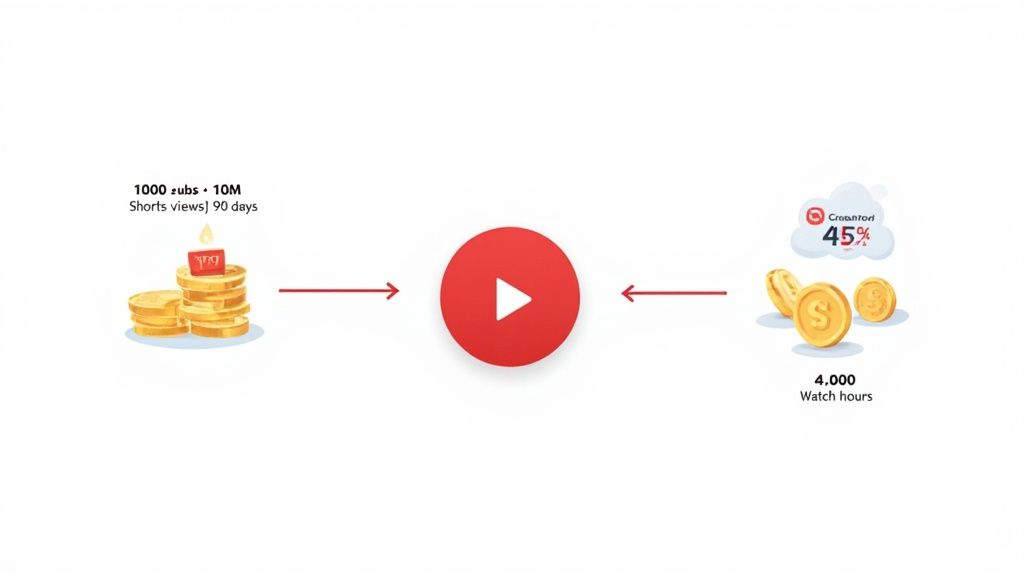
Watching these numbers will tell you exactly which milestone you're closest to hitting.
How The Shorts Revenue Model Actually Works
Shorts monetization is a bit different from your typical long-form video. Instead of ads running directly on your video, YouTube pools all the money from ads that appear in between videos in the Shorts feed.
This giant pot of money is called the "Creator Pool."
First, YouTube takes a cut to cover music licensing costs—a necessary step since so many Shorts use popular tracks. What's left is then divided up among all the monetizing creators. Your slice of the pie is determined by your share of the total Shorts views for that period.
From your allocated portion, you get to keep 45%. It's a unique system where everyone's views contribute to a shared pool before the final payouts are calculated.
And the opportunity is massive. YouTube Shorts has absolutely exploded, now pulling in over 90 billion daily views. That's a staggering number of eyeballs and a huge potential audience for your content.
Key Takeaway: You can't earn ad revenue without getting into the YPP, so make that your top priority. Whether you aim for the 10 million Shorts views or the 4,000 long-form watch hours, getting there opens the door. But don't stop there—explore other income streams, too. A great starting point is learning how to monetize your creativity with YouTube Shorts and finding the right tools for the job.
YouTube Shorts Monetization Methods at a Glance
For a clearer picture, here's a quick summary of the primary ways you can earn money with YouTube Shorts. Each method has its own set of requirements and potential returns.
| Monetization Method | Key Requirements | Earning Potential |
|---|---|---|
| Shorts Ad Revenue | YPP Member: 1k subs & 10M Shorts views (90 days) OR 4k watch hours (12 mos) | Variable; depends on total ad spend, your view share, and geography. Can be significant for high-volume channels. |
| Affiliate Marketing | No official YouTube requirements, but brand-dependent. A small, engaged audience is key. | Commission-based. Can range from a few dollars to thousands per month depending on your niche and audience trust. |
| Brand Deals & Sponsorships | No official YouTube requirements. Brands look for niche authority and engaged communities. | Highly variable. Can start at $100–$500 for smaller channels and scale into the tens of thousands for top creators. |
| YouTube Shopping (Merch) | YPP Member. No merchandise-specific subscriber minimums. | Depends on product appeal and audience loyalty. Profit margins can be 10-30% per item. |
This table should help you see that while the YPP is the foundation, it's really just the beginning of your monetization journey. By combining these methods, you can build a more resilient and profitable creator business.
Making Money with Shorts: Your YPP Game Plan
Getting into the YouTube Partner Program (YPP) is your ticket to the show. It's the official gateway to earning ad revenue from your Shorts. Once you're in, the door opens not just to ad money, but also to fan funding and other cool monetization features YouTube offers.
First things first, you have to qualify. While the old-school path of 4,000 watch hours on long-form content is still there, the Shorts-specific route is a much faster sprint for most. You'll need two things: 1,000 subscribers and a whopping 10 million valid public Shorts views within a 90-day window.
You can keep an eye on your progress right inside YouTube Studio. Just click over to the "Earn" tab, and you'll see your live stats ticking up toward those magic numbers.
How the Money Actually Works: The Creator Pool
Shorts monetization isn't like your typical long-form video. There aren't ads running during your 30-second masterpiece. Instead, YouTube pools all the revenue from ads that pop up between Shorts in the feed. This big pot of money is called the Creator Pool.
Before a single creator sees a dime, YouTube takes a cut to pay for music licensing. This is a huge deal. It means you can use trending audio without getting hit with a copyright strike, and the artists still get paid. It's a win-win.
After the music labels are paid, the rest of the pool is divided among eligible creators. Your piece of the pie is based on your share of the total views. If your Shorts got 1% of all monetized views that month, you get 1% of the funds from the Creator Pool. From that share, you get to keep 45%.
Setting Realistic Earning Goals
Let's talk numbers. Because of this pooled model, the revenue per mille (RPM), or what you earn per thousand views, is naturally lower for Shorts than for long-form videos. Most creators see an RPM somewhere in the $0.01 to $0.07 range.
This means a million views might net you somewhere between $10 and $70. It's a wide range because factors like where your viewers are and how much they engage play a massive role.
As an example, a creator’s RPM can swing wildly based on geography. Views from the United States might hit $0.328 per 1,000, while views from a market like India could be closer to $0.008. You can find more detailed breakdowns of Shorts earnings to get a clearer picture.
Don't let the low RPM discourage you. The name of the game with Shorts is volume. Their viral nature means you can rack up views at a scale that's tough to achieve with longer videos. Many creators use Shorts as a powerful discovery tool, funneling millions of new viewers to their more profitable long-form content.
The most important step? Head to the "Earn" section of your YouTube Studio and accept the "Shorts Monetization Module." If you don't click accept, your views won't count for anything, even if you’re already in the YPP. It’s a simple click that turns your views into potential cash.
Building Income Streams Beyond Ad Revenue
Let's be real: relying only on the Shorts ad revenue pool is a massive mistake. Sure, it's a nice baseline income once you're eligible, but you'll never build real wealth off those fractional pennies per thousand views. The smartest creators know the truth.
Think of your Shorts not as the final product, but as the top of your business funnel. They are the hook, the free sample that gets people interested. From there, your job is to lead them toward much more profitable opportunities. This is how you turn casual viewers into loyal customers and build a real, sustainable business on YouTube.
First, it helps to understand how the ad money even works. This chart breaks down how YouTube splits the pot.
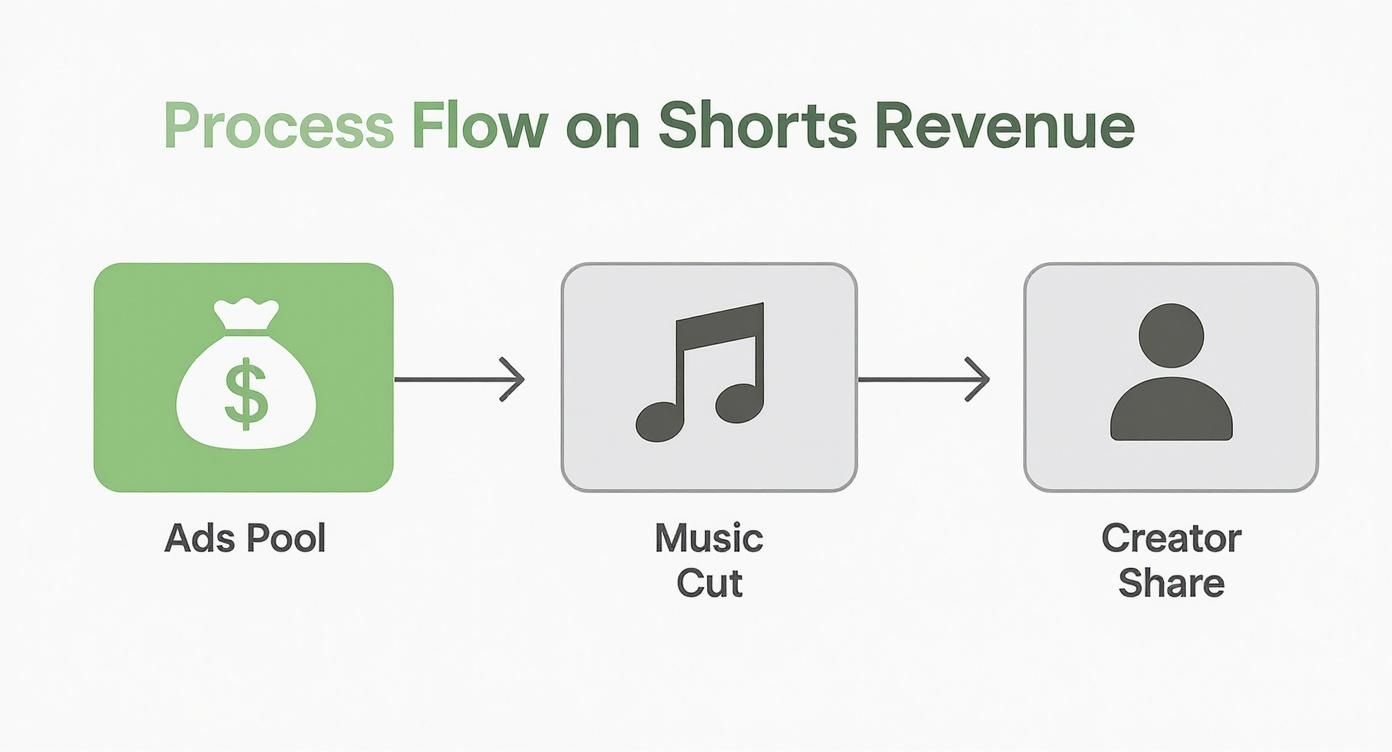
The big takeaway? After YouTube pays for music licenses, the remaining pool is split among all eligible creators based on views. It's a crowded space, which is exactly why you need to build your own income streams where you control the price and the profit.
Master Affiliate Marketing
Affiliate marketing is the fastest way to start earning real money, often long before you even qualify for the YouTube Partner Program. All you need is an audience that trusts you.
The idea is simple: you recommend a product or service you genuinely use, and when someone buys it through your special link, you get a commission. No inventory, no customer service—just authentic recommendations.
Here's where to put your links for maximum impact:
- Pinned Comments: This is your prime real estate. On every relevant Short, pin a comment with a strong call-to-action and your affiliate link. It’s the first thing engaged viewers see.
- Channel Description: Your channel's "About" page is the perfect spot for your evergreen, most important affiliate offers.
- Link-in-Bio Tools: Services like Stan Store are a game-changer. They let you create a single, memorable link that opens up a menu of all your best affiliate links, products, and socials.
Attract High-Value Brand Deals
Once your channel starts picking up steam, brands will come knocking. Sponsorships are a huge step up because companies pay for direct access to your audience, often at a rate that blows ad revenue out of the water for the same number of views.
Get ahead of the game by creating a simple one-page media kit. All it needs are your key channel stats (subs, average views), a little about your audience (demographics), and your contact info. Having this ready to go makes you look like a pro and signals to brands that you’re serious about business.
Sell Your Own Products
This is the end game. Selling your own stuff gives you the highest profit margins and complete control. You officially shift from being a content creator to a business owner, and your Shorts become free, powerful ads for everything you sell.
Here are a few paths you can take:
- Digital Products: E-books, templates, guides, or mini-courses are fantastic because there are no inventory costs and infinite scale. Beyond ads, selling digital products is how many creators build six-figure businesses; finding the best places to sell digital products is a great first step to getting your work in front of the right buyers.
- Physical Merchandise: Think t-shirts, mugs, or hats. Merch is less about profit and more about building a strong, visible community around your brand.
- Services: If you have expertise, sell it. Offer 1-on-1 coaching, consulting, or freelance services related to your niche.
For a full-blown e-commerce setup, platforms like Shopify are the gold standard. But for creators just starting with digital goods, other tools can be much faster. If you want a deep dive on a platform built specifically for creators, check out our Stan Store review on how to sell digital products. This is the strategy that moves you from chasing pennies-per-view to building a lasting brand.
Crafting Shorts That Actually Make You Money
Let’s be real: not all Shorts are created equal, especially when you’re trying to build a business on YouTube. Sure, you can chase viral dance trends and rack up millions of views, but those often attract low-value audiences that advertisers don't care about. If you want to maximize your earnings, you need to stop chasing empty views and start strategically creating content that attracts an audience with problems to solve—and money to spend.
The secret is to play in profitable sandboxes. Niches like personal finance, technology reviews, software tutorials, and business education are gold mines. They naturally pull in viewers who have purchasing power and are actively looking for solutions. When you create content in these spaces, your channel becomes a magnet for high-ticket affiliate offers and premium brand sponsorships.
Grab Them in the First Three Seconds
The Shorts feed is brutal. It's a high-speed, swipe-or-stop environment where you have less than three seconds to convince someone to pause. That opening moment, your hook, is everything. If it doesn't immediately signal value or spark a little curiosity, they're gone.
Here are a few hook formulas I've seen work time and time again:
- The Bold Statement: Kick things off with a surprising or even controversial opinion. Something like, "Stop using your credit card until you know this one secret." It’s an instant pattern interrupt.
- The "You" Question: Speak directly to the viewer with a problem you know they have. "Are you tired of your laptop running slow? Try this."
- The Result Teaser: Don't bury the lede. Show the amazing outcome right at the start. You can flash a clip of the finished product or the final number before you explain how you got there.
Mastering the hook isn't optional if you're serious about making money with Shorts. It's the one skill that determines whether your video gets watched or just becomes another forgotten swipe.
Expert Insight: Remember, Shorts are often your top-of-funnel discovery tool. Their notoriously low RPMs don't tell the whole story. A well-crafted Short is like a movie trailer; its main job is to give viewers a compelling reason to check out your more profitable, long-form videos where the real monetization happens.
Use Shorts as Trailers for Your Main Content
This is easily the most powerful strategy in the playbook: treat your Shorts as promotional clips for your long-form videos. It’s a simple shift in mindset that turns low-value Shorts views into a powerful engine for driving traffic to the content that actually pays the bills.
Here’s how it works in practice. Find a key insight, a powerful moment, or a surprising statistic from one of your longer videos and chop it into a standalone Short. Then, at the very end of the Short, add a clear call-to-action telling viewers to watch the full video for the complete story. This simple tactic is a game-changer. It boosts the watch time on your high-RPM videos and lifts your channel's overall revenue. This is just one of many YouTube SEO optimization tips that can have a massive impact on your earnings.
The Modern Toolkit for Monetizing Shorts
Look, the only way to scale a YouTube Shorts business without burning out is to work smarter, not harder. The biggest creators aren't just making content; they're building efficient systems with the right tech. If you're serious about turning your views into actual income, getting your toolkit sorted out is non-negotiable.
This modern tech stack will help you streamline everything from creating the actual Shorts to getting paid, freeing you up to focus on what really matters: making great content that grows your channel.
Automating Your Content Pipeline
The single biggest bottleneck for any Shorts creator is the relentless need to produce high-quality content. This is exactly where AI repurposing tools have become an absolute game-changer. Instead of trying to brainstorm dozens of unique Shorts ideas, you can create one solid long-form video and let an AI do all the heavy lifting.
Tools like Opus Clips were built for this. You just drop in a link to a longer video, and its AI gets to work. It finds the most engaging parts, automatically reframes them into vertical clips, and even adds those dynamic captions everyone loves. One video can suddenly become ten or more Shorts. We break down the entire workflow in our detailed OpusClip review.
Here’s a peek at the Opus Clips interface. It makes turning one video into a bunch of clips incredibly simple.
What's really useful is that the platform gives each clip a "virality score," helping you figure out which ones have the best shot at taking off so you can publish them first.
Tools for Tracking and Managing Your Business
Once you have a steady flow of content, you need a system to track what's working and keep your workflow organized. Your first stop should be mastering YouTube Studio's built-in analytics, but adding a few specialized tools will give you a serious competitive edge.
A project management tool becomes essential as you start juggling a content calendar and sponsorship outreach. Many top creators run their entire operation out of Notion, using it as a central hub to plan videos, keep track of affiliate links, and manage their brand deal pipeline.
And if you're focused on affiliate income or selling your own digital products, a link-in-bio service is an absolute must-have.
Key Takeaway: A link-in-bio tool is your monetization command center. It turns that single, precious link in your YouTube profile into a menu of your most important offers—from affiliate products to your own courses and digital downloads.
Platforms like Stan Store are designed specifically for creators. They give you a slick storefront to sell digital products and manage all your links in one place. To round out your modern toolkit, if you need professional-sounding voiceovers without dropping cash on expensive mics, an AI voice generator like Murf.ai can produce clean, high-quality audio in minutes.
Crafting Your First Monetized Short
Alright, enough theory. The fastest way to figure this out is to actually do it. This is my exact workflow for creating and publishing a Short with monetization baked in from the jump.
Follow these steps, and you'll turn what feels like a chore into a natural part of your content creation habit.
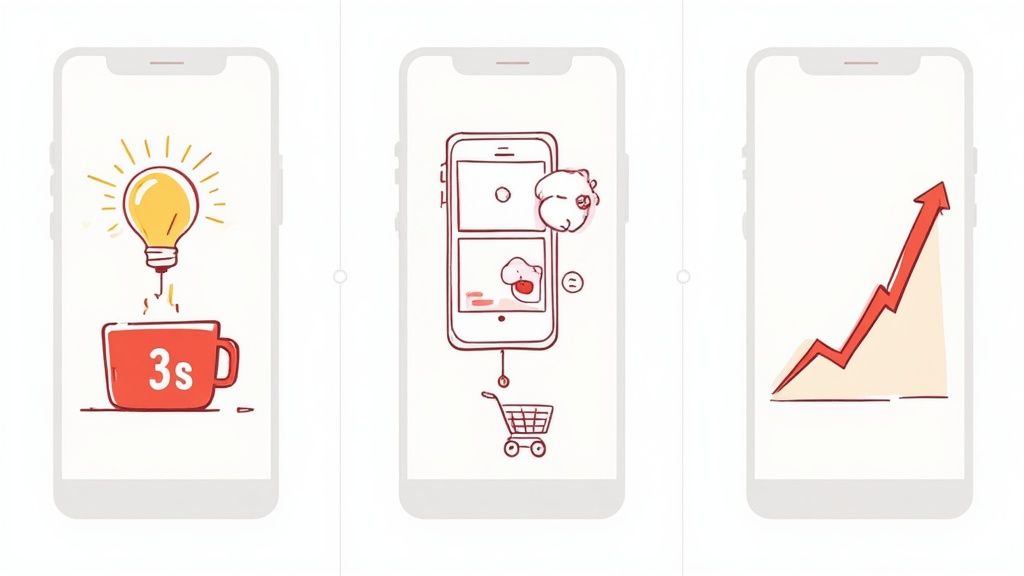
It all starts with an idea. But instead of just chasing whatever trend is popular this week, think about solving a specific problem for your audience. What’s one quick win or a super valuable tip you can deliver in under 60 seconds?
From Idea to Published Short
Once you've got your topic, you need to script it out. Even a few bullet points on a notepad will do. Your script needs two things above all else: a powerful hook in the first three seconds and a crystal-clear call-to-action (CTA) at the end.
For example, a tech reviewer could start with, "This AI tool just saved me five hours of work," and wrap it up with, "Find the link to try it for yourself in the pinned comment." See how that works?
Next up, filming. Grab your phone and shoot vertically. Good lighting and clear audio are completely non-negotiable, even if you’re just using your phone's built-in mic. Keep your shots dynamic and edit ruthlessly to keep people from swiping away.
Here’s the money move: that CTA has to point viewers toward something you can monetize. This could be an affiliate product, a digital download you host on a platform like Stan Store, or even a signup link for your email list managed with a tool like Brevo.
Finally, write a title and description that are actually optimized for search. Think about what your ideal viewer would type into YouTube to find your video and use those keywords.
After you hit publish, your job isn't done. The most important step is to immediately write and pin that comment with your link. This makes sure your monetized link is the very first thing people see, which dramatically increases your odds of getting a click.
Your Top Questions About Monetizing Shorts
Jumping into Shorts monetization can feel like navigating a maze. There's a lot of conflicting info out there, so let's cut through the noise and answer the most common questions you probably have.
How Much Does YouTube Really Pay for 1 Million Views on a Short?
This is the big one, right? For 1 million views on a single Short, most creators are seeing payouts somewhere between $10 and $70.
That’s a pretty wide range, and it’s because a few key things are at play. The biggest factor is your audience's location—views from the US, for example, pay a whole lot more than views from other regions. It also depends on how much ad money is in the shared Creator Pool during that specific time.
While it’s definitely not long-form video money on a per-view basis, the sheer volume you can get with a viral Short means it can still become a meaningful income stream.
Can I Make Money From Shorts if I’m Not in the YouTube Partner Program?
You can't get a slice of YouTube's official ad revenue pie without being in the YPP, simple as that. But—and this is a big but—you can absolutely make money from the traffic your Shorts generate. In fact, these other methods are often way more profitable.
The best part? You can start these today, no matter your subscriber count:
- Affiliate Marketing: Talk about products you use and love, drop a link, and earn a commission when someone buys. It’s a classic for a reason.
- Brand Sponsorships: Once you have an engaged audience, brands will pay you to feature their products in your Shorts.
- Selling Your Own Stuff: Got a digital product, a cool t-shirt design, or a coaching service? Use your Shorts to drive traffic to your own storefront on a platform like Shopify.
Does Using Copyrighted Music Kill My Monetization?
Surprisingly, no—as long as you do it the right way. YouTube's system is actually built to handle this.
When you grab a track from YouTube’s official audio library, your Short is still fully eligible for monetization. Here’s the clever part: YouTube automatically deducts the cost of that music license from the Creator Pool before any money gets paid out to creators.
This is huge. It means you can jump on trending audio to get more views without worrying about copyright strikes that would normally get your video demonetized.
If you're a small channel and not in the YPP yet, my advice is to go all-in on affiliate marketing. It's the most straightforward path to earning your first dollar. You don't need a million views—just an audience that trusts what you have to say. Find a few great products relevant to your niche and start there.