How to Improve Sales Conversion Rate A Practical B2B Guide

If your sales conversion rate is flat, the fix isn't to randomly test new pricing or rewrite your homepage. That’s just guesswork. The real solution is surgical: first, find the single biggest leak in your sales funnel, then focus all your energy on plugging that one hole.
This means using your own data to find the bottleneck before you change a single word of copy.
Find and Fix Your Leakiest Funnel Stage
Before you can fix anything, you need to know exactly where your sales process is breaking down. Too many businesses waste time tweaking things that aren't the real problem. The most effective move you can make is to map out your entire B2B sales funnel and find the spot where most people disappear. Think of it as creating a simple "leak report."
First, define the key stages of your process. If you need a refresher on how this works, you can get a complete breakdown of the core B2B sales funnel stages. For most service businesses, it boils down to three critical handoffs:
- Lead to Marketing Qualified Lead (MQL): How many of the people who initially contact you turn into genuinely interested prospects?
- MQL to Sales Qualified Lead (SQL): Of those interested prospects, how many are actually a good fit for a real sales conversation?
- Opportunity to Close: And finally, how many of those qualified conversations actually become paying clients?
Once you've got these stages mapped out, do the math. Calculate the conversion rate from one stage to the next. This simple exercise will immediately point to your weakest link.
Pinpoint Your Biggest Bottleneck
So, how do you know if your numbers are any good? This is where industry benchmarks come in handy. They give you a baseline to compare against.
For B2B, the pipeline leaks can be pretty dramatic. You'll often see conversion rates of 20-25% for lead-to-MQL, but then a steep drop to just 12-18% for MQL-to-SQL. The final jump from opportunity to a closed deal typically lands somewhere between a tough 6-9%.
For small teams with tight resources, those numbers tell a critical story: you have to be ruthless with qualification to avoid wasting your time.
The chart below gives you a visual of where these drop-offs usually happen.
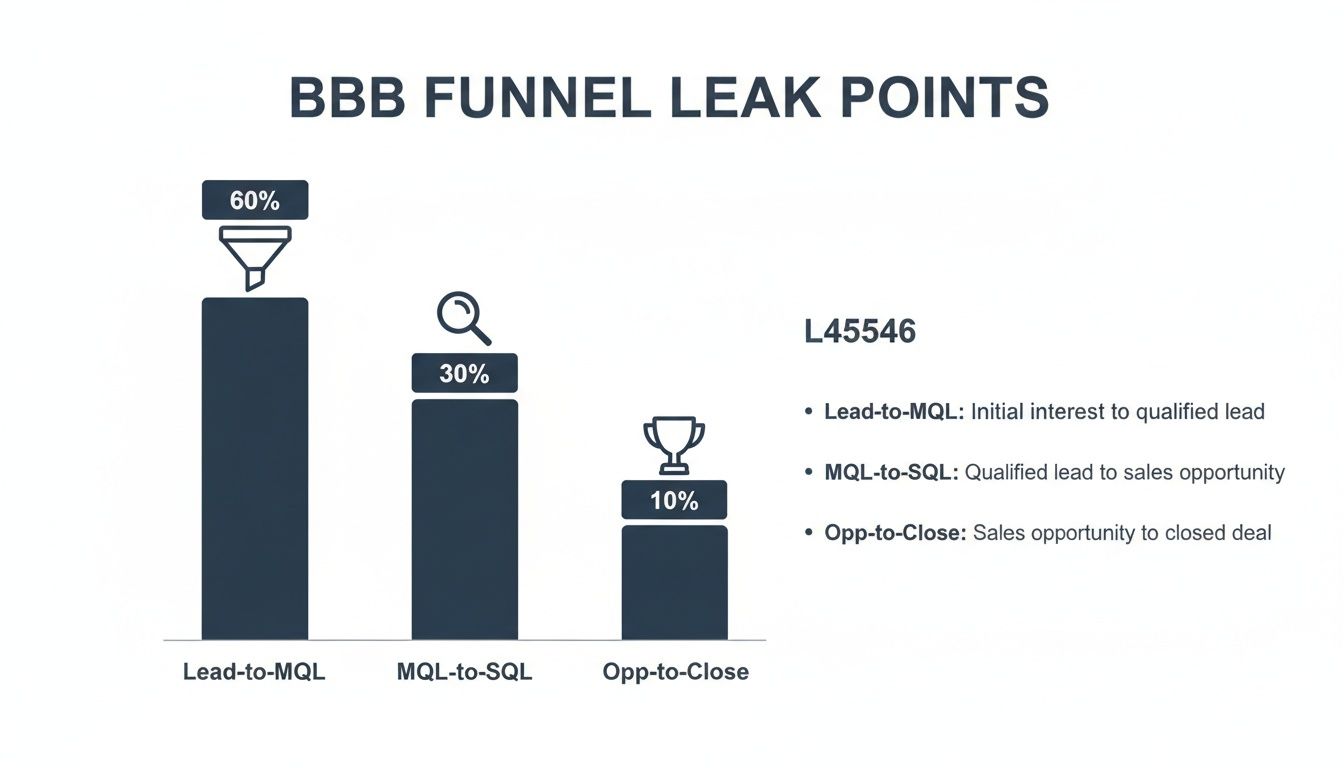
As you can see, the biggest leaks often spring up right at the beginning, during those early qualification stages, long before a deal is even on the table.
Now, let's put this into action. Compare your funnel performance against industry averages to identify your biggest leaks.
B2B Sales Funnel Conversion Benchmarks
| Funnel Stage | Average B2B Conversion Rate | Your Target Rate |
|---|---|---|
| Lead to MQL | 20-25% | [Enter your goal here] |
| MQL to SQL | 12-18% | [Enter your goal here] |
| Opportunity to Close | 6-9% | [Enter your goal here] |
By plugging in your own numbers next to these benchmarks, you'll see in black and white which part of your funnel is underperforming the most. That’s your target.
Key Takeaway: Stop optimizing randomly. A 10-minute funnel audit will show you exactly where to focus your energy for the biggest impact on revenue. Your goal is to find the one stage that, if improved, would make everything else downstream so much easier.
To get your diagnostics right, it helps to have a solid foundation in the principles of conversion. This practical guide on how to improve website conversion rates gives you a broader context that will inform the experiments you'll run later.
Stop Cold Calling and Start Getting Replies
Generic outreach is the fastest way to tank your sales conversions. If you're seeing a big drop-off right at the top of your funnel, it’s almost certainly because your first touch feels like spam.
The fix? Stop playing the numbers game. You need to build a high-reply-rate engine fueled by relevance and perfect timing.
That means no more blasting generic templates to huge, cold lists. Instead, your energy should go into finding high-intent contacts by looking for buying signals. These are triggers that tell you a company is actively looking for solutions right now.
What are they?
- A recent funding announcement.
- A new C-suite executive just got hired.
- Job postings that signal growth or a new initiative.
These events open up small windows where a business is practically begging for the right tool or service to come along.
A killer workflow here is combining smart prospecting with personalized automation. For example, you can use a tool like Apollo to build hyper-targeted lists based on these exact signals. It lets you go way beyond basic company size and location to find people who are actually ready to listen.
Automate Your First Touch (Without Sounding Like a Robot)
Once you’ve got that high-intent list, you can bring in a smart automation tool to scale up the personalization. This isn't about faking a connection; it's about using tech to make genuine outreach more efficient.
A tool like PhantomBuster, for instance, can automate sending LinkedIn connection requests that reference something specific—a prospect's recent post, a shared connection, or that new funding round you found.
This single move immediately separates you from the flood of generic "I'd like to connect" requests that everyone ignores.
The whole point is to make every touchpoint feel like a warm referral, not a cold call. When you reference a specific, timely event, you prove you’ve done your homework and have a real reason to be in their inbox.
This shift is everything. Industry data shows that while some B2B sales call conversion rates look decent on paper, traditional cold calling is a dead end. Check out this sales call conversion rate data—it’s clear that moving toward a more informed, referral-style approach is the only way to win.
Writing Copy That Actually Gets a Reply
Even with perfect targeting, a weak email will get you nowhere. Your message needs to be short, direct, and focused completely on the prospect's world.
Here’s a simple framework that just works:
- The Hook: Lead with your personalized trigger. "Congrats on the recent funding round," or "Saw you're hiring for a new sales director..."
- The Problem: Briefly connect that trigger to a problem you solve. "Companies at your stage often struggle with..."
- The Value Prop: Nail your solution in one sentence. "We help B2B agencies do X by doing Y."
- The Ask: End with a low-friction, easy-yes question. "Open to a 15-minute chat next week to see if this could help?"
This structure respects their time and cuts straight to the chase. For a deeper dive, we've broken down more proven formulas in our guide on how to write cold emails that convert.
Combine smart targeting, personalized automation, and sharp copy, and you'll finally stop worrying about reply rates and start filling your pipeline with leads who actually want to talk.
Build Landing Pages That Actually Convert
Getting people to your website is only half the battle. Let's be honest, it's the easier half. The real work—the part that actually generates revenue—starts the second a visitor hits your page. A high-converting landing page is your best salesperson, working 24/7 to turn casual interest into real action.

It all kicks off with a simple but non-negotiable principle: message match. The headline on your landing page must echo the promise you made in your ad. If your ad shouts, "Get a Free SEO Audit," your landing page headline can't whisper, "The Best Digital Marketing Services." That disconnect is a conversion killer and a one-way ticket to a sky-high bounce rate.
You don't need to be a developer to build pages quickly. Tools like Leadpages let you start with a proven template so you can focus on what matters most: crafting copy that speaks directly to your visitor's pain points.
Writing Copy That Sells
Your copy needs to be clear, compelling, and obsessed with a single outcome. Forget the clever wordplay and industry jargon; clarity always wins.
I recommend sticking to a simple, effective page structure:
- Headline: State the biggest benefit or solve their most pressing problem.
- Bullet Points: List 3-5 tangible outcomes or benefits your service delivers. What will their life look like after they work with you?
- Call-to-Action (CTA): Ditch the generic "Submit." Use specific, low-friction language like "Get My 15-Minute Audit" or "Start My Free Trial."
This framework guides the visitor logically toward the goal without giving them a chance to get overwhelmed. For a deeper dive into the psychology and design principles, it's worth exploring proven strategies for landing page conversion rate optimization.
A Prioritized List of Quick Wins
If you're looking for the quickest conversion lifts, you don't need to overhaul your entire page. Certain A/B tests consistently deliver outsized results with minimal effort. Here’s a prioritized list of experiments to run.
High-Impact Landing Page A/B Tests
| Test Idea | Potential Impact | Implementation Effort |
|---|---|---|
| Reduce Form Fields | High | Low |
| Headline Variation | High | Low |
| CTA Button Copy | Medium | Low |
| Add Social Proof | Medium | Medium |
| Change Hero Image/Video | Medium-High | Medium |
Start at the top of this list. Reducing form fields is often the fastest path to a measurable win. Once you've tested that, move on to the headline, then the CTA, and so on.
The Fastest Test for Immediate Wins
If you’re wondering how to improve sales conversion rate with the least amount of effort, the answer is always your form. The single fastest A/B test you can run is on its length. It’s so tempting to ask for a name, company, phone number, and budget—but every extra field you add is another reason for someone to give up.
The average conversion rate for a B2B SaaS site is a dismal 2.1%. While many factors are at play, an overly demanding form is one of the most common culprits. Some studies show that fully optimized funnels can convert 70% more visitors than their unrefined counterparts. You can read more about these B2B sales statistics to see how you stack up.
Try this simple experiment today:
Duplicate your landing page. On the new version, change the form to ask for just one thing—an email address. That's it. You can always qualify the lead later. This single change can often boost sign-ups by 20-30% by slashing the effort required to convert.
That’s a massive win from a five-minute change.
Set Up a Rhythm for Continuous Testing
Improving your sales conversion rate isn't a project you knock out once and call it a day. It’s a constant process of learning, tweaking, and adapting. The teams that win at this don't try to boil the ocean with a massive, one-time overhaul. Instead, they treat it like a series of small, calculated experiments.
This approach keeps you from getting bogged down by intimidating projects. Instead, you build momentum with consistent, measurable wins. The goal is to get into a simple, repeatable rhythm—a weekly or bi-weekly sprint—that compounds over time.
Build Your Testing Backlog
First things first, you need one central place to dump all your ideas. Think of it as your testing backlog. A simple project management tool is perfect for this. You can spin up a quick board in Notion or just create a project list in Todoist.
This backlog should capture every single hypothesis you have for improving conversions, no matter how small it seems. For example:
- "Changing our landing page CTA from 'Submit' to 'Get My Free Audit' will lift form submissions."
- "I bet adding a testimonial section above the fold will build enough trust to increase sign-ups."
- "Testing a new subject line for our follow-up email should improve our open rate by 10%."
Framing each idea as a clear hypothesis is key. It forces you to define exactly what you're testing and what you expect to see happen.
Prioritize Impact Over Effort
Once you have a list of ideas brewing, you need to prioritize. You can't test everything at once, so go for the quick wins first. A simple impact-versus-effort matrix is a fantastic way to decide where to start.
Go through each idea in your backlog and give it a quick score for both potential impact and the effort required to get it live. This immediately helps you spot the low-hanging fruit—those high-impact, low-effort tests that can deliver results right away. One week you might test a new email subject line; the next, you might tweak the call-to-action on your main landing page.
The real power here is in the cadence. By running one small, focused experiment at a time, you create a powerful feedback loop. You'll quickly learn what resonates with your audience and what falls flat, allowing you to make smarter decisions with every single sprint.
For a deeper dive into the nuts and bolts of improving website conversions, check out this practical guide to website conversion rate optimization. It offers a comprehensive framework that fits perfectly with this agile testing approach. By documenting your hypotheses, results, and key learnings in a simple dashboard, you'll build an invaluable resource that fuels future growth.
Use Social Proof and Pricing Tricks to Guide the Sale
Sometimes, the biggest things slowing down your conversion rate have nothing to do with your funnel or your email copy. They're psychological hurdles. Getting a prospect over their natural hesitation often boils down to two incredibly powerful tools: social proof and pricing strategy.
First, social proof. This is all about building trust before you even get on a call. When potential customers see that people just like them have already won with your service, their sense of risk plummets. This is why having killer testimonials and case studies isn't just nice—it's non-negotiable.
But you can't just sit around and hope for praise. You need a system to go out and get it.
For instance, a tool like NiceJob can completely automate the review collection process. It makes gathering positive feedback and splashing it across your site and social media almost effortless. The data here is pretty compelling: just displaying customer reviews can crank up conversion rates by as much as 270%.
Structure Your Pricing to Make the "Yes" Obvious
Once you've built that foundation of trust, the next job is to make the buying decision feel like a no-brainer. This is where pricing psychology enters the picture. How you frame your prices can be just as important as the numbers themselves.
One of the most effective tactics I've seen work time and again is the classic three-tiered pricing model. By laying out options like "Basic," "Pro," and "Premium," you’re doing more than just offering choices—you're anchoring value and guiding the decision.
This structure works so well because it taps into a few key psychological triggers:
- Charm Pricing: Ending your prices with a 9 (like $49 or $99) is a classic for a reason. It just feels significantly cheaper than the next round number.
- The Decoy Effect: You'll often see the middle option flagged as "Most Popular." It’s intentionally designed to look like the best possible value when compared to the other two. This simplifies the decision by framing one choice as the smartest one.
Your goal with tiered pricing isn't just to show options; it's to steer prospects toward your preferred package. The highest tier makes the middle one seem more affordable, while the lowest tier makes the value of upgrading crystal clear.
By combining undeniable social proof with smart pricing, you tackle both the emotional need for trust and the logical need for an easy decision. It’s a one-two punch that dismantles the most common sales barriers, making it much easier for a prospect to say "yes" without you having to change a single thing about your core service.
Your 7-Day Sales Conversion Action Plan
Look, information without action is just noise. This guide has handed you the strategies, but now it's time to actually execute. Let's boil it all down into a simple, 7-day sprint designed to get you a measurable win in just one week.

The goal here isn't to fix everything at once. That's a recipe for burnout. Instead, we’re going to build momentum by proving you can move the needle on one specific metric. This is how you really learn how to improve sales conversion rate in a way that actually sticks.
Your Week of Action
Day 1: Pinpoint the Leak. First things first, map out your sales funnel stages. Do the math and find the single biggest conversion drop-off. Where are you losing the most people? That's your target for the week.
Day 2: Build a High-Intent List. Time to find the right people. Use a tool like Apollo to identify 50 prospects who are showing clear buying signals. We're chasing quality here, not quantity.
Day 3: Launch a Quick A/B Test. Clone your main landing page using a tool like Leadpages. On the new version, be ruthless. Slash your contact form down to just one or two essential fields—name and email, maybe—then launch the test.
Days 4-5: Execute Your Outreach. Go time. Run your refined outreach campaign, contacting the targeted list you built on Day 2. Make sure you track every single reply.
Day 6: Analyze Early Results. Pop the hood and check your A/B test data. Is the shorter form generating more leads? How are your outreach reply rates looking?
Key Insight: Don’t get hung up waiting for perfect statistical significance on your first test. Your real goal is to gather quick, directional data to inform your next move. Speed of learning beats perfect results at this stage.
- Day 7: Document and Plan. Write it down. What did you learn? What worked, and what bombed? Based on these fresh insights, plan next week’s experiment. This is how you build a repeatable system for growth.
Got Questions? We've Got Answers.
Dialing in your sales process always brings up a few common questions. Here are the straight answers we give to B2B agencies and businesses we work with.
How Fast Can I Actually See My Conversion Rate Improve?
You can see a lift from small, focused tests in as little as one or two weeks. Seriously.
Quick wins like simplifying a form on a landing page built in Leadpages or just A/B testing a new headline are designed to give you rapid feedback.
Bigger changes, though—like a total rewrite of your outreach sequence—will naturally take longer. You'll want to give those 30 to 60 days to see if they're really moving the needle. The trick is to get into a rhythm of small, weekly experiments instead of banking on one massive change to fix everything.
What's a Good Sales Conversion Rate for a B2B Service Business?
It definitely varies by industry, but there are some solid benchmarks to shoot for.
Getting 20-25% of your leads to become a Marketing Qualified Lead (MQL) is a great target. From there, converting 12-18% of those MQLs into a Sales Qualified Lead (SQL) is considered strong.
Once you have a qualified opportunity on the line, closing 25-30% of them is excellent. If your total lead-to-close rate is anywhere above 3-5%, you're probably doing very well. Just remember, the real goal is to beat your own numbers month after month.
What's the One Change That Usually Has the Biggest Impact?
It almost always comes down to two things: clarifying your offer and simplifying your form. These hit the biggest friction points a new prospect faces head-on.
Our advice? First, make absolutely sure your offer solves a specific, painful problem for a very niche audience. Be ruthless about it. Second, test a form that asks for the bare minimum—maybe just an email address to start. That one-two punch almost always delivers a quick and meaningful boost.