
How to figure out profit margin: A Practical Guide for B2B Agencies


Knowing your profit margin is the single most important health check for your business. It’s the raw number that tells you what percentage of your revenue is actual, take-home profit.
This isn't just an accounting exercise. This metric should drive every major decision you make, from project pricing and operational spending to when you can afford to hire new team members. It all boils down to two core numbers: Gross Profit Margin and Net Profit Margin.
Your Quick Guide to Agency Profit Margin

For a service-based agency, your profit margin is a direct reflection of your business model's sustainability. Without a crystal-clear picture of your profitability, you’re flying blind. You can't tell the difference between busy work and genuinely lucrative projects. This is especially true when your main "cost" is your team's time.
The whole process breaks down into two essential layers.
First up is your Gross Profit Margin. Think of this as the profitability of your services before you factor in any overhead. It answers a simple but vital question: "Is the work we deliver to clients actually profitable on its own?"
Then you have the Net Profit Margin, which paints the complete picture. This metric accounts for every single business expense—salaries, rent, software subscriptions, and marketing tools like Brevo. It answers the ultimate question: "After everything is paid for, what’s left in the bank?"
Understanding both margins is non-negotiable. A high gross margin with a low net margin is a massive red flag that your overhead is eating you alive. On the flip side, a low gross margin means your services are either underpriced or too expensive to deliver.
Gross Margin vs Net Margin At a Glance
To make it even clearer, here’s a quick comparison of the two most critical profit margin metrics for your agency.
| Metric | What It Measures | Formula | Why It Matters for Your Agency |
|---|---|---|---|
| Gross Profit Margin | The profitability of your services, excluding overhead. | (Revenue - Cost of Goods Sold) / Revenue | Shows if your projects are priced correctly and if your delivery process is efficient. |
| Net Profit Margin | The overall profitability of your entire business after all expenses. | (Revenue - All Expenses) / Revenue | Reveals your true, bottom-line profitability and the overall financial health of your agency. |
Tracking both gives you the financial clarity you need to build a resilient and scalable business.
Why Benchmarks Matter
Knowing your own numbers is just the first step; context is everything. Profit margin calculations often start with gross margin, which averages a seemingly healthy 36.56% across all industries. But once all costs are paid, that figure plummets to a net margin of just 8.54%.
For marketing agencies like yours, data from NYU Stern reveals the Business & Consumer Services sector averages a gross margin of around 33.38%. After overhead, the net margin typically lands somewhere between 6-8%. You can find more industry-specific data to see how your agency truly stacks up.
Keeping a close eye on these two figures will give you the financial clarity needed to build a resilient agency that’s built to last.
Margin vs. Markup: Getting This Right Is Everything

Before we get into the numbers, we need to clear up one of the most common—and costly—misunderstandings in business: margin is not the same as markup.
I've seen countless agency owners get this wrong. They confuse the two concepts, misprice their projects, and then spend the end of the quarter wondering where all their profit went. It's a silent killer of profitability.
Markup is simple and additive. You take your cost and add a percentage on top. For instance, if a project costs you $6,000 to deliver and you apply a 50% markup, you're just adding $3,000 to the cost. The price you charge the client becomes $9,000. Easy, right? But fatally flawed.
Margin, on the other hand, is about the final price. It’s the percentage of your total revenue that is actual, take-home profit. This is the number that truly matters for building a sustainable business.
A Tale of Two Pricing Scenarios
Let's walk through a real-world example. Imagine you're quoting a web design project and your direct costs—contractor fees, specific software licenses, etc.—come out to $6,000.
The Markup-First Trap: You decide a 50% markup sounds healthy. You add $3,000 (50% of $6,000) to your costs, arriving at a client price of $9,000. You made $3,000 in profit. But what's your profit margin? It’s your profit ($3,000) divided by the total revenue ($9,000), which is only 33.3%. That is a huge difference from the 50% you thought you were making.
The Margin-First Strategy: You decide your goal is to achieve a 50% profit margin. This means your $6,000 cost must represent the other 50% of the final price. The math is a little different: you divide your cost by (1 - your desired margin). So, $6,000 / (1 - 0.50) = $12,000. Your client price is $12,000, your profit is $6,000, and your profit margin is a true 50%.
By defaulting to a markup-based price, you would have left $3,000 on the table without even knowing it. This is why you must focus on margin. It forces you to price your work based on the profitability you need to achieve, not just what it costs to get done.
If you really want to lock this concept in, digging into the key differences between Margin vs Markup is essential. Confusing them can lead to some seriously painful financial miscalculations down the road.
Always, always start with your target margin and work backward to determine your price. Never the other way around. This simple shift in thinking will protect your bottom line and help you build a much more financially sound agency.
Nailing Down Your Agency's Costs
You can't calculate your profit margin with fuzzy numbers. It all starts with a rock-solid, accurate picture of your costs. The whole exercise falls apart without it. To get this right, you need a simple, consistent way to track and categorize every single dollar that goes out the door.
This whole process boils down to splitting your expenses into two buckets: Cost of Goods Sold (COGS) and Operating Expenses (Overhead). Getting this one separation right is the key to calculating both your gross and net profit margins accurately.
What Are Your Direct Costs?
Direct costs, also known as COGS, are the expenses you only have because you're delivering a service to a specific client. If you didn't have that project, you wouldn't have this cost. It's that simple.
For a B2B agency, this list is usually pretty short and sweet:
- Contractors and Freelancers: Any money paid to writers, designers, developers, or other specialists you bring in for a particular project.
- Project-Specific Ad Spend: The budget you're managing and spending on platforms like Google Ads or LinkedIn for a client's campaign.
- Per-Client Software: Tools you pay for on a per-seat or per-client basis. Maybe that's a landing page builder like Leadpages for one client or a license for an automation tool like PhantomBuster for another.
These are your "cost of sale" items. Adding them all up is the first real step to understanding the raw profitability of the work you do.
Think of it this way: your gross margin tells you how profitable your service delivery machine is. If you can't turn a healthy profit after subtracting these direct costs, then either your pricing or your delivery process is fundamentally broken.
Don't Forget Your Indirect Costs
Next up are your indirect costs, which most people just call operating expenses or overhead. These are all the costs you have to pay just to keep the lights on, whether you have one client or one hundred. They are absolutely essential, but they aren't tied to any single project.
Here's what this usually looks like for an agency:
- Your Salary: This is non-negotiable. If you forget to pay yourself a real, market-rate salary, you'll get a dangerously inflated sense of how profitable your business actually is.
- General Software and Tools: This covers your CRM, project management software, and any marketing tools like Apollo that the whole business uses.
- Accounting and Legal: Fees for your accountant, any legal services, and your accounting software subscription.
- Marketing and Sales Costs: Your own ad spend, content creation, and anything else you spend to land new clients.
To make this distinction crystal clear, here’s a quick breakdown of common agency expenses.
Direct Costs vs Indirect Costs Examples for an Agency
This table breaks down common expenses to help you categorize costs correctly for your margin calculations.
| Expense Category | Example | Direct Cost (COGS) | Indirect Cost (Overhead) |
|---|---|---|---|
| Labor | Freelance designer for Client A's website | ✔️ | |
| Labor | Your monthly salary as the owner | ✔️ | |
| Software | Leadpages subscription for a specific client | ✔️ | |
| Software | Apollo subscription for lead generation | ✔️ | |
| Advertising | Google Ads budget for Client B's campaign | ✔️ | |
| Advertising | LinkedIn Ads for your own agency's marketing | ✔️ | |
| Professional Services | Monthly retainer for your accountant | ✔️ | |
| Office | Co-working space membership | ✔️ |
Categorizing these correctly is the foundation for an accurate profit margin calculation. It’s what separates the true cost of delivering the work from the cost of running the business.
These overhead costs are what you subtract from your gross profit to find your true, bottom-line net profit. A great system makes all the difference here. Using dedicated accounting software is really the only sustainable path if you're serious about your long-term financial health. For anyone just getting started, you can learn more about managing your finances with cloud-based accounting software to build that strong foundation early on.
The goal is to create a simple, repeatable workflow. Whether you use a spreadsheet, a tool like Notion, or proper accounting software like Xero, consistency is everything. Track every expense and categorize it the right way, every single month. That discipline is what gives you the clean data you need for any meaningful financial analysis.
Alright, you've tallied up your costs and have everything neatly organized. Now for the fun part: running the numbers. This is where all that diligent tracking pays off and you get a crystal-clear picture of your agency's financial health.
We’re going to look at two crucial calculations: Gross Profit Margin and Net Profit Margin.
Calculating Gross Profit Margin
First up is Gross Profit Margin. Think of this as the profitability of your core service delivery. It answers one of the most important questions you can ask: "Are we actually making money on the work we do for clients?"
To figure this out, you simply subtract your direct costs (COGS) from your total revenue. The formula is refreshingly straightforward.
Formula: Gross Profit Margin = ((Total Revenue - Direct Costs) / Total Revenue) x 100
Let's walk through an example. Imagine you just wrapped up a project for a B2B client that brought in a nice, round $10,000 in revenue.
Your direct costs tied specifically to this project were:
- Freelance Developer: $2,500
- Project-Specific Software License: $300
- Client Ad Spend: $1,200
That brings your total direct costs (COGS) to $4,000. Now, let's plug those numbers into the formula:
Gross Profit Margin = (($10,000 - $4,000) / $10,000) x 100 = 60%
Your Gross Profit Margin for this project is a solid 60%. This tells you that for every dollar of revenue you earned, 60 cents is left over to cover your overhead and, ultimately, contribute to your net profit. Not bad at all.
This simple process flow helps visualize how to approach your cost tracking before you even start calculating.
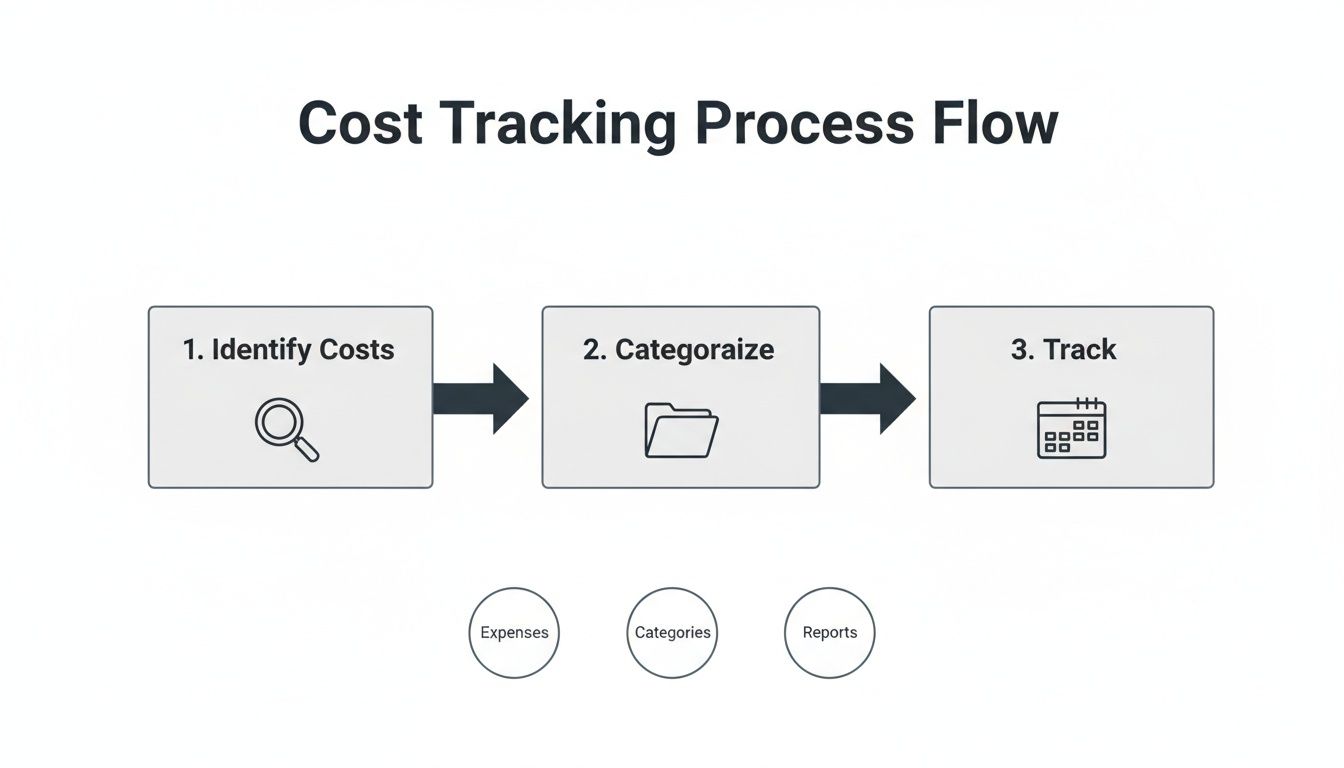
This visual just hammers home the point that accurate margins start with a disciplined workflow: identify, categorize, and track every single expense. For agencies, time is quite literally money, so getting a handle on your team's hours is a direct path to a healthier bottom line. For a deeper dive, check out this guide on mastering calculating billable hours—it's essential for getting this part right.
Calculating Net Profit Margin
Now for the number that really matters: your Net Profit Margin. This is the bottom line. It reveals your true profitability after every single expense—including all that overhead—is paid. This is what's actually left in the bank.
The formula is similar, but this time, you're subtracting all your costs.
Formula: Net Profit Margin = ((Total Revenue - Total Costs) / Total Revenue) x 100
Let's stick with our $10,000 project. We already know the direct costs are $4,000. Now, let's say your total monthly operating expenses (all that overhead) come out to $3,500.
Your total costs for this project are $4,000 (Direct) + $3,500 (Overhead) = $7,500.
Net Profit Margin = (($10,000 - $7,500) / $10,000) x 100 = 25%
Your Net Profit Margin is 25%. In the agency world, that's a very strong result. It's always good to have some context, because margins vary wildly between industries. For example, while big banks might hit 30.89%, the auto industry squeaks by at 3.53%. The advertising sector averages around 7.92%, but a lean, efficient service business can absolutely push for a 20% net margin or higher.
And if you're wrestling with spreadsheets to get all this data in one place, our guide on how to merge in Excel might save you a few headaches.
Using Profit Margins to Make Better Decisions
Calculating your profit margin isn't just about looking in the rearview mirror at last month's numbers. When you use it right, it becomes your most powerful tool for steering the business forward. Knowing what your margin is is one thing; knowing what it should be is how you make smart decisions.
For a healthy, lean service business, a 15-25% net profit margin is a realistic target. But that's just a benchmark. The real magic happens when you use your own numbers to make concrete moves, turning raw data into real-world action.
Interpreting Your Margin Signals
Your gross and net margins are constantly sending you signals about the health of your agency. You just have to learn how to read them.
Low Gross Margin: If your gross margin on a specific service consistently drops below 50%, that’s a massive red flag. It tells you the service is either underpriced or costs too much to deliver. This is your cue to raise your prices or get serious about streamlining your delivery process to cut those direct costs.
Low Net Margin: What if your gross margin looks healthy, but your net margin is struggling to stay above 10%? This is a clear signal that your overhead is choking your profits. It's time for a full-blown audit of your operating expenses. Scrutinize every software subscription, every marketing dollar, and every administrative cost to find what you can trim.
Your profit margin isn't just a number on a spreadsheet; it’s a decision-making framework. It tells you when to be aggressive with growth, when to focus on efficiency, and when to rethink your core offerings.
Setting Realistic Benchmarks
Comparing your numbers to industry averages gives you crucial context. And this is vital because margins vary wildly between industries. For example, specialty retail might have a gross margin of 36.5% but nets only 2.4%. Meanwhile, a telecom company could have a 63.1% gross margin but a -0.8% net margin.
For the B2B marketing work you do, the Business Services sector averages around a 33% gross margin, with net margins typically landing between 5-10%. You can explore more detailed industry data to see exactly how you stack up.
Understanding these decision rules transforms your profit calculation from a simple report into an active, strategic guide for your agency's growth.
It also connects directly to other key metrics. If you're struggling with profitability, you probably need to look at how much it costs to bring in new clients in the first place. Our customer acquisition cost calculator can give you a much clearer picture of your sales and marketing efficiency.
The Most Common Profit Calculation Mistakes I See
Knowing the formulas is one thing, but running the numbers correctly is another. I’ve seen countless agencies stumble over the same few mistakes, which quietly drain their profitability until it’s too late.
These aren’t complex accounting errors. They’re small, easy-to-make assumptions that give you a completely misleading picture of your business’s health. Let’s walk through the big ones so you can sidestep them entirely.
Forgetting to Pay Yourself
This is, without a doubt, the most frequent and dangerous error. Founders often don't pay themselves a real, market-rate salary, especially in the early days. They just take whatever is left over at the end of the month.
The problem? Your compensation is a real operating expense. When you don’t account for it, your net profit margin looks fantastic—but it's completely artificial. This false sense of security leads to underpricing projects and overspending on other things, because you think you have more cushion than you actually do.
Mixing Up Your Costs and Ignoring Subscriptions
Another classic tripwire is miscategorizing your costs. If you accidentally label an indirect cost (overhead) as a direct cost (COGS), or vice versa, it throws off both your gross and net profit margins. You’ll have no idea where your business is truly efficient.
The simplest gut check is to ask: "Would this cost still exist if I didn't have this specific client project?" If the answer is no, it's a direct cost.
It’s also surprisingly easy to let software subscriptions bleed you dry. That $20/month for a new AI writer or that $50/month for a project tool you barely use might seem trivial. But they add up, creating a slow, steady drain on your net margin. I recommend using a good task manager like Todoist or a document workflow system like SignNow to schedule a quarterly audit of every single recurring expense. You’ll be shocked at what you find.
The real reason so many businesses struggle with cash flow isn't a lack of revenue—it’s a lack of true profit. Relying on your top-line revenue as the main success metric is a direct path to a cash crunch, because it ignores what it actually cost you to earn that money.
Finally, you have to avoid two other major traps I see all the time:
- Only looking at project-level profit. This is critical, of course, but it can easily hide a bloated overhead problem. You can have a string of profitable projects but still run an unprofitable business if your operating costs are out of control.
- Using markup to set your prices. As we covered earlier, this simple mix-up is a guaranteed way to underprice your work. You'll consistently leave money on the table, and it directly damages your bottom line every single time.
Got questions about profit margins? Most agency owners do. Here are the quick answers to the questions I hear all the time.
What Is a Good Profit Margin for a B2B Agency?
For a B2B agency, a healthy net profit margin is anywhere between 15% and 25%. That's the sweet spot. It means after you've paid for everything—salaries, software, rent, contractors—you still have enough cash left over to invest in growth, build a buffer, and actually pay yourself.
On individual projects, your gross profit margin should be much higher, ideally 50% or more. This is critical because that gross margin has to cover all your business overhead and still leave you with that target net profit.
If your project margins are dipping below 50%, it's a red flag. It’s time to take a hard look at your pricing structure or how efficiently your team is delivering the work.
How Often Should I Calculate Profit Margin?
At least monthly. No exceptions.
This isn't something you can put off until the end of the quarter. A single bad month can tank your annual numbers, and if you wait three months to spot the problem, the damage is already done.
Monthly tracking gives you a real-time pulse on your agency’s financial health. It helps you catch costly issues early, spot negative trends before they become disasters, and make smart decisions fast. I recommend using an accounting tool like Xero to make this a painless, routine part of your month-end close.
Can I Improve My Profit Margin Without Raising Prices?
Absolutely. While raising your prices is often the most direct route, it's not your only move.
You can make a significant impact by focusing on your costs. Here are two places to start:
- Slash your direct costs. This means getting smarter about project delivery. Can you negotiate better rates with your go-to freelancers or contractors? Is there a way to streamline your delivery process to reduce the hours it takes to get a project done? Every dollar you save here goes directly to your gross margin.
- Audit your overhead. This is where small leaks can sink the ship. Go through every single software subscription with a critical eye. If it isn't essential for client delivery or actively growing the business, cut it. You'd be surprised how quickly those "only $20 a month" tools add up.