A Guide to Mastering B2B Sales Funnel Stages

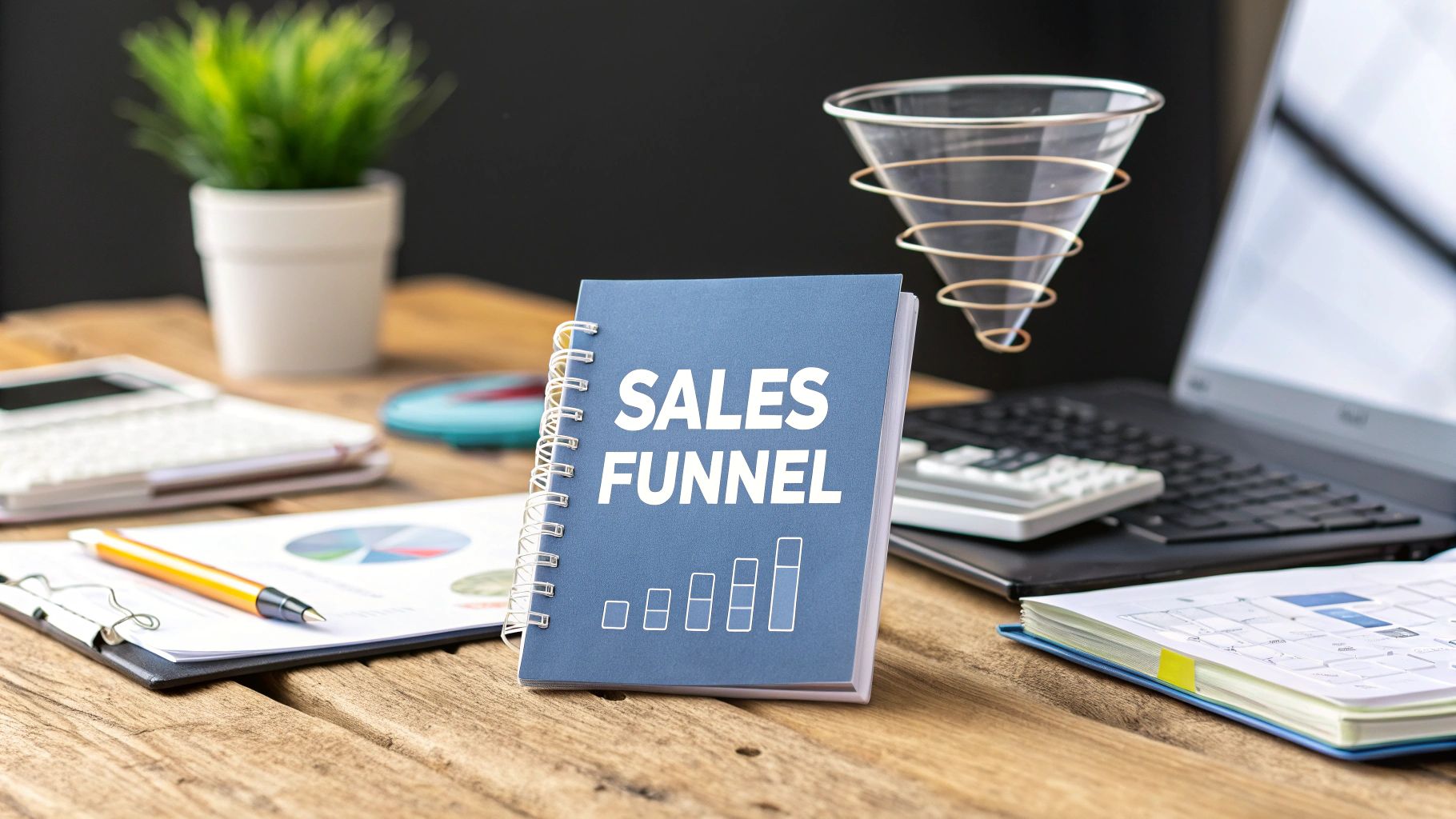
The B2B sales funnel stages map out the entire journey a potential customer takes, from the first moment they realize they have a problem to the day they become a loyal, paying partner. Unlike the quick, gut-driven B2C world, this process is built for a much longer, logic-based sales cycle that almost always involves a committee of decision-makers.
Think of it as your strategic playbook for turning strangers into predictable revenue.
What a B2B Sales Funnel Is and Why It Matters
Let's cut through the jargon. A B2B sales funnel isn't some rigid, academic framework—it's a guided path. At the top, you have a massive pool of businesses that might have a problem you can fix. As they move down, each stage is designed to educate them, build trust, and prove your value until only the absolute best-fit partners make it to the bottom.
Having this structured process isn't just a "nice-to-have"; it's non-negotiable for any kind of sustainable growth. Without a funnel, your sales efforts are just a series of random, reactive shots in the dark. You're sailing without a map.
A well-oiled funnel gets your marketing and sales teams rowing in the same direction. Marketing’s job is to attract and warm up potential customers, teeing them up so sales can step in and engage with genuinely qualified leads at the perfect moment.
The Modern Funnel Is Not a Straight Line
The old-school image of a funnel—wide at the top, skinny at the bottom—is still a decent starting point. But the modern buyer's journey is way messier. Today's business buyers don't just march neatly from one stage to the next.
They might jump from the consideration stage all the way back to research. They might take a demo with your sales team and then go completely dark for three months before popping back up again.
A modern, flexible funnel is built for this chaotic reality. It's about showing up with the right information at every single touchpoint, whether that’s a sharp blog post, a compelling case study, or a perfectly timed, personalized demo.
A B2B business without a funnel is like a car without a GPS. You might get there eventually, but you’ll waste a ton of gas and make a lot of wrong turns along the way.
Core Benefits of a Structured Funnel
When you finally get a clear sales funnel in place, a few critical things start to happen:
- Predictable Revenue: By tracking how many prospects move from one stage to the next, you can start forecasting sales with actual data, not just wishful thinking.
- Improved Efficiency: Your team stops wasting time and energy on tire-kickers and can focus entirely on the leads that have a real chance of closing.
- Enhanced Customer Experience: A smart funnel ensures prospects get the exact information they need, right when they need it. This builds massive trust and credibility.
- Scalable Growth: A defined process is a repeatable one. As your company grows, you can scale your sales and marketing efforts without everything falling into chaos.
For a comprehensive deep dive into building, measuring, and optimizing your own funnel, I highly recommend reading Mastering the B2B Sales Funnel. It's a fantastic resource for turning your funnel into a true revenue engine.
Mapping the Five Core B2B Sales Funnel Stages
Knowing the B2B sales funnel stages in theory is one thing. Watching them play out with a real customer is something else entirely. Let's get past the textbook labels and dig into the actual journey a prospect takes—from a curious stranger to a committed business partner.
Think of it less like a straight line and more like a conversation. Each stage is defined by a shift in your prospect's mindset, and your job is to guide that shift by offering the right help at the right time.
Let's break down the five core stages every B2B buyer moves through.
This diagram shows how it all flows, turning strangers into partners and filtering for the best-fit customers along the way.
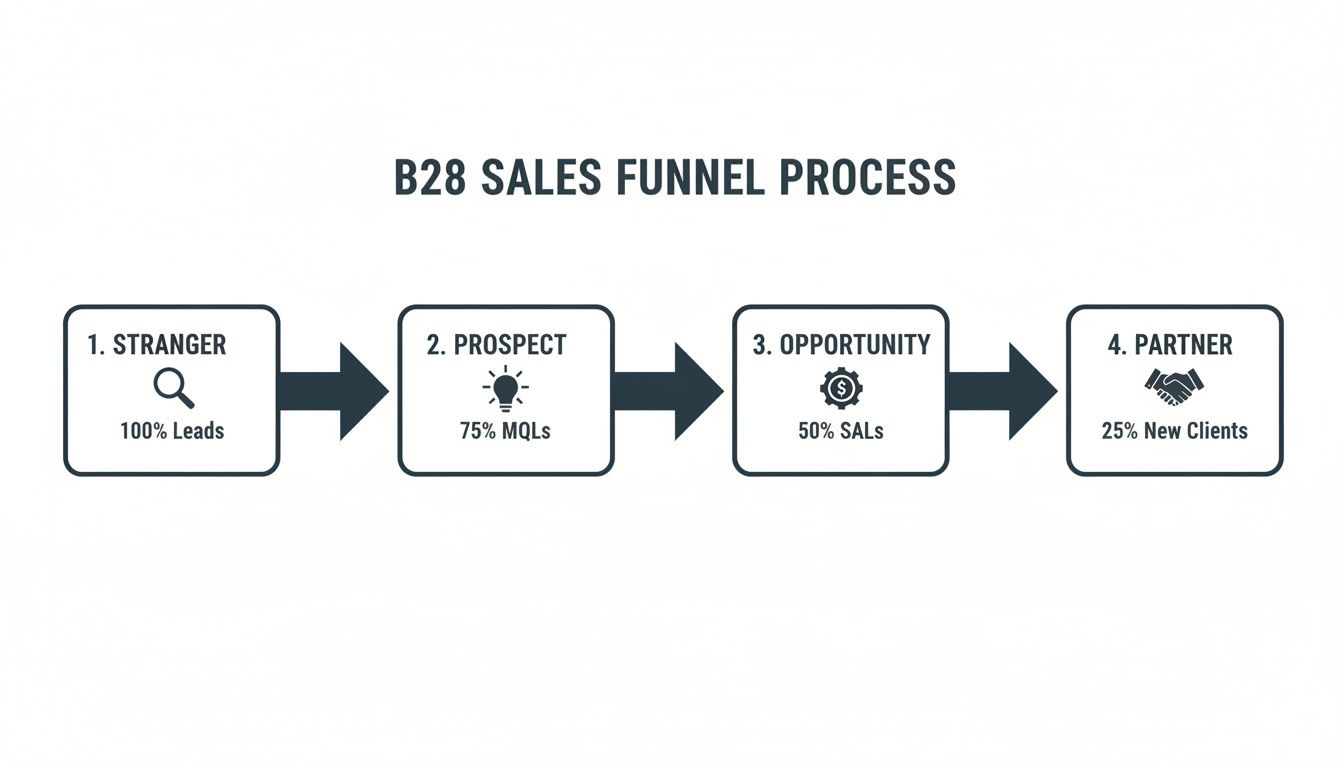
As you can see, each stage qualifies prospects further, making sure only the most interested and suitable leads make it to the end.
To give you a quick overview, here’s how each stage maps to your prospect's mindset and your company's objective.
B2B Sales Funnel Stages Overview
| Stage | Prospect's Question | Company's Goal |
|---|---|---|
| Awareness | "Why am I struggling with this problem?" | Educate and build trust. |
| Interest | "How can I solve this problem?" | Capture their information. |
| Consideration | "Is your solution the right fit for my specific situation?" | Prove your value. |
| Decision | "What will it take to get started?" | Make buying easy. |
| Retention | "Did I make the right choice?" | Deliver on promises. |
This table is your cheat sheet. Now, let's dive into the specifics of what happens at each step and what you need to do to keep things moving.
Stage 1: Awareness
This is the "lightbulb" moment. At the very top of the funnel, your potential customers are just realizing they have a problem or a need. They aren't looking for your specific product yet; they're just trying to put a name to their pain point.
Their main question is: "Why am I struggling with this problem?"
Your goal is to be the expert they find while searching for answers. This is absolutely not the time for a sales pitch. It’s all about providing genuine, helpful content that builds trust and quietly positions you as an authority.
- Real-World Scenario: The owner of a small agency notices their project pipeline is a rollercoaster. They Google "how to get more consistent client work" and land on your in-depth blog post about that exact topic.
Stage 2: Interest
You’ve got their attention. Now the prospect slides into the Interest stage. They understand their problem a lot better and are actively looking for ways to fix it. They've gone from being problem-aware to solution-aware.
Their main question shifts to: "How can I solve this problem?"
Here, your job is to turn an anonymous visitor into a known lead. You do this by offering something valuable—a lead magnet—in exchange for their contact info. For a deeper dive, check out our guide on how to generate B2B leads.
- Real-World Scenario: After reading your article, the agency owner sees a call-to-action for a free ebook: "The 5-Step Playbook for a Full Client Pipeline." They type in their email and hit download. Boom. You have a lead.
Stage 3: Consideration
Welcome to the middle of the funnel. Your lead is now weighing their options, and you’re on the shortlist. They're comparing features, pricing, and potential ROI against your competitors—and against the option of doing nothing at all.
Their question gets much more specific: "Is your solution the right fit for my specific situation?"
Your objective is simple: prove that you are the best choice for them. This stage is all about building a rock-solid business case with proof points, case studies, and personalized demos. You can use a tool like Unbounce to spin up targeted landing pages for demo requests that speak directly to their pain points.
- Real-World Scenario: The agency owner gets an email inviting them to a live webinar on how your project management software helps agencies stabilize their pipeline. They attend and see exactly how it solves their problem.
Stage 4: Decision
This is it—the bottom of the funnel. Your prospect is ready to pull the trigger. They have the info they need, they've likely gotten buy-in from their team, and a decision is about to be made.
Their final question is: "What will it take to get started?"
Your only goal here is to make the buying process completely frictionless. Think clear proposals, simple contracts, and being ready to knock down any last-minute objections. A tool like SignNow is great here because it gets rid of the print-sign-scan dance with easy electronic signatures.
It’s crucial to have realistic expectations here. Funnel data shows that B2B visitor-to-lead rates hover around 1.8–3.0%. That means you might need over 10,000 website visitors just to get 3 qualified opportunities, which might only result in a single deal.
- Real-World Scenario: The agency owner was so impressed with the webinar that they requested a one-on-one demo. The sales rep answers their final questions and sends a clear proposal, which the owner signs electronically that same day.
Stage 5: Retention
The sale isn't the finish line. The final—and you could argue, most important—stage is Retention. Keeping a customer is massively cheaper and more profitable than finding a new one.
Their ongoing question is: "Did I make the right choice?"
Your goal is to make them answer "yes" every single day. This means delivering on your promises with a killer onboarding experience, proactive support, and constantly looking for ways to provide even more value.
- Real-World Scenario: The agency gets a personalized onboarding session. Over the next few months, their dedicated customer success manager checks in, shares useful tips, and helps them get the most out of the software, cementing a long-term partnership.
Choosing the Right KPIs for Each Funnel Stage
A sales funnel without data is just a collection of good intentions. If you want to turn your process from an art into a science, you need to measure what actually matters at each of the b2b sales funnel stages.
Key Performance Indicators (KPIs) are your diagnostic tools. They’re the metrics that show you what’s working, what’s broken, and where your funnel is leaking cash. Tracking the right numbers is the only way to make informed decisions instead of relying on gut feelings. It's how you build a predictable revenue engine and finally prove your marketing is working.
Let’s break down the most important KPIs for each stage, so you know exactly what to watch.
Awareness Stage KPIs
At the very top of the funnel, the game is all about reach and attention. You're not measuring sales yet; you're measuring whether your ideal customers even know you exist. Your goal is to attract a relevant audience and make them aware they have a problem you can solve.
- Website Traffic: This is your baseline. How many people are discovering your brand? Dig into total users, new users, and traffic sources (organic, social, referral) to see which channels are actually pulling their weight.
- Brand Mentions: Are people talking about you? Track how often your company is mentioned on social media, in forums, or on other websites. It’s a raw signal of your growing authority.
- Impressions and Reach: For paid ads or social media, this tells you how many eyeballs saw your content. It’s a pure measure of top-of-funnel visibility.
Interest and Consideration Stage KPIs
Once you have their attention, the focus shifts to engagement. Are they just looking, or are they actually taking the next step? This is where you measure if prospects are actively evaluating you as a potential solution.
- Content Download Rate: If you offer lead magnets like ebooks or whitepapers, this tracks how many visitors actually download them. A high rate means your content is hitting a nerve.
- Email Open and Click-Through Rates (CTR): So they subscribed. Now what? Are they opening your emails and clicking the links inside? Low engagement here is a red flag that there’s a disconnect.
- Demo Request Rate: This is a huge one. It measures the percentage of visitors or leads who take the high-intent step of asking for a product demo. It’s a clear sign someone is moving from "interested" to "serious."
- Webinar Attendance Rate: If you use webinars, track how many people who register actually show up. This number separates the mildly curious from the genuinely engaged.
While funnel performance varies, some benchmarks can give you a target. The average end-to-end sales funnel conversion hovers around 2.3–2.9%, but top performers can push past 5.3%. For a B2B SaaS company, a website visitor-to-lead conversion of 2–5% is a solid start. From there, aiming for a Lead-to-MQL rate of 25–35% and an Opportunity-to-Close rate of 15–30% gives you a realistic baseline to build on.
Decision and Retention Stage KPIs
At the bottom of the funnel, everything gets tied directly to revenue. These are the numbers that hit the balance sheet and determine the long-term health of your business.
Tracking the right data transforms your funnel from a simple model into a powerful diagnostic tool. It tells you not just what happened, but why it happened, so you can fix leaks and double down on what works.
Here are the bottom-line metrics to obsess over:
- Close Rate (or Win Rate): The big one. What percentage of your qualified opportunities become paying customers? This is the ultimate measure of your sales team's effectiveness.
- Average Deal Size: Knowing the average revenue per new customer is critical for forecasting. It helps you understand the real value of each "win."
- Customer Lifetime Value (CLV): CLV measures the total revenue you can expect from a single customer over their entire relationship with you. A rising CLV means you're killing it at retention and upselling. Check out our guide on how to measure marketing ROI to dig deeper.
- Churn Rate: The silent killer of growth. This is the percentage of customers who cancel or stop doing business with you. Keeping churn low is absolutely essential for sustainable success.
By plugging in these KPIs and reviewing them regularly, you get a clear, data-driven x-ray of your entire sales process. It’s how you stop guessing and start optimizing every step for maximum impact.
Here’s a breakdown of the simple, repeatable plays you can run to move prospects from one stage to the next.
Think of these less as complex strategies and more as specific missions with a clear objective. You're not trying to boil the ocean; you're just trying to give a prospect the right information at the right time so they feel confident taking the next step.
Let's walk through three high-impact playbooks you can set up today.
Playbook 1: From Awareness to Interest
The goal here is painfully simple: turn a nameless website visitor into a known lead. They found you through your content, and now you need to earn enough trust to get their email address. The best way to do that is to offer them something valuable they can't get anywhere else.
Here’s the step-by-step:
- Find a High-Traffic Blog Post: Pop open your analytics and find an article that already brings in your ideal customers. This is your workhorse—the content that’s already proven to attract the right people.
- Create a "Content Upgrade": Build a downloadable resource directly related to that post. This could be a checklist, a template, an ebook, or a deep-dive case study. The key is that it offers a more actionable, hands-on version of the article's topic.
- Spin Up a Simple Landing Page: Use a tool like Leadpages to quickly create a page just for your new resource. Keep the copy tight, focused on the benefits, and make the call-to-action impossible to miss.
- Add Calls-to-Action (CTAs): Go back to your original blog post and sprinkle in a few clear, compelling links that send readers to the landing page to grab their download.
This playbook just works. It meets prospects exactly where they are. They just got value from your free content, and you’re immediately offering them an even bigger win for the small price of an email.
Playbook 2: From Interest to Consideration
Alright, you have a lead. Now the game shifts from grabbing attention to building a solid business case. The prospect knows they have a problem and is now looking at their options. Your job is to prove that your solution is the absolute best fit for them.
An email nurture sequence is the perfect tool for this.
An effective nurture sequence isn't about blasting sales pitches. It's a carefully crafted conversation that builds trust by consistently delivering value and insight over time.
This playbook uses a short, focused email series to guide them toward a high-intent action, like booking a demo.
- Email 1 (The Welcome): Deliver the resource they asked for right away. Keep it short and sweet, focused on the value they just received.
- Email 2 (The Case Study): Two days later, send a story. Tell them about a customer who had the exact same problem they're facing and show them the specific, measurable results you delivered.
- Email 3 (The Objection Buster): Wait another two days, then tackle a common objection head-on. This shows you get it, you understand their concerns, and it builds massive credibility.
- Email 4 (The Demo Offer): Finally, make a direct offer for a personalized demo. But don't call it a sales pitch. Frame it as a "strategy session" to show them exactly how you can solve their problem.
This sequence is designed to systematically build trust, prove your value, and make a demo feel like the logical next step in their journey.
Playbook 3: From Consideration to Decision
Your prospect is on the fence. They’ve read your stuff, they get the value, but they still need a final push. This is where a flawless product demo comes in. Your goal is to make your solution’s value so blindingly obvious that saying "yes" is a no-brainer.
Here’s how to run a demo that actually closes deals:
- Do Your Homework: Before the call, spend some time researching the prospect and their company. Understand their role, what their company does, and check for any recent news. You should walk in knowing more than just their name.
- Start with Their Pain, Not Your Product: The first 10 minutes of the demo are all about them. Ask open-ended questions to confirm their biggest challenges. Don't even think about showing a feature until you fully understand their world.
- Show, Don't Just Tell: Tailor the demo to their specific pain points. Instead of a boring tour of every feature, focus only on the parts of your solution that solve the problems they just told you about.
- Confirm Value Along the Way: After showing how a feature solves one of their problems, pause. Ask a simple question like, "Can you see how this would help you hit [their desired outcome]?" This gets them to verbally agree on the value and builds momentum toward a "yes."
- Outline a Clear Next Step: End the call by summarizing the value and proposing a dead-simple next step. Whether it’s sending a proposal or scheduling a follow-up, make it completely frictionless. A tool like Sign now can make signing proposals quick and easy.
It's also critical to understand how different channels feed into these playbooks. Referral traffic, for instance, often converts like crazy, with some studies showing rates of 20–26% for actions like booking a call. B2B SaaS, on the other hand, might see lower visitor-to-lead rates of 1–3% but can get strong activation later in the funnel. You can learn more about how conversion rates vary by industry and deal size in this detailed report.
The Essential Tech Stack for Your B2B Sales Funnel
Let's be honest: the right technology can turn a clunky, manual sales process into a well-oiled machine that actually generates revenue. A smart tech stack is the central nervous system for your entire operation, making sure data flows smoothly between all the different b2b sales funnel stages.
This isn't about buying every flashy new tool. It's about building a practical blueprint of essential software to build, manage, and scale your funnel without breaking the bank.
We’ll break these tools down by their core jobs, giving you a clear framework to improve how you track leads, streamline your outreach, and grow your sales.
Customer Relationship Management (CRM)
Your CRM is the heart of your entire tech stack. Think of it as the single source of truth for every single prospect and customer interaction—from their first visit to your website to their most recent purchase. A good CRM tracks every email, call, and deal, giving you a complete 360-degree view of your pipeline.
- Primary Funnel Role: A CRM manages the whole customer journey. It’s where you get the critical data for sales forecasting, lead scoring, and spotting exactly where your prospects are getting stuck.
- Example: While everyone knows Salesforce is the enterprise giant, many smaller businesses find platforms like Brevo are a much better fit. It bundles powerful CRM features with marketing automation, creating a more integrated and affordable solution.
Outreach and Prospecting Tools
These tools are the engine for top-of-funnel growth. They’re what you use to find, enrich, and start conversations with potential customers at scale. Modern outreach platforms do way more than just send email blasts; they let you build multi-channel sequences across email, LinkedIn, and even phone calls.
The real secret to effective outreach isn't just volume; it's personalization at scale. The best tools let you automate your follow-ups while making every single touchpoint feel like it was written just for that prospect.
Platforms like Apollo are indispensable here, giving you verified contact data and powerful sequencing features all in one place. For LinkedIn, PhantomBuster is fantastic for generating highly targeted leads. And if you want to create really personalized email campaigns that actually get replies, a tool like Lemlist is hard to beat.
Content and Conversion Tools
Content is the fuel for every stage of your funnel, but that fuel needs a home. This category covers everything from building landing pages that convert to writing SEO-optimized articles that attract the right people.
- Landing Pages: An effective landing page is non-negotiable for turning interest into actual leads. Tools like Leadpages make it incredibly easy to build and A/B test pages without needing a developer.
- Content Creation: To grab prospects in the Awareness stage, you need content that shows up in search results. Frase is a brilliant AI-powered tool that helps you research, outline, and write SEO-friendly articles that directly address your ideal customer's pain points.
- Website Platform: Your website is your digital storefront. A flexible platform like Webflow gives you total design control, so you can create a professional site that performs just as good as it looks.
Automation and Operations
Automation tools are the glue that holds your entire stack together. They handle the repetitive grunt work, nurture leads in the background, and ensure a smooth handoff between your marketing and sales efforts.
If you’re a small business just getting started, our guide on https://www.unkoa.com/marketing-automation-for-small-business/ offers a practical roadmap.
Chatbots, powered by tools like ManyChat, can qualify website visitors for you in real-time. For a more comprehensive way to manage and visualize your entire sales process, it can also be incredibly helpful to explore dedicated funnel builder platforms.
To help you piece it all together, here’s a quick-glance table of the essential tools.
Recommended Tools for Your B2B Funnel
| Tool Category | Example Tool | Primary Funnel Role |
|---|---|---|
| CRM | Brevo | Manages the entire customer journey and serves as the central database. |
| Outreach & Prospecting | Apollo.io | Finds and engages leads at the top of the funnel (Awareness, Interest). |
| Content & SEO | Frase | Creates content to attract prospects in the Awareness stage. |
| Landing Pages | Leadpages | Converts traffic into leads at the Interest and Consideration stages. |
| Automation | ManyChat | Connects different tools and automates repetitive tasks across all stages. |
| Website Platform | Webflow | Acts as the digital hub for all your content and conversion points. |
This stack provides a solid foundation. You don't need everything on day one, but starting with a good CRM and an outreach tool will put you miles ahead of the competition.
Your B2B Sales Funnel Implementation Checklist
Knowing the theory is one thing, but building momentum comes from turning insight into action. Fast. This is your launchpad for getting these strategies off the ground and seeing real results, right away.
First, let's get a basic map of your funnel down on paper. This quick-start guide will take you from a blank page to a working plan in less than an hour.
30-Minute Quick Start Guide
- Define Your Ideal Customer (10 minutes): Who are you really selling to? Forget job titles for a second. Jot down their biggest daily frustrations, what a "win" looks like for them, and where they actually go for information. Getting this right makes every other step ten times easier.
- Map Their Questions (10 minutes): For each of the five B2B sales funnel stages, what's the one burning question your ideal customer is asking? For Awareness, it might be, "Why is my team so unproductive?" By the Decision stage, it's probably, "Will this solution deliver the ROI my boss is demanding?"
- Identify One Killer Piece of Content (10 minutes): You don't need a huge content library to get started. Based on the questions you just mapped, what's one high-value resource you could create? A simple checklist, a short case study, or a detailed template can do a ton of heavy lifting to move someone from just looking to actually being interested.
With this initial map in hand, you can use the following checklist to audit your current setup, find the gaps, and figure out what to do next.
Comprehensive Funnel Checklist
Use this to make sure you've covered your bases for each stage of the journey.
Awareness Stage:
- You know the 3-5 core keywords your ideal customer is typing into Google to find solutions.
- Your website has at least one solid blog post or resource built around those keywords.
- You're active on at least one social media channel where your customers actually hang out.
Interest & Consideration Stage:
- You have a lead magnet (like an ebook or webinar) that asks for an email in return for the value it provides.
- An automated email nurture sequence is ready to go for new leads. A tool like Brevo is perfect for handling this without a lot of fuss.
- Case studies or testimonials are easy to find on your website, giving you that crucial social proof.
Decision & Retention Stage:
- Your pricing is clear and easy to find. No one likes a scavenger hunt.
- You have a simple, friction-free way for prospects to book a demo or a sales call.
- A straightforward onboarding process is defined for every new customer, setting them up for success from day one.
Got Questions? We’ve Got Answers.
As you start putting these B2B sales funnel stages into practice, a few common questions always pop up. Let's tackle them head-on to clear up any confusion and get you moving faster.
How Long Is the B2B Sales Cycle, Really?
Honestly, there’s no magic number. A B2B sales cycle can be as short as a few weeks or stretch out for more than a year. It all comes down to the moving parts: the deal size, how many decision-makers need to sign off, and just how complex your solution is.
A smaller deal, say under $5,000, might wrap up in a month. But if you’re chasing an enterprise-level contract, expect it to take six months or more. Those big deals involve a ton of vetting and budget approvals. The real goal isn't to find a universal answer, but to map your funnel so you can understand your own average cycle and start trimming it down.
What’s the Difference Between a Sales Funnel and a Sales Pipeline?
People throw these terms around like they're the same thing, but they offer two totally different views of the world.
A sales funnel is the customer's journey. Think of it from their perspective as they move from vague Awareness to a final Decision. It’s more of a marketing model focused on converting a huge pool of potential leads into customers.
A sales pipeline, on the other hand, is the salesperson's to-do list. It’s all about the specific actions a rep takes to push a deal forward, with concrete stages like "Demo Scheduled" or "Proposal Sent." While the funnel is about lead volume, the pipeline is all about tracking deal progress.
My Sales Funnel Is Leaking. How Do I Fix It?
A leaky funnel just means you're losing people somewhere along the way. The trick is to find out where they're dropping off and then plug the hole. The first step is always to look at your KPIs for each stage and pinpoint the biggest drop-off.
- Losing people between Awareness and Interest? Your content probably isn't hitting the mark. It's not connecting with their real pain points. A tool like Frase can help you build SEO-optimized articles that answer the exact questions your audience is asking.
- Struggling to get them from Interest to Consideration? This usually points to weak lead nurturing. You need to build trust. Set up a targeted email sequence using a platform like Brevo to drip-feed them case studies, testimonials, and helpful guides.
- Close rate is low at the Decision stage? You've likely got too much friction in the buying process. Make it painfully easy for them to say "yes." Use a tool like Sign now to get proposals and contracts signed with just a few clicks.