Grow with b2b marketing for startups: practical strategies to win clients


Before you spend a single dollar on marketing, you need to know exactly who you're selling to and why your product is the only thing that makes sense for them. Get this right, and everything else—your copy, your ads, your sales outreach—falls into place. Skip it, and you're just burning cash.
Building Your Go-To-Market Foundation

A lot of startups get stuck building these exhaustive, theoretical buyer personas that are useless in the real world. Forget that. Your goal isn't a perfect document; it's a practical guide that tells you what to write on your website and who to target in your next cold email campaign.
This whole process should be fast. You're looking for actionable insights, not a PhD thesis. This foundation is the bedrock for everything that follows, making sure your outbound, content, and paid ads are all pulling in the same direction.
Pinpoint Your Ideal Customer Profile
Your Ideal Customer Profile (ICP) is just a sharp description of the company that gets the most value from what you've built. Don't get lost in generic demographics just yet. Focus on the practical stuff that screams "perfect fit."
To figure this out, you need to become a bit of a digital detective. Go hang out where your potential customers are already complaining about the problems you solve.
- Scour Competitor Reviews: Head over to sites like G2 and Capterra. What do people love about your competitors? Even better, what do they absolutely hate? Those complaints are your golden opportunities.
- Lurk in Online Communities: Dive into relevant subreddits (think r/sysadmin or r/sales) and niche LinkedIn Groups. Search for keywords around the pain points you address and pay close attention to the exact language people use to describe their frustrations.
- Talk to Your First Users: If you have even one or two people using your product, get them on a call. Ask them what specific problem they "hired" your product to solve. What did their world look like before you showed up?
Your first ICP is just a hypothesis. It’s a starting point, not a stone tablet. You’ll tweak it constantly as you get more data and customer feedback. The idea is to be specific enough to focus your energy without boxing yourself in.
Map Critical Pain Points
Once you have a good idea of who to target, you need to figure out what keeps them up at night. B2B customers don't buy features; they buy solutions to problems that are costing them money, wasting their time, or just driving them crazy.
Try to sort their challenges into a few buckets:
- Process Pains: Where are their current workflows just completely broken or clunky?
- Financial Pains: Are they spending way too much on another tool or losing revenue because of some specific bottleneck?
- Productivity Pains: What’s stopping their team from getting more done in less time?
Understanding this on a deep level lets you craft a value proposition that hits home. You’re not just selling another piece of software; you're selling a better way to run their business. This initial work is essential for developing a coherent plan; for more details, check out this excellent marketing plan example.
To go even deeper on your initial strategy, this Founder's Go-To-Market Strategy Playbook for Startups is a fantastic resource.
Assembling A Lean And Powerful B2B Tech Stack
Your marketing tech stack is the engine that powers your growth. For a cash-strapped startup, every tool has to earn its keep and deliver a clear, immediate return without burning through your runway. The goal isn't to collect shiny new toys—it's to build a core set of tools that automates the grunt work and gives you clean data on what’s actually working.
This isn't an exhaustive list of every tool on the market. It's a curated, high-leverage stack that covers the entire journey, from finding prospects to closing your first deals. This is how you build an efficient, repeatable workflow that lets a one-person team punch way above its weight.
Core Tools For Prospecting And Outreach
Before you can sell anything, you need to know who to talk to. The first part of your stack should be laser-focused on building targeted contact lists and starting conversations. This is where precision beats volume, every single time.
Your foundation needs two things: a way to source data and a way to automate engagement. This combo lets you find the right people and then talk to them at scale without losing that human touch.
- Data Sourcing and List Building: A tool like Apollo is non-negotiable for an early-stage B2B startup. It’s a massive contact database with killer filters, letting you build hyper-targeted lists that perfectly match your ICP. You can hunt for prospects by job title, company size, industry, and even the specific technologies a company uses.
- LinkedIn Automation: Manually sending connection requests on LinkedIn is a soul-crushing time sink. A workflow automation tool like PhantomBuster handles this for you, sending connection requests and personalized follow-ups on your behalf. This keeps your pipeline warm while you’re busy doing everything else.
Put them together, and you have a powerful outbound machine. Use Apollo to identify your ideal prospects, then let PhantomBuster engage them on the single most important B2B platform.
Building Your Inbound And Conversion Engine
Once you start getting people's attention, you need a way to capture it. This means having professional landing pages that convert and a simple system to manage your leads. You do not need a full-blown, enterprise-grade marketing automation platform on day one.
Instead, just focus on simple, effective tools that get the job done fast.
The best tech stacks are built, not bought. Start with the absolute essentials that solve an immediate problem. Only add a new tool when a specific bottleneck becomes too painful to ignore.
A lean inbound stack just needs three things:
- Landing Page Builder: You can't wait on a developer every time you need to launch a page for a webinar, ebook, or demo request. A tool like Leadpages lets you create and publish beautiful, conversion-focused pages in minutes, no code required.
- Email Marketing Platform: A simple email tool is crucial for nurturing anyone who shows interest. Brevo is a great starting point. It has a generous free plan that lets you send automated email sequences to new subscribers, keeping your startup top-of-mind.
- Productivity and Organization: To keep all this straight, you need a central hub. Forget expensive, clunky project management software. Something flexible like Notion is perfect for organizing your campaigns, tracking content ideas, and even building a simple, no-frills CRM to manage your leads.
A lean and effective tech stack is the backbone of any successful startup marketing effort. Below is a simple toolkit that covers your bases without breaking the bank.
Your Core B2B Startup Marketing Toolkit
| Tool | Primary Use Case | Lean Startup Goal |
|---|---|---|
| Apollo | Finding and verifying B2B contacts | Build a list of 250 ICP-fit prospects per week |
| PhantomBuster | Automating LinkedIn outreach | Send 50 personalized connection requests per day |
| Leadpages | Creating high-converting landing pages | Achieve a >15% conversion rate on lead magnet pages |
| Brevo | Nurturing leads with email sequences | Maintain a >30% open rate on a 5-part welcome series |
| Notion | Organizing content and tracking leads | Move at least 5 leads per week through a simple sales pipeline |
This stack provides a solid foundation. As you grow, you'll identify new bottlenecks that require more specialized tools, but this core kit is more than enough to get you to your first paying customers.
The Financial Side Of Your Tech Stack
As B2B marketing gets more sophisticated, so does the spending. MarTech investment is projected to hit $10.11 billion in 2025—a 16% jump from 2024.
For a startup fighting for its first $2k to $5k in MRR, this trend means choosing your tools wisely is more critical than ever. B2B service companies typically allocate around 10.33% of their revenue to marketing, so every dollar you spend on software has to count. You can dive deeper into B2B marketing statistics and trends to help inform your budget and strategy.
Executing A Scrappy Outbound Marketing Playbook
Forget blasting a thousand generic emails and praying for a reply. For a startup, that’s just burning cash and time. Effective outbound marketing is a game of precision, not volume.
A scrappy, successful outbound playbook is all about quality over quantity. It's a repeatable workflow that even a one-person team can use to spark real conversations—the kind that lead directly to revenue.
The goal here is simple: combine hyper-targeted list-building with personalized, multi-channel outreach. This approach shows you respect your prospect's time and positions you as a problem-solver, not just another vendor pushing a product.
Building A High-Quality Prospect List
Your entire outbound strategy will live or die by the quality of this list. Get it wrong, and you're just shouting into the void. A poorly targeted list guarantees low response rates and a ton of wasted effort.
Your mission is to build a small, ridiculously relevant list of contacts who are a perfect match for your ICP.
This is where a tool like Apollo becomes your secret weapon. Instead of just grabbing random job titles, you can layer specific filters to zero in on the exact right people at the right companies.
- Start with Firmographics: Filter by industry, company size (headcount or revenue), and location. This is your foundational pool of target accounts.
- Layer in Technographics: Does your product integrate with HubSpot? Or maybe it replaces Salesforce? Use technology filters to find companies already using a specific CRM, marketing platform, or even a coding language. This is a massive signal of a good fit.
- Use Buying Intent Signals: Look for companies that are hiring for specific roles (like "hiring sales managers") or just got a fresh round of funding. These are neon signs flashing "we have a problem, and we have the budget to fix it."
A great prospect list isn't just a list of names; it's a curated set of hypotheses. Each contact represents a belief that your solution can solve a specific, pressing problem for their business.
This is basically how the core tools in a lean stack fit together. You find the right people, automate the tedious parts, and focus on the conversation.
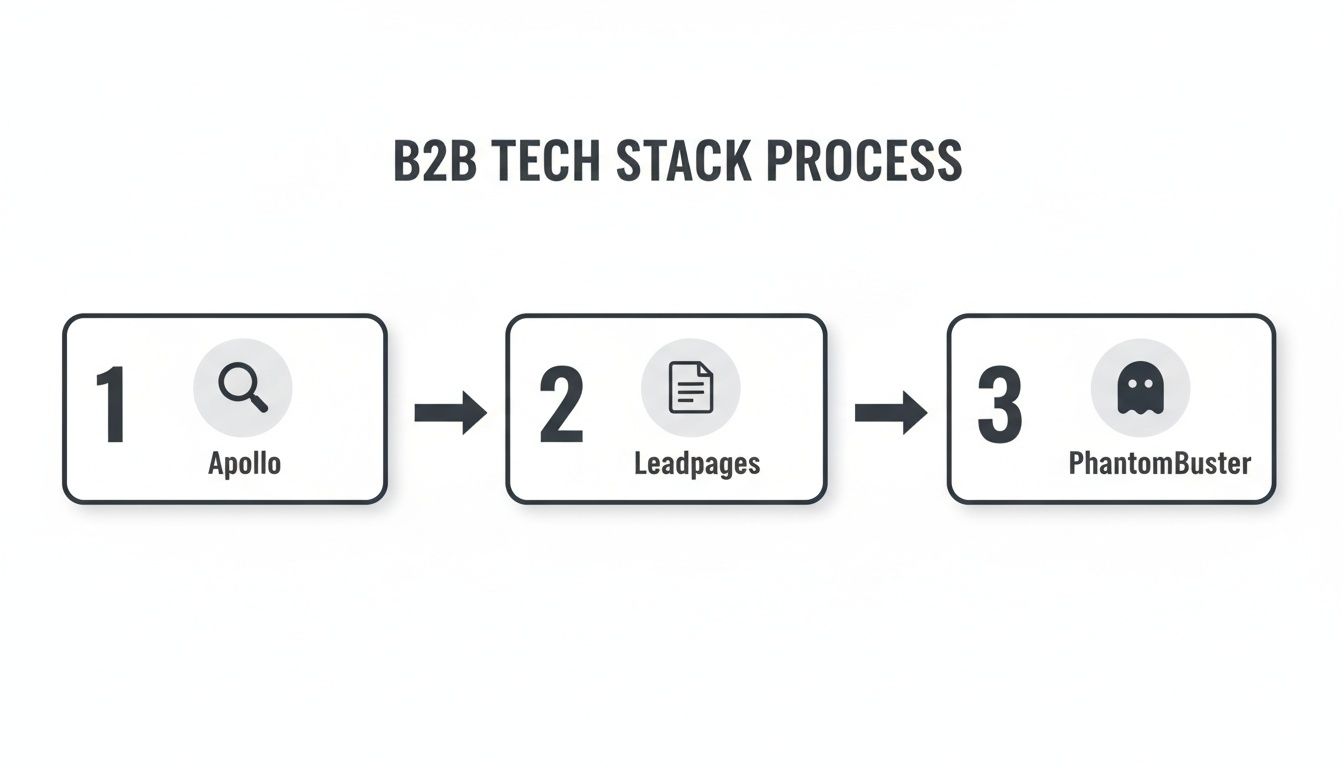
This workflow shows how you can integrate tools like Apollo for sourcing, Leadpages for conversion, and PhantomBuster for engagement to create a pretty seamless machine for sourcing and converting leads.
Crafting Emails That Get Replies
Okay, you’ve got your highly targeted list. Now you have to write a cold email that someone actually opens and responds to.
Forget the long, feature-packed essays nobody reads. Your email needs to be short, personal, and focused entirely on the prospect's world, not yours.
A winning cold email really only has three parts:
- A Relevant Opener: Prove you’ve done 30 seconds of homework. Mention a recent company announcement, a post they shared on LinkedIn, or that you noticed they use a particular technology.
- A Clear Problem Hypothesis: State the specific problem you think they're facing, based on their role and industry. For example, "Saw you're hiring SDRs. Most VPs of Sales I speak to at Series B tech companies are struggling with inaccurate sales forecasting as they scale."
- A Low-Friction CTA: Don't ask for a 30-minute demo right away. That’s too much commitment. Instead, ask a simple, interest-based question like, "Curious if improving forecast accuracy is a priority for you right now?" It makes it incredibly easy for them to reply.
If you need a starting point, you can check out some proven B2B cold email templates and then tweak them to fit your own voice and value prop.
Creating A Multi-Channel Outreach Sequence
Relying on email alone in 2024 is a mistake. Decision-makers are slammed, and their inboxes are a warzone. A multi-channel approach that combines email with LinkedIn engagement will dramatically increase your odds of getting a response.
This is where a tool like PhantomBuster can come in handy to automate the LinkedIn side of things without you living on the site all day.
Here’s a simple but brutally effective sequence you can steal:
- Day 1: View their LinkedIn profile. They get a notification. Then, send a personalized connection request.
- Day 2: Send that first personalized cold email.
- Day 4: Like or comment on one of their recent LinkedIn posts. Be genuine.
- Day 6: Send a follow-up email that offers something valuable—a short guide, a relevant case study, a helpful article. No strings attached.
- Day 10: Send a final, super-brief email asking if the timing is just off.
Email is still an absolute powerhouse for B2B. The market is expected to hit $13.69 billion in revenue by 2025, a huge jump from $7.5 billion in 2020. In fact, 50% of U.S. marketers say it’s their most effective channel, generating twice as many leads as paid ads. To sharpen your strategy, dive into a modern outbound lead generation playbook.
Just remember, personalization is everything; an incredible 96% of marketers see sales lift when they personalize their outreach. And since B2B deals can involve up to 62 touchpoints over six months, a persistent, value-first strategy is the only way to win.
Creating Content That Actually Drives Leads
For a startup, content can't just be about "thought leadership" or brand awareness. It has to be a pipeline driver. Every article, guide, and how-to must earn its keep by attracting your Ideal Customer Profile (ICP) and nudging them toward a conversation. This means you have to skip the fluff. The only thing that matters is practical, problem-solving content that builds trust and proves you actually know what you're talking about.
The best content playbook for b2b marketing for startups is built on a simple idea: answer your customers' most urgent questions. This turns your blog from a marketing channel into a reliable source of qualified inbound leads. You’re creating assets your sales team can actually use and that your prospects will find genuinely helpful.
Sourcing Topics That Address Real Pain Points
The biggest mistake startups make with content is guessing what their audience wants to read. Your best ideas won't come from a brainstorming session; they'll come directly from the people you're trying to sell to. Your job is to become a digital detective and figure out what problems keep your ICP up at night.
This approach guarantees you’re creating content that resonates because it’s based on real-world demand, not what you think they want.
Here are a few high-signal places to hunt for topics:
- Customer and Sales Calls: Listen to the recordings of your sales demos and customer calls. What questions pop up over and over again? Every recurring question is a potential blog post.
- Online Communities: Dive into niche subreddits, LinkedIn groups, and Slack communities where your ICP hangs out. What are they complaining about? The language they use to describe their frustrations is pure gold for your headlines and copy.
- Competitor Questions: Look at the "People Also Ask" section on Google for your main keywords. These are direct insights into the follow-up questions your audience has right after their initial search.
By grounding your content in these sources, you ensure every piece you create hits a genuine pain point, making it far more likely to attract and convert the right people.
Structuring Content for Readability and SEO
Once you’ve got a killer topic, the structure of your post is what determines whether someone actually reads it and whether Google ranks it. B2B buyers are busy. They scan. Your content needs to be formatted for quick consumption.
A tool like Frase is a huge help here. It analyzes the top-ranking content for your keyword and tells you which topics and phrases to include, giving a tiny team a serious advantage.
For a startup, every piece of content should be a salesperson working for you 24/7. It needs to be sharp, to the point, and built to convert. There's no room for vanity metrics; it's all about driving leads.
Here’s a simple framework for structuring a post that actually gets results:
- A Compelling H1 Title: Your title should clearly state the problem you're solving and for whom. Weave in your keywords naturally.
- An Empathetic Introduction: Hook the reader in the first two sentences by showing you understand their specific problem. Briefly state how your article will solve it.
- Actionable H2 and H3 Subheadings: Break up your content with clear, descriptive subheadings. This makes the article scannable and helps readers find exactly what they're looking for.
- Short Paragraphs and Visuals: Keep paragraphs to 1-3 sentences. Use bullet points, numbered lists, and bold text to make key information pop.
- A Clear Call-to-Action (CTA): End every single post with a clear next step. This is where you connect your content to lead generation.
This structure doesn't just improve the reader's experience; it also sends strong signals to search engines about your content's quality and organization, helping you rank higher.
Connecting Content Directly to Lead Generation
This is the most critical part. A blog post without a CTA is a wasted opportunity. You’ve attracted a high-intent visitor; now you need to give them a way to take the next step. This is how you turn your blog from a cost center into a revenue generator.
Don't just slap a generic "Contact Us" at the end of every post. The best CTAs are content-specific and offer more value. For instance, if you write a guide on improving a specific workflow, your CTA could offer a downloadable template or a free tool that helps them implement what they just learned.
You can use a tool like Leadpages to quickly spin up dedicated landing pages for these offers, making it simple to capture lead information. This turns your most valuable articles into powerful lead magnets.
Content marketing is a lifeline for startups hunting for leads. The data doesn't lie: 74% of B2B marketers generate more leads through content, and companies with active blogs see 67% more monthly leads. But here’s the catch—55% of marketers struggle to create content that actually converts. SEO gives you a massive advantage, with close rates hitting 15%, which completely dwarfs the 2% from cold calls. Given that millennials now make up 59% of B2B buyers and prefer to find answers themselves, a strong content strategy is non-negotiable. You can explore more must-know B2B marketing statistics for 2025 to inform your approach.
Measuring What Matters To Scale Your Wins
In the early days, you can't afford to guess what's working. Every dollar and hour you pour into b2b marketing for startups has to be tied directly to growth. This means you need a dead-simple way to track what matters without drowning in vanity metrics.
The goal isn’t to build some complex analytics monster. It's about focusing on a handful of KPIs that tell you if you're actually moving the needle. This is how you find the confidence to double down on a winning tactic and kill what’s not working before you burn through your runway.
Building Your Lean Startup Dashboard
You don’t need fancy, expensive software to get started. Honestly, a basic spreadsheet or a flexible tool like Notion is more than enough. This becomes your central hub, giving you a real-time snapshot of your pipeline's health.
Your dashboard should pull in a few core numbers from each of your main channels—outbound, content, and paid. The idea is to have one place where you can see the entire journey, from that first touchpoint all the way to a closed deal.
At this stage, clarity beats complexity. A simple dashboard that you actually use is infinitely more valuable than a sophisticated one that you ignore. Focus on metrics that directly influence revenue.
When you track these numbers week over week, you'll start to see trends emerge almost immediately. Is your email reply rate suddenly dropping? Time to tweak your messaging. Is one specific blog post driving a surprising number of demo requests? That's your signal to create more content around that exact topic.
Focusing On Mission-Critical KPIs
Forget about tracking every single click, impression, and "like." For a cash-strapped startup, only a few numbers truly matter. These are the metrics that connect your marketing activities directly to sales conversations and, ultimately, to revenue.
Here are the essentials you should be watching like a hawk:
- Email Reply Rate: For any outbound campaign, this is your most important top-of-funnel signal. It tells you if your targeting and messaging are actually resonating. A low reply rate is a blaring alarm that you need to fix your prospect list or rewrite your email copy.
- Lead-to-Meeting Conversion Rate: Of all the people who reply or show interest, how many are actually booking a meeting? This metric cuts through the noise and reveals the true quality of your leads and the effectiveness of your call-to-action.
- Customer Acquisition Cost (CAC): This is the bottom line: your total sales and marketing spend divided by the number of new customers you signed in a period. Keeping your CAC low is a matter of survival. As a rule of thumb, startups often spend around 10% of their revenue on marketing, so every dollar has to work hard. For a deeper dive, check out our guide on how to measure marketing ROI.
This lean approach keeps your marketing accountable. It helps you justify your budget, make smarter decisions, and build a repeatable engine that fuels growth from your first few clients to consistent monthly revenue.
To keep it simple, here's a table summarizing the key metrics you should be tracking from day one.
Key Performance Indicators For Early-Stage B2B Startups
| Metric (KPI) | Lean Benchmark | Tool for Tracking |
|---|---|---|
| Email Reply Rate (Cold Outbound) | > 5% | Your sales engagement tool (e.g., Apollo, Lemlist) |
| Lead-to-Meeting Rate | > 20% | Your CRM or a simple spreadsheet |
| Website Conversion Rate (Demo/Trial) | > 2% | Google Analytics, Fathom, or your web platform |
| Customer Acquisition Cost (CAC) | < 1/3 of LTV | Spreadsheet or CRM |
| Content-Sourced Leads | Track month-over-month growth | Google Analytics, Search Console, CRM |
This simple framework gives you just enough data to know what's working without creating a ton of administrative overhead. Stick to these, and you'll have a clear view of your path to predictable revenue.
Burning Questions for Early-Stage B2B Founders
Let's be honest. When you're a founder, you're the entire marketing department. You're also building the product, talking to customers, and probably making the coffee. It's a lot.
Here are the real-world answers to the questions that pop up most often when you're trying to land those first few customers.
How Much Should We Actually Spend on Marketing?
Forget the generic advice. The classic "spend 10% of revenue" benchmark is fine for established companies, but it's not super helpful when you're just starting out. If you're venture-backed and chasing aggressive growth, you might hear numbers closer to 15%.
But the real answer isn't a percentage—it's about efficiency.
In the beginning, your budget is your time. Your goal is to find customers without burning cash on expensive ads. Focus on channels with high leverage, like targeted cold outreach and foundational SEO. A tool like Apollo gives you a massive ROI by letting you find your first customers' direct emails without a huge ad spend.
What's the "Best" B2B Marketing Channel to Start With?
There’s no magic bullet, but one combination is nearly unbeatable for getting those first meetings on the calendar: targeted outbound paired with long-term content.
- LinkedIn & Cold Email: This duo is all about precision. You can hand-pick the exact decision-makers at companies that match your Ideal Customer Profile. It’s measurable, cheap to start, and you can get your first meetings booked within a few weeks.
- SEO-Focused Content: This is your long game. It takes a while to pay off, but creating genuinely helpful articles that solve your ICP's biggest pains is the most sustainable way to get inbound leads. It builds trust and literally works for you while you sleep.
Don't try to be everywhere at once. It's a classic rookie mistake. Get really, really good at LinkedIn outreach before you even think about dabbling in five other platforms. Mastery of one channel beats mediocrity across many, every single time.
How Do I Know If Any of This is Actually Working?
Early on, success isn't about vanity metrics. Forget website traffic, social media followers, and likes. None of that pays the bills.
It's about conversations and revenue. That’s it.
You need to track a few key performance indicators (KPIs) that connect what you're doing directly to a sale. Here are the only ones that matter at this stage:
- Email Reply Rate: For your outbound campaigns, this tells you if your targeting is right and if your message is resonating. You should be aiming for >5%. If it's lower, your list or your copy is off.
- Meetings Booked: This is the big one. How many of those positive replies are turning into actual sales calls?
- Lead-to-Customer Conversion Rate: Of the people you talk to, what percentage ends up paying you?
Keep these numbers in a dead-simple spreadsheet or a Notion doc. A quick weekly check-in is all you need. This discipline forces you to see what’s truly working so you can kill what isn't and pour fuel on your wins.