10 Scrappy B2B Lead Generation Tactics That Actually Work in 2025

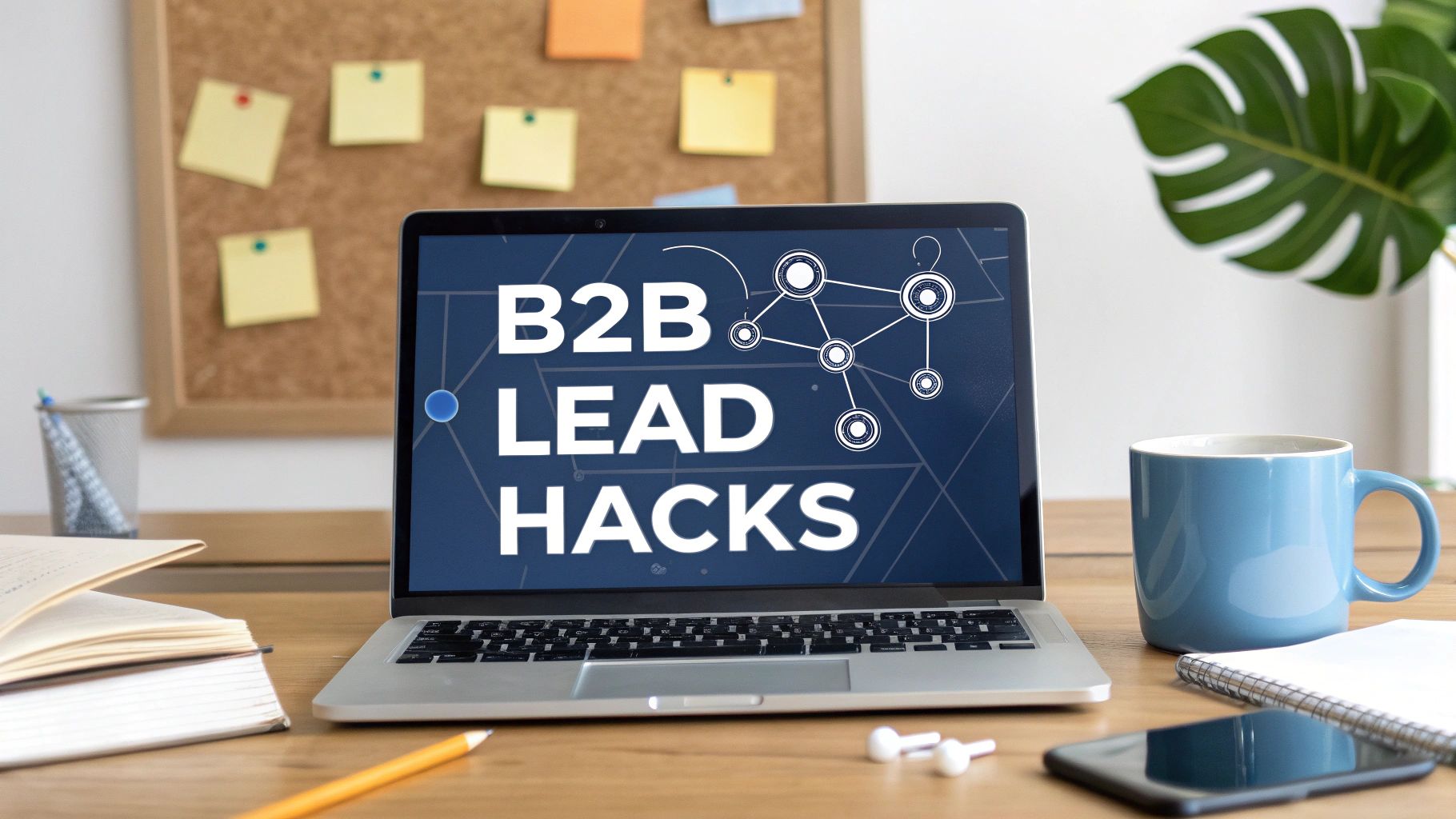
Finding your next client shouldn't feel like a lottery. For small agencies and solo founders, the pressure to generate a consistent flow of qualified leads is constant, and generic advice about 'creating great content' doesn't cut it when you have limited time and a tight budget. You need lean, repeatable workflows that deliver measurable results, not vague theories. This is a practical playbook of actionable b2b lead generation tactics designed specifically for those who need to move quickly and efficiently.
This isn't just another list. We're breaking down the exact steps for proven strategies like LinkedIn outreach, cold email sequencing, and targeted account-based marketing. You'll get specific tool recommendations, such as Apollo for prospecting and Leadpages for high-converting landing pages, alongside the critical decision tradeoffs to help you choose the right path for your business. For a foundational understanding of the entire process, you can also delve into a comprehensive guide on how to generate business leads and grow your sales.
Our goal is simple: to give you a scrappy, no-fluff guide to building a predictable lead pipeline. Each tactic is designed to be implemented quickly, so you can stop guessing and start seeing tangible growth. Let's turn your lead generation problems into reliable revenue.
1. LinkedIn Outreach & Automation
LinkedIn outreach involves direct messaging and connection requests to prospects, supercharged with automation to scale your reach. This is one of the most effective B2B lead generation tactics because it leverages LinkedIn's professional network to pinpoint decision-makers within your target accounts and start conversations directly. The process is simple: find prospects matching your Ideal Customer Profile (ICP), send personalized connection requests or messages, and follow up systematically to book meetings.

Why It Works for Scrappy Teams
For solo founders and small agencies, this tactic offers a direct line to high-value prospects without needing a massive ad budget. B2B SaaS companies use tools like PhantomBuster to automate sequences while maintaining a personal touch, and consultants use it to find marketing directors at companies within specific verticals and employee counts. It’s a highly targeted approach that puts your message right in front of the right people.
Quick Implementation Steps
- Warm Up Your Account: Before automating, spend a week genuinely using your LinkedIn profile. Like posts, comment thoughtfully, and connect manually to build a positive activity history.
- Define Your ICP: Be specific about job titles, industries, company sizes, and locations you're targeting.
- Build Your Prospect List: Use LinkedIn Sales Navigator to create precise lists. You can then use tools like PhantomBuster or Apollo to extract this data.
- Craft Your Sequence: Write a short, personalized outreach sequence of 3-5 messages. Your first message should reference something specific from their profile.
- Launch & Monitor: Start with a small batch of 50-100 prospects. Track your connection acceptance rate and reply rate before scaling. There are many tools to help manage these campaigns, so you can learn more about the best LinkedIn automation tools to find one that fits your needs.
One-Sentence Test for This Week: Manually send 10 personalized connection requests to ideal prospects mentioning a recent post or a shared connection and track your acceptance rate.
2. Cold Email Outreach & Sequences
Cold email involves sending targeted, personalized emails to prospects who haven't opted in, followed by automated sequences to nurture engagement. It’s one of the most scalable B2B lead generation tactics because it allows you to directly contact decision-makers with a message tailored to their specific challenges. The core process is to build a high-quality list of prospects, craft compelling emails that solve a problem, and automate follow-ups to maximize reply rates.

Why It Works for Scrappy Teams
For solo founders and small agencies, cold email offers a cost-effective way to generate high-quality leads without a large marketing budget. A SaaS founder can target VPs of Sales at recently funded companies, while a consultant can pinpoint COOs at e-commerce stores still using manual fulfillment. It provides a direct channel to decision-makers, allowing you to validate an offer and book meetings quickly with precision targeting.
Quick Implementation Steps
- Warm Up Your Domain: Set up a new email address and spend two weeks gradually increasing sending volume. Start with 5-10 emails per day and slowly ramp up to build a positive sender reputation.
- Build a Targeted List: Use a tool like Apollo to find verified contact information for prospects that match your ICP. Always verify emails with a tool like Bouncer to protect your domain.
- Craft Your Sequence: Write a 3-5 email sequence focused on the prospect's pain points. Keep the first email under three sentences with a short, curiosity-driven subject line.
- Personalize and Launch: Use tools like Lemlist to add personalization at scale. Start with a small batch to test your messaging. For more ideas, explore some effective B2B cold email templates.
- Monitor and Optimize: Track your open rates, reply rates, and bounce rates. A bounce rate over 5% signals a problem with your list quality that needs immediate attention.
One-Sentence Test for This Week: Manually send 10 highly personalized emails to ideal prospects referencing a specific company trigger (like a new job posting or funding announcement) and track your reply rate.
3. Content Marketing & SEO
Content marketing and SEO involve creating valuable, targeted content that ranks on search engines to attract prospects who are actively looking for solutions. This is a powerhouse among b2b lead generation tactics because it pulls in high-intent leads organically, positioning your brand as a helpful authority. Instead of pushing your message out, you attract buyers by answering the exact questions they type into Google.
Why It Works for Scrappy Teams
For consultants or small agencies, ranking a single, in-depth guide can generate a consistent stream of qualified inbound leads for months or even years without ongoing ad spend. A B2B SaaS company can create content comparing itself to competitors (e.g., "alternative to [competitor]") to capture prospects at the final decision-making stage. It’s a long-term asset that builds trust and authority, making sales conversations much warmer.
Quick Implementation Steps
- Identify High-Intent Keywords: Brainstorm problems your ICP faces. Use a keyword tool to find phrases with commercial intent, like "how to fix [problem]" or "[service] for [industry]."
- Create Cornerstone Content: Write a comprehensive, long-form guide (3,000+ words) targeting your main keyword. Make it the single best resource on the web for that topic.
- Build Topic Clusters: Write shorter, related articles (1,500-2,000 words) that answer specific sub-questions and link back to your cornerstone piece to build topical authority.
- Embed Lead Magnets: Within your content, offer a valuable, downloadable resource like a checklist, template, or case study in exchange for an email address.
- Publish & Promote Consistently: Aim for 2-4 new posts per month. Sporadic publishing won't build the momentum needed for SEO. Share new content with your network to get initial traffic.
One-Sentence Test for This Week: Identify one high-intent keyword your ideal customer would search for and outline a blog post that provides a complete, actionable solution to their problem.
4. Landing Page & Lead Magnet Conversion
This B2B lead generation tactic involves creating dedicated landing pages to convert cold traffic into qualified leads using high-value lead magnets. Instead of sending visitors to a generic homepage, you direct them to a focused page offering a specific resource, like a guide, template, or free audit, in exchange for their contact information. This strategy captures prospects you can then nurture into customers.
Why It Works for Scrappy Teams
Solo founders and small agencies can use this to build an email list without a massive content marketing engine. A B2B agency might create a landing page for a free "Website Performance Audit," while a SaaS company could offer an "ROI Calculator." These targeted offers convert cold paid traffic at much higher rates (often 15-25%) than a generic "Contact Us" page, turning ad spend directly into attributable leads.
Quick Implementation Steps
- Identify a Core Problem: Pinpoint one specific, urgent problem your Ideal Customer Profile faces. Your lead magnet must solve a small piece of this problem.
- Create a High-Value Lead Magnet: Build a resource that offers an immediate win, such as a checklist, a downloadable template, or a short video workshop. To learn more about how to do this effectively, you can explore in-depth resources about what is a lead magnet.
- Build Your Landing Page: Use a tool like Leadpages or Unbounce to create a simple page. Focus on a strong headline, bullet points listing benefits, and a clear call-to-action (CTA).
- Keep the Form Simple: For cold traffic, only ask for a business email. You can gather more information later in your nurture sequence.
- Set Up Instant Delivery: Ensure your lead magnet is sent automatically and immediately upon signup to provide instant value and build trust.
One-Sentence Test for This Week: Create a one-page Google Doc with your top 5 tips for a client problem, then build a simple landing page offering it as a free download to your network.
5. Account-Based Marketing (ABM)
Account-Based Marketing (ABM) flips the traditional lead generation funnel upside down. Instead of casting a wide net, you target a specific list of high-value accounts with personalized campaigns across multiple channels. This precision tactic focuses on engaging entire buying committees at your dream clients, treating each account as a market of one to close bigger, more complex deals. It's one of the most strategic B2B lead generation tactics for moving upmarket.

Why It Works for Scrappy Teams
For small agencies and consultants, ABM is a game-changer because it concentrates your limited resources on accounts with the highest revenue potential. Instead of wasting time on unqualified leads, you focus all your energy on landing a few key clients. For example, a B2B SaaS company might target 50 Fortune 500 companies with tailored demos and content, while an agency could engage 30 specific companies in their vertical with hyper-relevant case studies.
Quick Implementation Steps
- Identify High-Value Accounts: Start small by building a list of 20-30 "dream" client accounts that perfectly match your ICP.
- Map the Buying Committee: Use tools like Apollo to identify all key decision-makers and influencers within each target account (e.g., CEO, CFO, Head of Ops).
- Craft Personalized Messaging: Develop tailored outreach for each persona. Your message to a CFO should focus on ROI, while your message to a Head of Operations should highlight efficiency gains.
- Launch a Multi-Channel Campaign: Coordinate your outreach across channels. A prospect should see your message on LinkedIn, in their email inbox, and via retargeting ads within a short timeframe.
- Track Account-Level Engagement: Measure your success by tracking how many contacts you've engaged within an account, not just individual lead conversions.
One-Sentence Test for This Week: Choose one dream client, identify three key decision-makers on LinkedIn, and send each a unique message that speaks directly to their role and potential challenges.
6. Paid Advertising (LinkedIn, Google, Facebook)
Paid advertising involves running targeted campaigns on platforms like LinkedIn, Google Ads, and Facebook to drive immediate traffic to landing pages or direct conversations. This is one of the fastest B2B lead generation tactics because it accelerates your reach, placing your message directly in front of highly specific audiences at scale. The core process involves defining a target audience, creating compelling ad creative and offers, and optimizing campaigns to hit a target cost-per-lead.
Why It Works for Scrappy Teams
For solo founders and small agencies, paid ads offer predictable lead flow once a winning formula is found. A B2B SaaS can use LinkedIn ads to target a 'VP of Marketing' at a specific company size with an ROI calculator, while an agency can run Google Search ads for high-intent keywords like "hire SEO agency." It provides a scalable way to generate leads without waiting for organic channels to mature.
Quick Implementation Steps
- Choose Your Platform: Start with LinkedIn if your budget is under $2k/month; its B2B targeting is highly specific. Use Google Ads for high-intent search keywords.
- Define Your Target & Offer: Determine your exact audience (e.g., job titles, industries) and create a valuable offer, such as a free audit, a case study, or a webinar.
- Set Up Your Campaign: Build your campaign with a clear cost-per-lead (CPL) goal. For LinkedIn, use Lead Gen Forms instead of landing pages to boost conversions by pre-filling user data.
- Create Ad Variations: Develop 3-5 different ad creatives and copy variations to test against your target audience. This allows you to identify which messages resonate most effectively.
- Launch and Optimize: Launch your campaign and monitor performance closely for 2-3 weeks. Allocate more budget to the winning ad combinations and pause underperforming ones. Set up retargeting campaigns for website visitors, as they often convert 3-5x better than cold traffic.
One-Sentence Test for This Week: Set up a $50 LinkedIn Lead Gen Form campaign targeting one specific job title in your ICP with a "free checklist" offer to measure your initial cost-per-lead.
7. Referral & Partnership Programs
Referral and partnership programs incentivize your existing network to send warm leads your way. This B2B lead generation tactic leverages the trust built by your current customers, partners, or complementary service providers to generate high-quality introductions. Instead of cold outreach, you get prospects who are already primed to trust you, often leading to significantly higher close rates and shorter sales cycles.
Why It Works for Scrappy Teams
For small agencies and solo founders, this is a low-cost, high-leverage growth channel. It turns your best customers into a sales force. For example, a web design agency can partner with marketing agencies, offering a 20% commission on referred clients. A consultant can partner with CPAs who refer clients in need of strategic financial advice. It's an efficient way to build a pipeline without a large marketing budget.
Quick Implementation Steps
- Identify Potential Partners: List your top 10-20 happiest customers and any businesses that serve a similar audience but don't compete with you.
- Define the Offer: Decide on a compelling incentive. A 20-30% commission is common, but you could also offer reciprocal referrals or discounts on your services.
- Create Simple Referral Assets: Prepare a one-page PDF explaining your value proposition and an email template your partners can easily forward.
- Make It Frictionless: Set up a unique referral link or a simple online form for submissions. Ensure you have a system to track who referred whom.
- Close the Loop: When a referral converts, immediately notify your partner, thank them, and send their commission promptly. To further explore how partnerships can drive B2B leads, consider this complete guide to B2B affiliate marketing.
One-Sentence Test for This Week: Email your three happiest clients and ask if they know anyone who could benefit from your services, offering a 20% commission as a thank-you for any closed deal.
8. Webinar & Virtual Event Strategy
A webinar or virtual event strategy involves hosting live or on-demand presentations that solve a specific problem for your target audience. This is a powerful B2B lead generation tactic because it commands 30-60 minutes of a prospect's undivided attention, allowing you to demonstrate deep expertise, build trust, and transition from education to a direct sales offer. The format is designed to attract qualified leads who are actively seeking a solution and positions you as a credible authority.
Why It Works for Scrappy Teams
For consultants and small SaaS companies, webinars are a high-leverage way to generate leads at scale without a massive budget. An agency can host a "DIY Website Audit" webinar, providing real-time value and booking 5-8 new clients from a single event. Similarly, a B2B SaaS company can run a monthly "How to Solve X" webinar, turning 200 registrants into 20-30 qualified sales conversations. It's a direct channel to engage and convert a warm audience.
Quick Implementation Steps
- Choose a Niche Topic: Focus on a specific, urgent pain point. Instead of "Customer Success 101," host "3 Quick Wins to Reduce Customer Churn This Quarter."
- Promote Extensively: Begin promoting your webinar 2-3 weeks in advance across email, LinkedIn, and partner channels to build a registration list of 200+.
- Structure for Engagement: Keep the core presentation to 40 minutes, using clear slides and examples. Dedicate the final 15-20 minutes to a live Q&A session to boost interaction.
- Make a Clear Offer: Present a time-sensitive offer at the end of the webinar, such as a free consultation or a special discount, to drive immediate action.
- Repurpose the Content: Record the webinar and edit it into short clips for social media, a full video for your YouTube channel, and a gated asset on a landing page to capture leads long after the live event.
One-Sentence Test for This Week: Outline a 40-minute webinar presentation that solves one specific problem for your ideal customer and includes a compelling call-to-action at the end.
9. Strategic Partnerships & Co-Marketing
Strategic partnerships involve collaborating with complementary, non-competing businesses to access each other's audiences. This is one of the most powerful B2B lead generation tactics because it builds on borrowed trust and multiplies your reach without a significant ad spend. You can co-create content, run joint webinars, or offer bundled services to provide immense value to a pre-qualified audience that already trusts your partner.
Why It Works for Scrappy Teams
For small agencies and solo founders, partnerships are a force multiplier. A marketing agency can partner with a web design firm to co-host a "Website to Sales Machine" webinar, instantly tapping into a new pool of warm leads. SaaS companies do this by partnering with integration partners, getting their solution in front of a massive existing customer base. It’s a low-cost, high-trust way to generate high-quality leads.
Quick Implementation Steps
- Identify Potential Partners: List 5-10 companies that serve your Ideal Customer Profile but don't compete with you. Think about what services your clients need right before or after yours.
- Craft a Specific Pitch: Don't just ask to "partner up." Reach out with a concrete idea, like co-authoring a guide or hosting a joint webinar on a specific topic.
- Start with a Single Initiative: Begin with one clear co-marketing campaign. A joint webinar or an exclusive offer to each other's email list is a great starting point.
- Define the Terms: Create a simple agreement outlining lead ownership, follow-up processes, timelines, and promotion commitments from both sides.
- Promote and Track: Promote the initiative heavily to both audiences. Use unique tracking links or a dedicated landing page to measure the leads generated specifically from the partnership in your CRM.
One-Sentence Test for This Week: Identify one ideal partner and send them a specific pitch to co-host a 30-minute webinar on a topic that solves a shared customer pain point.
10. Direct Outreach & Sales Conversations
Direct outreach involves one-on-one phone calls, video calls, or even voice memos to engage prospects identified through research. It’s one of the most powerful b2b lead generation tactics because it bypasses digital noise and gatekeepers, allowing you to build a human connection almost instantly. This approach trades scalability for high-impact conversations, focusing on quality over quantity to book meetings and build genuine relationships with key decision-makers.
Why It Works for Scrappy Teams
For early-stage founders and consultants without a marketing budget, this is often the fastest path to revenue. It requires nothing more than a phone and well-researched prospect list. An agency founder can make 5-10 highly personalized calls a day and secure 1-2 meetings a week. Some consultants have found success sending 30-second voice memos on LinkedIn, achieving response rates of 25-30% compared to the typical 2-3% for text-based messages.
Quick Implementation Steps
- Build a Hyper-Targeted List: Identify 20-30 ideal prospects using LinkedIn Sales Navigator or a tool like Apollo. Focus on accounts where you can make a significant, measurable impact.
- Conduct Pre-Call Research: Spend 15 minutes on each prospect. Look for their recent company news, LinkedIn activity, or mutual connections. Find a specific, relevant "hook" for your conversation.
- Time-Block Your Outreach: Dedicate 60-90 minute blocks in your calendar exclusively for calls. This "call block" builds momentum and prevents distractions, improving your focus and effectiveness.
- Craft a Compelling Opener: Don't start with "I'm calling because..." Instead, use a credible observation like, "I saw your company was featured in TechCrunch for its new AI initiative, and it relates to the work we do with..."
- Track and Iterate: Log every call outcome in a simple CRM or spreadsheet. Note who answered, their interest level, and when to follow up. This data is crucial for refining your approach.
One-Sentence Test for This Week: Send a 30-second personalized voice memo via LinkedIn to five ideal prospects, referencing a specific piece of their recent content, and measure your reply rate.
10-Point Comparison of B2B Lead Generation Tactics
| Approach | Implementation complexity | Resource requirements | Expected outcomes | Ideal use cases | Key advantages |
|---|---|---|---|---|---|
| LinkedIn Outreach & Automation | Medium — setup automation and warm‑up procedures | LinkedIn account, automation tools, time for personalization; moderate cost | Initial conversations in 3–4 weeks; pipeline in 8–12 weeks; low single‑digit reply rates without strong personalization | B2B targeting decision‑makers, pipeline building for SaaS/services | Access to rich profiles, professional context and higher deliverability than cold email |
| Cold Email Outreach & Sequences | Medium–High — deliverability and reputation management required | Email platform, verified contact lists, domain warm‑up, analytics | First qualified conversations in 4–6 weeks; 10–12 weeks for pipeline; variable reply rates (0.5–2% typical) | Scalable outbound across B2B verticals where email addresses can be sourced | Fully controllable messaging, high ROI when optimized |
| Content Marketing & SEO | High — long term strategy, content and technical SEO work | Skilled writers, SEO tools, backlink efforts; ongoing time investment | Slow build: meaningful traffic in 3–6 months; compounding leads over 6–24+ months | Long sales cycles, thought leadership, companies seeking organic inbound growth | Sustainable, low per‑lead cost over time and strong credibility |
| Landing Page & Lead Magnet Conversion | Low–Medium — straightforward to implement and test | Landing page builder, lead magnet creation, traffic source (ads/organic) | Launch in 1–2 weeks; 2–4 weeks to validate lead magnets and conversion rates | Converting cold traffic from ads or content into nurtureable leads | Fast to launch, easy A/B testing, predictable conversion funnel |
| Account‑Based Marketing (ABM) | High — intensive personalization and multi‑channel coordination | ABM tools, sales‑marketing alignment, bespoke content, budget for touches | Initial engagement in 6–8 weeks; closed enterprise deals often 12–24 weeks | High‑value target accounts and enterprise deals where deal size justifies cost | Highest win rates and account penetration when executed well |
| Paid Advertising (LinkedIn, Google, Facebook) | Medium — platform learning curve and optimisation cycles | Ad budgets, creatives, tracking pixels, landing pages | Immediate traffic; 1–2 weeks to identify profitable audience/offer; CPL varies widely | Rapid demand generation and offer testing across markets | Fast scale and measurable ROI with quick feedback loops |
| Referral & Partnership Programs | Low–Medium — design program & recruit partners | Partners/customers, tracking system, commission or incentives | 4–8 weeks to recruit partners; 8–12 weeks for steady referral flow; high close rates | Businesses with existing customers/partners or complementary service networks | Highest close rates and low CAC when partners actively refer |
| Webinar & Virtual Event Strategy | Medium–High — content prep, promotion and live delivery | Webinar platform, promotion budget, presenter(s), production time | 6–8 weeks to pipeline impact; converts a fraction of attendees to sales conversations | Demonstrating expertise, engaging buying committees, lead qualification at scale | Deep engagement, builds trust quickly and produces reusable content |
| Strategic Partnerships & Co‑Marketing | Medium — partner selection and coordination required | Partner outreach, joint assets, shared promotion commitments | 4–12 weeks to generate qualified pipeline; reach scales with partner audience | Expanding reach cost‑efficiently via aligned, non‑competing partners | Access to warm audiences, shared cost, and added credibility |
| Direct Outreach & Sales Conversations | Low technical complexity but high time/skill intensity | Skilled salespeople/founder time, research per prospect, CRM | Immediate conversations; 1–2 weeks for first qualified meetings; high meeting conversion (10–20%) | Early‑stage companies, high‑touch deals, situations needing fast validation | Highest conversion and fastest feedback on fit and messaging |
Do This Next: Pick One Tactic and Go Deep
We've explored a comprehensive arsenal of B2B lead generation tactics, from the automated precision of LinkedIn outreach to the long-term compounding power of Content Marketing and SEO. Each strategy, whether it’s the hyper-focused approach of Account-Based Marketing or the scalable reach of a well-crafted webinar, offers a distinct path to filling your sales pipeline. But information without implementation is just noise. The goal isn’t to juggle all ten of these strategies at once; that’s a direct route to overwhelm and inconsistent results.
The real key to unlocking sustainable growth lies in focus and execution. Your next step isn’t to build a complex, multi-channel machine overnight. It's to choose one of these powerful b2b lead generation tactics and commit to mastering it over the next 90 days.
How to Choose Your Starting Point
Your best first move depends entirely on your current resources and immediate needs. Don't pick a tactic because it's trendy; pick it because it aligns with your strengths.
- If you have more time than money: Double down on sweat equity. Focus on Direct Outreach & Sales Conversations or LinkedIn Outreach. These methods require diligence and personalization but can be executed with minimal financial investment, often just your time and a tool like PhantomBuster to streamline your workflow.
- If you have a small budget for quick wins: Paid Advertising on platforms like LinkedIn, paired with a high-converting landing page built with Unbounce or Leadpages, can deliver targeted traffic and measurable leads almost immediately.
- If you excel at building relationships: Pour your energy into Strategic Partnerships & Co-Marketing or Referral Programs. These tactics leverage your network and the trust you've already built to generate warm, high-quality introductions.
Your 90-Day Mission
Once you've selected your tactic, treat it like a mission. Forget the others for now and go deep. Set up a simple tracking system in a tool like Notion to monitor your key metrics, whether that's email open rates, discovery calls booked, or new leads from a specific partner. Define your process, execute it consistently, analyze the data, and iterate. This focused approach is how you turn a single tactic into a reliable, repeatable revenue engine.
These b2b lead generation tactics are not just abstract ideas; they are the building blocks of a resilient business. By committing to mastering one at a time, you transform theoretical knowledge into tangible results, creating a predictable system for attracting and converting your ideal clients. The foundation for your growth is laid. Now, pick your tool and start building.