The AI Hiring Stack in 2026: What to Automate, and the One Layer to Never DIY
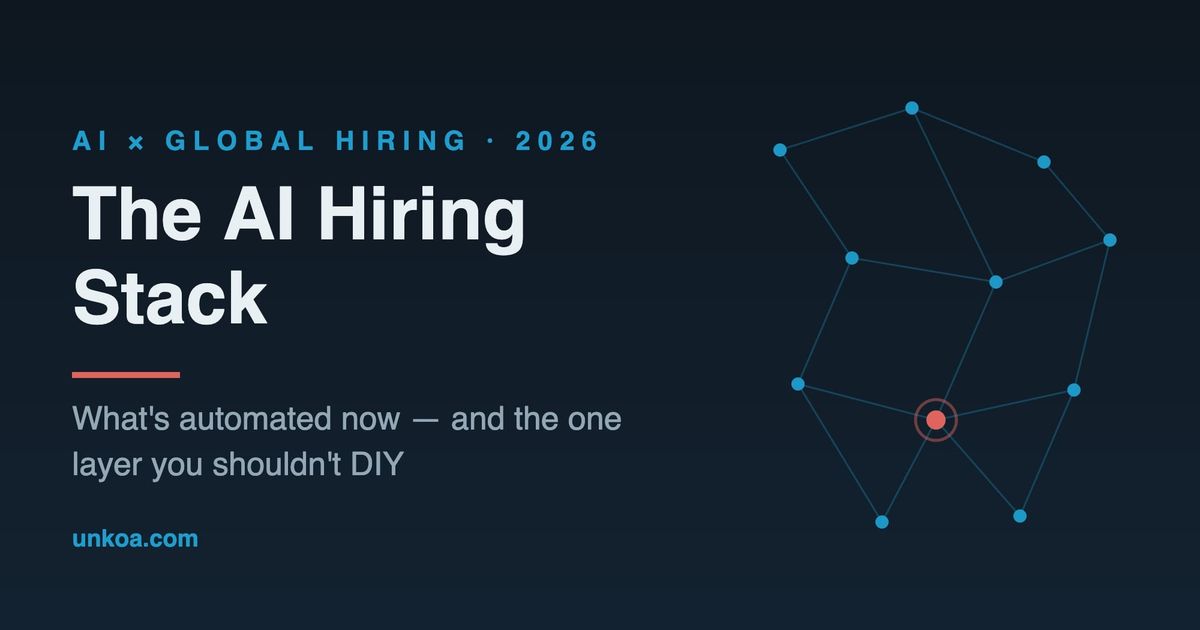
AI made finding and screening people anywhere on earth nearly free. Employing them legally is the part it cannot do. How small teams split the hiring workflow in 2026, with the data behind it.

Disclosure: this post contains affiliate links. We may earn a commission at no extra cost to you.
Cross-border hiring of AI trainers grew 283% in 2025. More than 70,000 people across 600+ organisations now teach AI systems for a living, according to Deel's 2026 Global Hiring Report, which draws on over a million worker contracts across 37,000+ companies in 150+ countries.
There is a loop hidden in that statistic. Companies are hiring people all over the world to build AI, while using AI to hire people all over the world. The tools and the workforce are converging on the same borderless pattern, and it changes what the practical question is for a small company. Not "should we use AI in hiring?" That one is settled. The real question in 2026 is which parts of the hiring workflow you hand to AI, and which part you deliberately hand to infrastructure instead. Teams that get the split right hire like companies ten times their size. Teams that get it wrong automate themselves into legal exposure in countries they have never visited.
The parts AI genuinely runs now
Sourcing has flipped from searching to matching. You describe the role, and the tools return ranked candidates with reasoning attached, plus outreach drafts. A week of recruiter time became an afternoon with a shortlist. The pool being matched is global by default, too. Among nearly 100 startups founded since 2020 that raised more than $100 million, the top destinations for international hires are the UK at 12.2%, Canada at 11.9% and Germany at 8.8%, per the same Deel report. The best-funded companies in the world hire for talent, not postcode.
Screening now happens before you enter the room. Structured interviews recorded on the candidate's own time, AI-scored take-home work, and CV analysis that actually reads the CV rather than keyword-matching it. The bar rose quickly here. Good tools explain why a candidate scored well, which is the difference between a filter and a judgement you can defend to your team.
Scheduling, note-taking and follow-ups have simply disappeared as chores. Meeting agents book the calls, transcribe them, pull out the signal, and draft the offer and rejection emails. Onboarding documents write themselves from the job spec: the 30-60-90 plan, the tool checklist, the first-week docs.
Add it up and the cost of finding and choosing a person anywhere on earth has fallen to nearly nothing. That is precisely what creates the new problem.
The part AI moved but cannot do
When sourcing was slow, geography limited you naturally. You hired where you understood the rules, because everywhere else was too much friction to bother with. AI removed the friction, and the market is pricing the result: specialised AI roles now command a 20 to 25% premium above base pay according to Deel's 2025 State of Global Compensation report, which is a strong reason to hire them wherever they cost less.
The moment you try to pay that person, though, you have left the territory AI can safely improvise in.
Employment status. Payroll taxes. Statutory benefits, including things like 13th-month pay, a legally required extra month of salary in many countries that catches out founders who have never heard of it. Termination rules that vary wildly. Misclassification exposure if your "contractor" works like an employee. And, since November 2025, a newly codified one: the OECD updated its Model Tax Convention commentary with a 50% working-time test for when a remote employee's home office becomes their employer's taxable presence in that country. I have broken that update down in a plain-English guide to the new 50% rule.
None of this is a text-generation problem. It is a jurisdiction problem. An AI assistant can describe Brazilian labour law impressively well. It cannot be your registered local employer, file your withholdings, or absorb the liability when a contractor relationship gets reclassified three years in. When the DIY approach fails here, the failure is not a bad draft. It is retroactive fines with interest, in a country where you have no lawyer.
So the honest picture of hiring in 2026 looks like this: AI has compressed the top half of the workflow to almost nothing, and the bottom half still needs real infrastructure.
Where Deel fits: the layer underneath the AI tools
This is the slot Deel occupies in a small company's stack. It is not another AI tool. It is the compliance and payroll layer the AI tools hand off to once a candidate says yes.
The core of it is the Employer of Record, or EOR. When your stack surfaces a hire in a country where you have no legal entity, Deel employs them on your behalf through its network of roughly 250 owned legal entities: compliant local contract, statutory benefits, tax filings, all of it, while the person works for you day to day. Your AI workflow ends at "chosen candidate," and Deel turns that choice into a lawful employee within days. Because a local entity is the legal employer, it also takes your company out of the permanent-establishment firing line for that employment, the problem covered in the 50%-rule guide above.
For the freelancer-first pattern most small teams actually run, the contractor side matters just as much. Deel's contractor management, at $49 per contractor per month, standardises localised contracts and invoicing, and flags when a contractor relationship starts drifting toward de-facto employment. Small teams otherwise have no smoke alarm for that. Payroll consolidates into one dashboard with local currencies and local filings, which replaces the spreadsheet-and-five-bank-transfers routine where compliance errors usually breed. And Deel has been applying AI inside its own guardrails: its AI Workforce agents (Hiring Guru for policy questions, Payroll Detective for anomalies, PTO Fairy for leave) automate the routine layer on top of real entities and filings, which is the only place automation is safe for this class of problem.
The division of labour to copy: let AI make you fast where mistakes are cheap, in sourcing, screening, scheduling and drafts. Put infrastructure where mistakes are expensive, in employment, payroll and tax.
A realistic two-week hire for a five-person team
Monday, an AI sourcing tool builds the shortlist. Tuesday to Thursday, recorded AI-screened interviews run on the candidates' own time. Friday, the founder does one live final call, the judgement step genuinely worth keeping human, and sends the offer that evening. The next week the hire is onboarded through Deel as an EOR employee, with a compliant local contract and payroll that simply runs on the 1st. No legal entity opened, and no foreign employment law on the founder's reading list.
The teams getting this wrong in 2026 run it in reverse. They automate the judgement, letting the AI effectively pick the hire, then hand-roll the compliance by paying that person like a freelance invoice and hoping. Keep the judgement human and buy the compliance. It is the cheaper mistake profile by a wide margin.
The bottom line
AI did not remove the hard part of global hiring. It moved it. Finding people is now nearly free, so employing them correctly is the constraint that remains, and it is one you buy your way out of rather than automate your way around. See how Deel handles that layer: open a free account and see what hiring in your target country actually involves.
If you want the costs first, my Deel pricing guide breaks down contractor management versus Contractor of Record versus EOR, line by line.
Related reading: The OECD's new 50% rule on remote work and permanent establishment · How to hire in Vietnam without breaking four laws at once · Deel vs Rippling 2026
Sources: Deel, Global Hiring Report 2026 (one million-plus worker contracts across 37,000+ companies; AI-trainer cross-border hiring up 283% in 2025; 70,000+ workers across 600+ organisations; cross-border hiring destinations of $100M+ startups); Deel, 2025 State of Global Compensation (20 to 25% pay premium for specialised AI roles); OECD Model Tax Convention Commentary update, November 2025.