10 High-Converting Ad Copy Examples to Drive B2B Growth in 2025

Great ad copy isn’t about clever taglines; it's about repeatable systems that turn attention into revenue. For solo founders, consultants, and small marketing teams, this means converting clicks into qualified leads, demos, and sales without wasting your budget on guesswork. We’ve compiled a comprehensive playbook of high-performing ad copy examples from every critical B2B channel, including LinkedIn DMs, Google Search campaigns, and landing page headlines.
Each example is a mini-playbook. We’ll dissect the strategy behind the copy, provide a tactical breakdown of why it works, and give you actionable steps to implement it immediately. This isn't just a gallery of good ads; it’s a practical guide to shipping campaigns faster and converting better. You'll see how to adapt these frameworks for your own campaigns using tools like Apollo for precise targeting and Leadpages for building high-converting destinations that capture value from every click.
To ensure your ad copy resonates with your audience and drives conversions, a key starting point is understanding what to include in effective ad copy. This collection goes beyond the basics, giving you proven templates and strategic insights to apply those fundamentals in real-world scenarios. Forget theory and abstract advice. Let's dive into the specific copy that gets results.
1. LinkedIn Direct Message Campaign - B2B SaaS Lead Generation
A personalized cold outreach campaign via LinkedIn Direct Messages is a powerful B2B strategy. This method moves beyond traditional ad placements, allowing you to connect directly with decision-makers in their professional digital habitat. By referencing specific, publicly available details about a prospect or their company, you can craft a message that feels less like a cold pitch and more like a relevant, timely conversation starter.

This approach is highly effective because it demonstrates genuine research and focuses on solving a specific, observable pain point. The goal is not to close a deal in the DMs, but to secure a brief introductory call where you can build rapport and explore their needs further.
Why This Ad Copy Works
- Hyper-Personalization: The copy leverages a "trigger" event (e.g., a new feature launch, a recent funding announcement, or a new job posting). This proves you've done your homework and aren't just spamming a generic list.
- Problem-Agitation: It immediately connects the trigger to a common industry problem. For example, "saw you're hiring new SDRs" is linked to the problem of "ramping them up quickly."
- Clear, Quantifiable Outcome: The message presents a specific, desirable result, such as "reduce sales cycle by 40%" or "get consistent 2-5 calls/week." This makes the value proposition tangible and compelling.
- Low-Friction Ask: The call-to-action is a simple, low-commitment request for a "15-min chat," which is much easier for a busy professional to agree to than a lengthy demo.
Strategic Insight: The key to successful LinkedIn DM outreach is relevance at scale. While the message is a template, the personalization token (the "trigger") is unique to each prospect, creating a one-to-one feel. This is a prime example of leveraging one-to-one communication tactics within a one-to-many lead generation system.
How to Implement This Strategy
- Identify Your Triggers: Define 3-5 specific events that signal a prospect is a good fit for your solution. Use tools like Apollo or LinkedIn Sales Navigator to track these triggers, such as company funding rounds, new hires in key departments, or specific technology usage.
- Craft Your Templates: Write a concise message for each trigger. Keep the body under 600 characters for mobile readability.
- Trigger A (New Hires):
Hi [Name], saw that [Company] is hiring for the [Department] team. Scaling teams often struggle with [Problem]. We help them achieve [Result]. Worth a quick chat next week? - Trigger B (Feature Launch):
Hi [Name], congrats on the launch of [specific feature]. Companies shipping new products like this often need help with [Problem]. We help them [Result]. Open to a 15-min call to share how?
- Trigger A (New Hires):
- Execute and Track: Use an automation tool like PhantomBuster with human-like delays to send connection requests and messages. Track your reply rates for each template variation in a simple spreadsheet to identify the winning ad copy examples. For a deeper dive into effective LinkedIn advertising strategies and examples, consider exploring a collection of 100 B2B LinkedIn Ads to Generate More Leads.
2. Email Subject Line - Pain Point + Curiosity Gap
An effective email subject line is the most critical component of any B2B cold outreach campaign. This ad copy example combines two powerful psychological triggers: it directly addresses a known pain point and simultaneously creates a curiosity gap. This format grabs attention by making the message immediately relevant to the recipient's professional challenges, compelling them to open the email to discover the implied solution.
This strategy works because it feels less like a generic sales pitch and more like an insightful observation from a peer. By naming a specific business problem, you demonstrate an understanding of their world, while the unanswered question creates an intellectual itch that can only be scratched by clicking "open." The goal is to earn the open, which then allows the email body to do the heavy lifting of building value.
Why This Ad Copy Works
- Immediate Relevance: The subject line speaks directly to a problem the prospect is likely facing. For example, "Your content is good. Your distribution isn't." immediately resonates with a content manager struggling with reach.
- Intrigue without Clickbait: It poses an implicit question without resorting to cheap tricks like "You won't believe this!" The curiosity is organic, based on a desire to solve a real business issue.
- Social Proof & Data: Incorporating specific numbers or referencing competitors (e.g., "Why 3 of your competitors landed $50k contracts") triggers a sense of urgency and a desire to keep up.
- Specificity: Vague subject lines are ignored. "The 2-hour bottleneck killing your pipeline" is far more powerful than "How to improve your pipeline," because it names a precise, relatable pain.
Strategic Insight: The most potent subject lines often use the exact language your customers use to describe their problems. The goal isn't to be clever; it's to be understood. Your open rate is a direct measure of how well you've captured and articulated your prospect's internal monologue.
How to Implement This Strategy
- Survey Your Customers: Before writing, interview 10-15 of your ideal customers. Ask them one simple question: "What's the single biggest bottleneck in your [department/role] right now?" Use their exact phrasing in your subject lines.
- Draft and Segment: Create two primary templates. One focuses purely on the pain point ("Most [Role] can't get their sales team to use a process"), and the other leads with curiosity ("The one metric your board actually cares about").
- A/B Test and Track: Use an email tool like Lemlist to run a 50/50 split test between your pain-focused and curiosity-focused subject lines. Track both open rates and reply rates; a high open rate with a low reply rate indicates the email body failed to deliver on the subject's promise. For a deeper analysis, you can learn more about how to improve email open rates and refine your approach.
3. Google Ads Search Campaign - High-Intent Keyword Copy
A high-intent Google Ads search campaign targets users actively looking for a solution to an immediate problem. This strategy focuses on keywords that signal a user is in the decision-making or buying stage, such as those including terms like "software," "pricing," "comparison," or "for [industry]." The ad copy is crafted to directly mirror the user's search query, confirming they've found a relevant answer and providing a clear path to conversion.
This approach is highly effective because it minimizes friction. Instead of educating a cold audience, you are meeting an informed buyer exactly where they are searching, with language that precisely matches their intent. The goal is to present your solution as the most logical, credible, and efficient choice to solve their stated problem.
Why This Ad Copy Works
- Mirrors User Intent: The headlines and description directly reflect the language of the search query. A user searching "B2B Sales Software for Agencies" immediately feels understood and validated.
- Quantifiable Value Proposition: The second headline instantly communicates a tangible benefit or result (e.g., "40% faster pipeline" or "30 conversations/week, not 3"). This number-based promise makes the value concrete and easy to grasp.
- Builds Instant Credibility: The third headline often uses social proof like "500+ reviews" or "Used by 5000+ founders." This reassures prospects that they are making a safe, popular choice and reduces perceived risk.
- Clear, Action-Oriented CTA: The description copy culminates in a low-friction call-to-action like "Book a demo today," guiding the user toward the next logical step in their buying journey.
Strategic Insight: The power of high-intent search ad copy examples lies in their alignment with the customer journey. You are not creating demand; you are capturing it. By segmenting keywords by intent (e.g., awareness, consideration, decision), you can tailor your copy to the user's mindset, dramatically increasing click-through and conversion rates.
How to Implement This Strategy
- Segment Keywords by Intent: Organize your keyword strategy into stages. For instance, 'CRM software' is an awareness keyword, while 'best CRM for small agencies' is consideration, and 'HubSpot vs Zoho pricing' is a high-intent decision keyword. For a deeper look into this process, learn more about how to find the right keywords for your small business.
- Craft Headline Variations: Write specific, compelling headlines for your responsive search ads.
- Headline 1 (Keyword Match):
B2B Sales Software for Agencies - Headline 2 (Benefit/Outcome):
Close Deals 40% Faster - Headline 3 (Social Proof):
Rated 4.9 Stars on G2 - Description:
Stop losing deals to manual processes. Our CRM tracks every lead in one place, so you can focus on selling. Get your free demo today.
- Headline 1 (Keyword Match):
- Align Ad and Landing Page: Ensure your landing page headline and core message perfectly match your ad copy. Use a tool like Leadpages to quickly build and test dedicated landing pages for your ad groups, maintaining message consistency and boosting your Quality Score.
- A/B Test and Track: Continuously test different angles in your headlines. Pit a benefit-focused headline against a credibility-focused one. Most importantly, track conversions at the keyword level, not just the ad group or campaign level, to identify and double down on your most profitable search terms.
4. Facebook/Instagram Carousel Ad - Problem-Solution-Social Proof Sequence
The carousel ad format on Facebook and Instagram is a storytelling powerhouse for B2B marketers. It guides a user through a logical narrative across multiple slides: identifying a relatable problem, presenting your product as the clear solution, and backing it up with compelling social proof. This sequence transforms a simple ad into a mini-presentation that educates and builds trust before asking for a click.
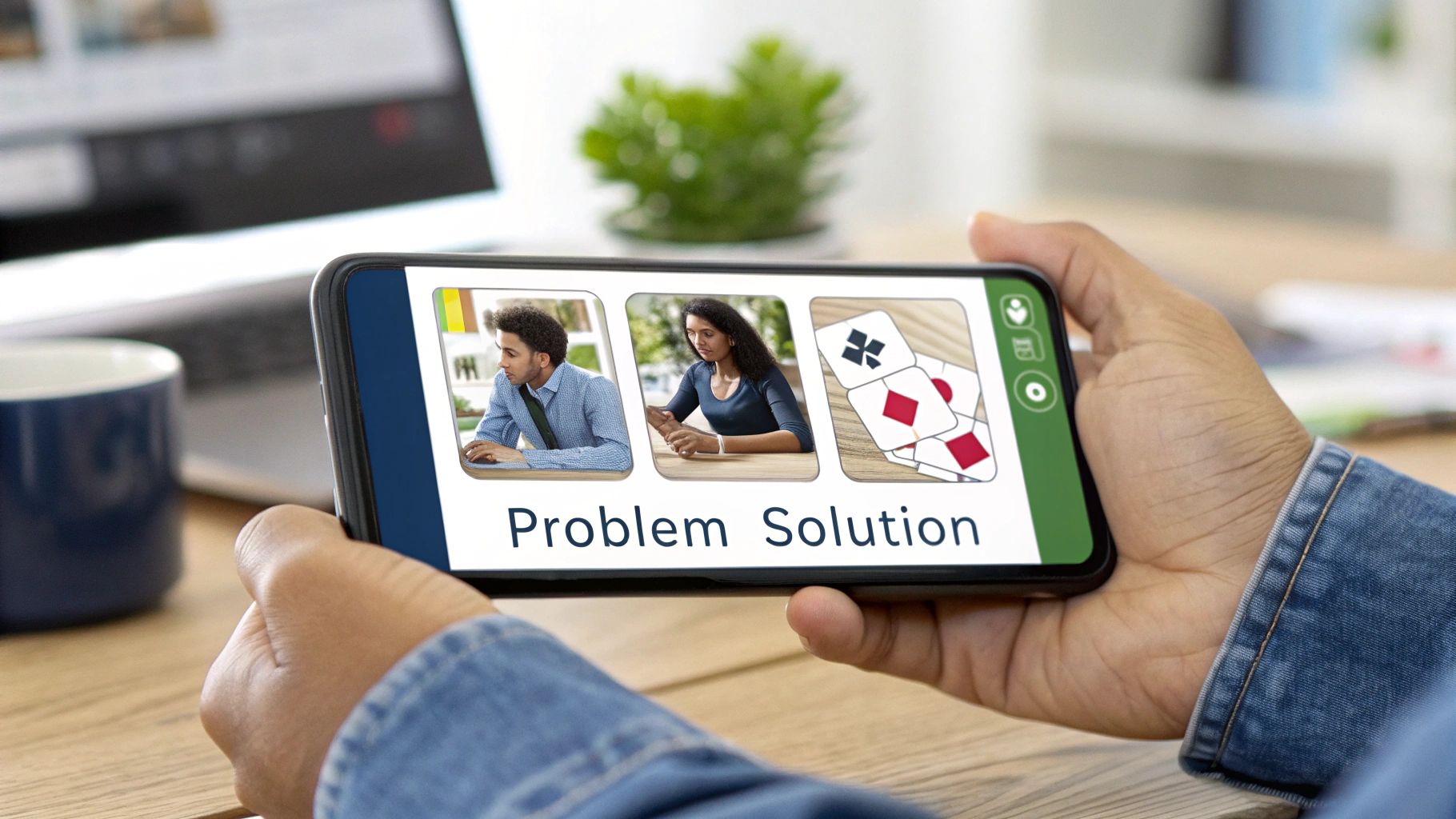
This method is particularly effective for SaaS and service providers because it breaks down a potentially complex value proposition into digestible, visually engaging steps. Instead of trying to convey everything in a single image or video, the carousel allows you to control the flow of information, leading the prospect from pain-point awareness to solution consideration in just a few swipes.
Why This Ad Copy Works
- Narrative Structure: It follows the classic Problem-Agitate-Solve framework. The first card stops the scroll by highlighting a common pain point (e.g., "Content creators lose 10+ hours/week on thumbnails"), making the user feel understood.
- Builds Trust Before Selling: The solution isn't introduced until the second or third card. This sequence respects the user's journey, earning their attention before making a direct pitch.
- Tangible Social Proof: The final cards provide concrete evidence, such as customer testimonials, case study data ("40% faster deal close"), or before-and-after visuals. This third-party validation is more persuasive than brand claims alone.
- Interactive Engagement: The nature of a carousel encourages users to swipe, increasing their time spent with the ad. This active participation can lead to higher message recall and click-through rates.
Strategic Insight: The power of the carousel lies in its ability to segment your message. The first card's only job is to stop the scroll and earn a swipe. The middle cards educate and build desire. The final card's only job is to drive the click. Each card has a singular focus, which is a prime example of creating effective ad copy examples that guide users through a micro-funnel within a single ad unit.
How to Implement This Strategy
- Map Your Narrative: Define the three core stages for your carousel.
- Card 1 (Problem): Identify a specific, quantifiable pain point your audience experiences. Use bold text and a high-contrast image. Example: "Your sales team is using 5 different tools for pipeline management."
- Card 2 (Solution): Introduce your product as the hero. Focus on the core benefit, not just features. Example: "We built one dashboard to unite them all."
- Cards 3-4 (Social Proof): Showcase results. Use customer quotes, data points, or a powerful before-and-after visual. Example: "See how [Client Name] cut admin by 12 hours/week."
- Write Compelling Headlines: Each carousel card has its own headline. Treat each one like a mini-ad. Make them short, punchy, and focused on a single idea. The headline for the problem card should be a question or a bold statement.
- Set Up the Campaign: In your ad platform, choose the "Carousel" format. Upload each image or video and its corresponding headline and description. For the final card, use a clear call-to-action like "Book a Demo" or "Try for Free" and ensure the destination URL is correct. Analyze card-level metrics to see which message resonates most.
5. YouTube Pre-Roll Ad Copy - 5-Second Hook + Value Proposition
A well-crafted YouTube pre-roll ad is a masterclass in efficiency. This format challenges advertisers to capture attention and deliver a core message before the viewer can hit the "Skip Ad" button, which typically appears after five seconds. The strategy relies on an immediate hook that identifies a relatable problem or sparks curiosity, followed by a swift value proposition that presents a clear solution.
This approach is powerful for B2B because it forces message clarity. By focusing on the first five seconds, you can drive brand awareness and funnel traffic even from viewers who skip, as the core problem and brand name have already been presented.
Why This Ad Copy Works
- Front-Loaded Value: The most critical information is delivered in the first three to five seconds. This respects the viewer's time and ensures the core message is heard even if they skip.
- Problem-Agitation Hook: The ad opens by immediately calling out a specific pain point. Voiceovers like, "Your sales team is drowning in spreadsheets" or "Most LinkedIn outreach is getting filtered as spam" create instant resonance with the target audience.
- Rapid Solution: The value proposition immediately follows the problem. The transition from a cluttered spreadsheet to a clean dashboard, or from a spam folder to a personalized message, visually and audibly communicates the benefit.
- Curiosity Gap: A hook like, "This is not another project management tool" creates a curiosity gap. It makes the viewer wonder what it is, encouraging them to watch past the five-second mark.
Strategic Insight: For B2B on YouTube, production quality is secondary to message clarity. The primary goal is to interrupt the viewer's pattern with a highly relevant problem. A simple, well-scripted screen recording or a phone video that clearly articulates a pain point can outperform a high-budget ad that fails to connect in the first five seconds.
How to Implement This Strategy
- Develop Your Hooks: Brainstorm 3-4 distinct hooks based on your audience's primary pain points. For example:
- Pain Point A (Inefficiency): "Your sales team is drowning in spreadsheets."
- Pain Point B (Ineffectiveness): "Most LinkedIn outreach is getting filtered as spam."
- Pain Point C (Overwhelm): "Tired of juggling five different marketing tools?"
- Script the First 5 Seconds: Write a tight script for each hook. The voiceover is critical, as many users may be listening without watching closely. Use simple visuals that reinforce the audio.
- Seconds 1-3 (Hook): Voiceover: "Most LinkedIn outreach is getting filtered as spam." [Visual: Email client showing a spam folder]
- Seconds 4-5 (Value Prop): Voiceover: "Not ours." [Visual: A personalized, engaging message in an inbox]
- Test and Measure: Launch your ads targeting custom intent audiences (people searching for your competitors or solution keywords). Don't just track clicks; analyze your view-through rate (VTR) at 25%, 50%, and 75% in YouTube Analytics. This data reveals exactly where your audience drops off, helping you refine your ad copy examples for maximum impact.
6. Landing Page Headline + Subheadline - Transformation-Based Copy (Leadpages Framework)
When a user clicks your ad, the landing page headline is the first thing they see. This two-part headline structure, popularized by platforms like Leadpages, is designed to immediately answer the visitor's crucial question: "Why am I here?" It achieves this by stating a clear before-and-after transformation in the main headline, then using the subheadline to tackle a primary objection or add compelling specificity.

This method ensures message match between your ad and your landing page, which is critical for reducing bounce rates and improving conversion. The visitor feels they are in the right place, and the copy quickly builds confidence by showing you understand their goals and their hesitations.
Why This Ad Copy Works
- States a Clear Transformation: The main headline isn't just a feature; it's a desirable outcome. "Reduce your sales cycle from 90 days to 30 days" is a powerful promise of change.
- Preemptively Handles Objections: The subheadline immediately disarms skepticism. For example, "Without changing your product, team, or pricing" removes common reasons a prospect might think the solution won't work for them.
- Adds Specificity and Proof: A subheadline like, "Here's the system we use with 200+ clients" adds social proof and credibility, making the promised transformation feel more achievable.
- Creates Instant Relevancy: It directly connects the user's problem to your solution, creating a seamless transition from the ad's promise to the landing page's offer.
Strategic Insight: The most powerful subheadlines often come directly from your sales calls. Listen for the most common "but what if..." or "we can't because..." objections. By addressing the #1 objection right in the subheadline, you remove the biggest friction point to conversion before the user even scrolls.
How to Implement This Strategy
- Define the Transformation: Clearly articulate the "before" state (the pain) and the "after" state (the desired result) your service provides. Frame this as your main headline.
- Headline Example:
Get consistent 5-10 qualified leads per week without cold calling.
- Headline Example:
- Identify the Core Objection: What is the single biggest doubt or constraint your ideal customer has? Is it cost, complexity, or required resources? Address this in your subheadline.
- Subheadline Example:
Most agencies fail at repeatable pipeline. Here's the system we use with 200+ clients.
- Subheadline Example:
- Ensure Message Match: Your landing page headline should be a direct continuation of the ad copy that brought the user there. If your ad promises to "Automate LinkedIn Outreach," your landing page should reflect that exact language. For a deeper look into this and other strategies, explore effective techniques for landing page conversion rate optimization.
- A/B Test Your Angles: Pit a transformation-focused headline ("From X to Y") against a benefit-focused one ("Achieve Y without X") to see which resonates more with your audience. Use tools on platforms like Leadpages or Unbounce to run these tests easily.
7. Cold Email Body Copy - Pattern Interrupt + Micro-Value
This cold email strategy is designed to slice through the noise of a crowded B2B inbox. It works by first breaking the recipient's pattern of deleting generic sales pitches with a highly specific and relevant observation. Immediately after, it delivers a small, genuinely useful piece of value with no strings attached, positioning you as a helpful expert rather than just another salesperson.
The goal of this ad copy example isn't to book a meeting right away. It's to earn a positive reply and permission to continue the conversation. By leading with generosity and demonstrating you've done your research, you build trust and stand out from the 99% of automated, self-serving emails your prospect receives daily.
Why This Ad Copy Works
- Pattern Interrupt: The opening line, such as "Noticed you've hired 3 people on the sales team in the last 60 days," is hyper-specific and cannot be automated at scale. This signals to the reader that the email is personalized and worth reading.
- Problem-Focused: It immediately connects the observation to a relevant business problem ("struggle with onboarding consistency at that scale"). This shows you understand their world and their potential challenges.
- Zero-Friction Value: The offer is a "micro-value" asset like a playbook, a short resource, or a quick tip. It's ungated and instantly useful, requiring no commitment from the prospect.
- Low-Threat CTA: The call-to-action is a simple question like "Worth a look?" or "Let me know?". This is a soft ask that is psychologically easier to respond to than a request for a 30-minute demo.
Strategic Insight: The power of this technique lies in reciprocity. By giving value first without asking for anything significant in return, you create a psychological desire for the prospect to reciprocate, often with their time and attention in a follow-up conversation. It flips the traditional sales script from "taking" to "giving."
How to Implement This Strategy
- Build a Hyper-Targeted List: Use a tool like Apollo to identify 20-30 ideal prospects. Look for specific buying signals, such as recent funding, key department hires, or new technology adoption that you can reference.
- Develop Your "Micro-Value" Assets: Create a small library of useful, ungated content. This could be a one-page checklist, a link to an insightful (non-gated) case study, a short Loom video with a tip, or a curated list of top industry articles.
- Craft and Send Manually (At First): Before scaling, manually send your emails to test the copy. Spend 5 minutes researching each prospect to find your pattern interrupt.
- Hiring Trigger:
Hi [Name], I noticed [Company] has hired [Number] new [Job Title]s recently. Teams growing this fast often face [Problem]. We built a 3-week playbook that [Client Name] used to achieve [Result]. Might be useful for the new folks. Let me know? - Content Trigger:
Hi [Name], your latest article on [Topic] was excellent. One thought: readers focused on that often hit a bottleneck with [Related Problem]. I put together a quick resource on solving it. Worth a look?
- Hiring Trigger:
- Follow Up Gently: If you don't receive a reply, follow up 5-7 days later with a simple, contextual nudge. A message like, "Hi [Name], just wanted to circle back on the playbook for new sales hires" is non-pushy and effectively reminds them of the initial value offered.
8. TikTok/Reels Ad - Creator-Style Storytelling (B2B Educational Angle)
B2B brands are leveraging short-form video platforms like TikTok and Instagram Reels by ditching corporate polish for authentic, creator-style content. This strategy involves creating 15-60 second videos that teach a quick lesson or share a counter-intuitive industry insight. The ad feels less like a sales pitch and more like valuable content from a trusted expert, which resonates strongly with the growing number of younger B2B decision-makers who consume content on these platforms daily.
This method is effective because it builds authority and captures attention in a highly saturated feed. By providing genuine value upfront through education, brands can attract a relevant audience, build trust, and drive traffic to a lead magnet or resource without the hard sell typical of traditional ad copy examples.
Why This Ad Copy Works
- Pattern Interrupt Hook: The ad starts with a bold, problem-focused statement like, "Your LinkedIn outreach sucks because you're doing this." This immediately grabs the attention of the target audience and makes them stop scrolling.
- Educational Value: Instead of just selling, the ad teaches something useful. It presents a common problem and then delivers a quick, actionable solution, positioning the brand as a helpful authority.
- Authentic Presentation: The ad mimics the native style of the platform. It uses a casual tone, simple graphics, on-screen text, and a direct-to-camera speaking style, which feels more genuine and trustworthy than a slick, high-production commercial.
- Subtle Call-to-Action: The CTA is often a soft sell, encouraging viewers to learn more by visiting a link in the bio for a "full playbook" or following the account for "more tips." This aligns with the educational nature of the content.
Strategic Insight: Success in B2B short-form video isn't about production value; it's about educational value. The goal is to become the go-to resource in your niche by consistently sharing high-impact insights in a digestible format. The algorithm rewards engagement, and education drives valuable comments and shares.
How to Implement This Strategy
- Identify Pain-Point Topics: Brainstorm 5-10 common mistakes, myths, or challenges your ideal customer faces. Frame them as compelling hooks (e.g., "Stop wasting money on [common practice]," "The #1 reason [target audience] fails at [task]").
- Script a Simple "Hook, Point, CTA" Format:
- Hook (3 seconds): State the problem or counter-intuitive insight. Example: "Most B2B agencies fail because of ONE mistake."
- Point (10-20 seconds): Briefly explain the problem and present your 3-step solution using on-screen text and simple visuals. Example: "They don't have a repeatable process. Here's what you need: 1. Systemize onboarding, 2. Standardize reporting, 3. Automate follow-ups."
- CTA (3 seconds): Direct them to the next step. Example: "We put our entire agency playbook in the link in bio. Go get it."
- Film, Edit, and Amplify: Record using a smartphone to maintain authenticity. Use a tool like Opus Clips to repurpose longer content or edit directly in the platform's app. Post 3-4 videos organically to build a presence before running your best-performing one as an ad, targeting audiences based on interests related to your industry. Measure success by engagement rate (comments, shares, saves) over simple views.
9. Comparison Page Copy - Versus Positioning (Feature-Led to Outcome-Led)
Comparison page copy is a high-intent marketing asset designed for prospects in the consideration stage. Instead of just listing your features, this strategy positions your solution directly against a known competitor or a common manual process (like spreadsheets or hiring an employee). It frames the choice not around technical capabilities, but around superior business outcomes like cost savings, time efficiency, or faster results.
This approach is highly effective because it intercepts prospects who are actively looking for justification to choose a solution. They are already problem-aware and solution-aware; your job is to prove why your solution is the best choice by translating features into tangible, quantifiable wins that directly address their evaluation criteria.
Why This Ad Copy Works
- Outcome-Focused Framing: It leads with the result, not the feature. Instead of "Automated Syncing," it says "Save 30 mins/rep/day." This speaks directly to the business value the prospect is seeking.
- Direct Comparison: It simplifies the decision-making process. By creating a clear "us vs. them" table, you control the narrative and highlight the areas where your solution excels, making the value proposition obvious.
- Builds Trust Through Honesty: Acknowledging a competitor and their (potentially limited) strengths can build credibility. You're not pretending they don't exist; you're confidently explaining why you're a better alternative for a specific use case.
- Data-Driven Persuasion: Using concrete numbers (e.g., "$350k+ vs. $30k," "3+ months vs. Day 1") makes the comparison more impactful and believable than vague claims.
Strategic Insight: A great comparison page isn't an attack on a competitor; it's a guide for the buyer. It helps them articulate the value of your solution to their team and leadership. By focusing on outcomes, you give your champion the exact business case they need to get budget approval.
How to Implement This Strategy
- Identify Your 'Versus': Determine what your prospects are really comparing you to. Is it a direct software competitor (like Salesforce), the "do-nothing" option (status quo), or a manual alternative (like hiring a junior employee)?
- Map Outcomes to Features: List your top 3-5 features. For each feature, define the primary business outcome it creates. For example, a feature like "template library" produces the outcome of "launching campaigns 80% faster."
- Build Your Comparison Table: Create a simple, mobile-friendly table.
- Headline:
Hire a $60k employee or use our $500/month software? - Row 1 (Outcome):
Time to First Revenue| Them:3+ months| Us:Day 1 - Row 2 (Outcome):
Long-term Cost (5 years)| Them:$350k+ benefits/taxes| Us:$30k - Row 3 (Feature):
Scalability| Them:Limited to 1 person| Us:Scales to unlimited users
- Headline:
- Add Social Proof: Immediately below the table, embed a quote from a customer who switched from the alternative. Example: "We used [Competitor] for two years but switched to [Your Product] and cut our admin time in half within the first month." This validates your claims with real-world evidence.
10. Twitter/X Thread - Multi-Tweet Problem Narrative
A Twitter/X thread is a series of connected tweets that tell a story or break down a complex topic. This format transforms a simple ad into an educational piece of content, establishing authority and building trust before ever asking for a click. By opening with a strong hook, you can guide a potential customer through a logical narrative that identifies a problem, explains the consequences, and presents your solution as the inevitable conclusion.
This method is highly effective in B2B because it offers value upfront. Instead of a hard sell, you're providing insights and a framework for thinking, which naturally qualifies leads who resonate with your perspective. It's a prime example of turning an ad into a thought leadership asset.
Why This Ad Copy Works
- Scroll-Stopping Hook: The first tweet uses a contrarian statement ("LinkedIn outreach isn't broken...") or a specific pain point ("Most agencies fail because...") to grab attention and create curiosity.
- Narrative Arc: The thread follows a classic problem-agitate-solve structure. It builds a case tweet-by-tweet, making the final call-to-action feel earned and logical rather than abrupt.
- Demonstrates Expertise: By breaking down a complex problem, you prove you understand your audience's world deeply. This builds credibility far more effectively than a simple claim.
- Value-First Approach: The core of the thread is educational. It provides a framework or insights that are valuable on their own, making the audience more receptive to the eventual pitch.
Strategic Insight: A Twitter/X thread isn't just a long ad; it's a micro-funnel. The first tweet captures attention, the middle tweets nurture interest by providing value and demonstrating expertise, and the final tweet drives a specific action. This format pre-frames the value of your offer, leading to higher-quality clicks and conversions.
How to Implement This Strategy
- Craft a Powerful Hook: Start with your most compelling idea. This could be a controversial opinion, a surprising statistic, or a question that addresses a deep-seated industry pain point.
- Outline Your Narrative: Structure your thread with a clear beginning, middle, and end.
- Tweets 1-2 (The Problem): State the hook and elaborate on the common problem. Example: "Tweet 1: Most agencies fail because they don't have a repeatable pipeline process. Here's a thread on why. Tweet 2: We analyzed 50 failing agencies. Common pattern: Sales uses spreadsheets, marketing doesn't know what's qualified..."
- Tweets 3-5 (The Agitation & Proof): Explain why this problem is so damaging. Use data, examples, or a mini-case study. Example: "Tweet 3: That means 3 different versions of truth. Leads fall through the cracks."
- Tweets 6-7 (The Solution & CTA): Introduce your framework or solution and end with a clear call-to-action. Example: "Tweet 6: Solution: One system, one source of truth. Our software was built for this. Tweet 7: Here's the 5-step framework we use to build it: [link to lead magnet/blog post]."
- Optimize for Readability: Keep each tweet short and punchy. Use line breaks to make them easy to scan. End the first tweet with "Thread:" or the 🧵 emoji to signal what's coming. Engage with replies promptly to boost visibility in the algorithm.
10 Ad Copy Examples — Side-by-Side Comparison
| Tactic (Platform) | Implementation complexity | Resource requirements | Expected outcomes | Ideal use cases | Key advantages |
|---|---|---|---|---|---|
| LinkedIn Direct Message Campaign (LinkedIn) | Low–Medium — setup + humanized cadence | Moderate: quality profile, target list (Apollo), optional automation (PhantomBuster) | 5–15% reply rate; 15–25% of replies → calls | B2B SaaS outreach to decision-makers; meeting bookings | High open rates; direct access to decision-makers; low cost per contact |
| Email Subject Line — Pain Point + Curiosity Gap (Email) | Low — research + A/B tests | Low: audience insight, testing volume (500+ per variant for sig.) | Open rates 25–40%; CTR 3–8% | Improve opens across cold & nurture email campaigns | Easy to test; broad applicability; ethical, relevance-driven |
| Google Ads Search Campaign — High-Intent (Google Ads) | Medium–High — keyword & landing optimization | High: CPC budget, keyword research, optimized landing pages | CTR 3–8%; $50–300 cost per qualified lead; 10–30% conversion to demos | Performance-driven acquisition for high-intent buyers | Reaches active searchers; measurable ROI; high intent traffic |
| Facebook/Instagram Carousel Ad — Problem→Solution→Proof (Facebook/IG) | Medium — creative sequence & testing | Moderate: design/visuals, ad spend, short production | CTR 0.8–2%; $15–60 CPL; 20–40% enter nurture | Storytelling lead-gen for B2B services/SaaS; mobile audiences | Higher engagement than single image; strong storytelling format |
| YouTube Pre-Roll Ad Copy — 5s Hook + Value (YouTube) | Medium — short-form scripting & video | Moderate: video production, targeting, ad budget | VTR 35–60%; CTR 0.5–2%; $5–30 per qualified click | Brand awareness and educational funnels for high-consideration products | Pay for engaged views; strong for educational/SaaS messaging |
| Landing Page Headline + Subheadline (Leadpages) | Low — copy + template setup | Low–Moderate: copywriting, Leadpages subscription, minimal design | 6–15% conversion typical on qualified traffic | Converting ad traffic to signups, demos, purchases | Fast to implement; high conversion when matched to ads |
| Cold Email Body Copy — Pattern Interrupt + Micro-Value (Email) | Medium — prospect research + personalization | Moderate: time per prospect, contact sourcing tools (Apollo) | 5–15% reply rate; 20–30% of replies → meetings | Outreach to skeptical prospects; initial relationship building | Higher reply rates than generic emails; builds trust with small asks |
| TikTok/Reels Ad — Creator-Style Storytelling (Short-form) | Medium — format-native planning & cadence | Low–Moderate: short video production, frequent posting, ad spend | Engagement 1–3%; $1–5 cost per link click; viral upside | Reaching younger decision-makers; brand awareness & virality | High organic reach potential; low CPM; authentic engagement |
| Comparison Page Copy — Versus Positioning (Website) | Low–Medium — research + outcome-focused copy | Moderate: verified data/case studies, web design | 12–25% conversion from targeted comparison traffic | Prospects in consideration stage comparing solutions | Directly handles objections; outcome-led persuasion; builds credibility |
| Twitter/X Thread — Multi-Tweet Narrative (Twitter/X) | Low–Medium — writing + consistent publishing | Low: time investment, audience building over months | Highly variable; strong engagement and inbound over time | Thought leadership, audience growth, repurposable content | High engagement potential; low cost; easy to repurpose content |
Do This Next: Implement One Ad Copy Framework This Week
We’ve dissected ten powerful ad copy examples, moving far beyond surface-level observations. You now have a strategic blueprint for crafting high-converting messages across Google Search, LinkedIn, Meta, cold outreach, and crucial landing pages. We’ve explored the psychology behind a pain-point-driven email subject line, the structured narrative of a Facebook carousel ad, and the high-intent precision required for Google Ads.
The common thread woven through every successful example is clarity over cleverness. The goal isn't to win a creative writing award; it's to connect with a specific person's immediate problem and present your solution as the most logical, efficient, and valuable next step. From the pattern-interrupting cold email to the transformation-focused landing page headline, effective ad copy meets the customer exactly where they are.
Your Action Plan: From Theory to Revenue
Knowledge is only potential power. True power comes from application. Staring at this list of ten frameworks can feel overwhelming, leading to analysis paralysis. The secret is to start small, get a quick win, and build momentum. Your task for this week is simple: choose one framework and implement it.
Here’s how to decide which one to tackle first:
Identify Your Biggest Bottleneck: Where is your growth engine sputtering?
- Not enough leads? Focus on top-of-funnel strategies. The LinkedIn Direct Message campaign or the Pain Point + Curiosity Gap email subject line are your best starting points. Use a tool like Apollo to build a hyper-targeted list of 50 prospects and test your new messaging.
- Low ad click-through rates? Your creative and copy aren't resonating. Revisit the Google Ads high-intent framework or the Problem-Solution-Social Proof sequence for your Meta ads. The goal is to better match your ad's promise with the user's intent.
- High traffic but low conversions? The problem is on your landing page. Implement the Transformation-Based Headline framework immediately. You can quickly build and test a new variant using a builder like Leadpages or Unbounce without needing to overhaul your entire website.
Commit to a Small, Measurable Test: Don't try to rewrite all your ads at once. Ring-fence a small experiment.
- For Outreach: Send 50 cold emails with your new subject line and 50 with your old one. Track the open rates. That’s your only metric of success for this test.
- For Paid Ads: Duplicate an existing ad set. Change only the headline or primary text based on one of the frameworks. Run it for 7 days with a small budget and compare the click-through rate (CTR) and cost per click (CPC).
- For Landing Pages: Use A/B testing software (most landing page builders have this) to send 50% of your traffic to the old page and 50% to the new one. Measure the conversion rate.
The Compounding Power of Great Copy
Mastering the art and science of ad copy is a fundamental leverage point in your business. It’s a skill that pays dividends across every channel, forever. Better copy means a lower cost per acquisition, higher quality leads, shorter sales cycles, and ultimately, more predictable revenue. It allows a solo founder to compete with a large corporation and a small marketing team to achieve an outsized impact.
You have the ad copy examples and the strategic playbooks. You don’t need more information; you need to take action. Pick your bottleneck, launch your one small test, and let the data be your guide. Start today.